



America’s Mediocre Test Scores

Education crisis or poverty crisis?
At a time when the national conversation is focused on lagging upward mobility, it is no surprise that many educators point to poverty as the explanation for mediocre test scores among U.S. students compared to those of students in other countries. If American teachers in struggling U.S. schools taught in Finland, says Finnish educator Pasi Sahlberg, they would flourish, in part, because of “support from homes unchallenged by poverty.” Michael Rebell and Jessica Wolff at Columbia University’s Teachers College argue that middling test scores reflect a “poverty crisis” in the United States, not an “education crisis.” Adding union muscle to the argument, American Federation of Teachers president Randi Weingarten calls poverty “the elephant in the room” that accounts for poor student performance.
But does the room actually contain the elephant?
To prove that poverty is the major factor driving America’s meager academic achievement, at least two of the following three claims need to be established:
1. Poverty is related to lower levels of student learning.
2. America’s poor students perform worse than other countries’ poor students.
3. The poverty rate in the United States is substantially higher than the rates in countries with which it is compared.
Let’s examine each in turn.
Is Poverty Related to Lackluster Learning?
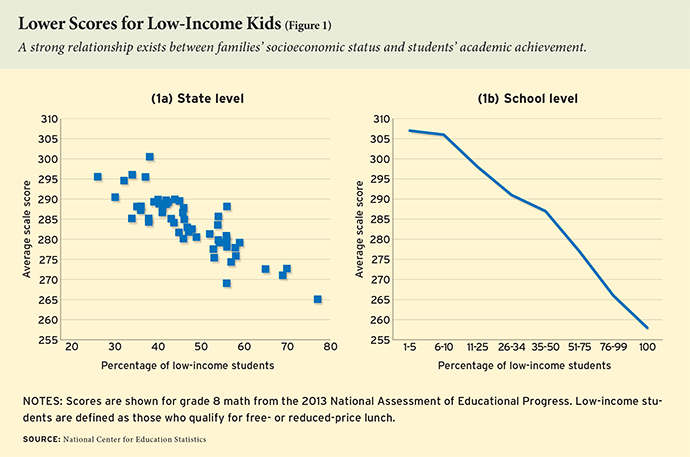
To this first question, the answer is obviously in the affirmative. That’s not to say “poor children can’t learn.” It is to say, rather, that there’s long been a clear connection between families’ socioeconomic status and students’ academic achievement. As can be seen in Figure 1a, states with higher percentages of students from low-income families report lower average scale scores in 8th-grade math on the National Assessment of Educational Progress (NAEP). The same connection between poverty and academic performance can be observed at the school level (see Figure 1b).
Why do kids from low-income families tend to score so much lower on average than their more-affluent peers? Is it something about poverty itself, that is, a lack of financial resources in the family? This is likely the case, as financial stress can create “toxic” conditions in the home and also make it difficult (if not impossible) for parents to afford the tutoring, educational games, summer camps, afterschool activities, and other educational experiences that middle-class and upper-middle-class students take for granted (and that almost surely boost their achievement).
But it’s not just about money. Poverty is associated with a host of other social ills that have a negative impact on learning. For instance, children in poverty are much more likely to be living in single-parent families headed by young, poorly educated mothers. Poverty is also associated with higher rates of alcoholism and other substance abuse in the home; greater incidence of child abuse and neglect; and heightened family involvement in the criminal justice system. All of these are well-known “risk factors” that are associated with lower test scores as well as with a greater likelihood of dropping out of high school.
So, yes, in general, poverty and factors correlated with low family income are strongly related to low test scores.
Do U.S. Students from Low-Income Families Underperform Their Peers Overseas?
The next question is whether U.S. students from low-income families are lower-scoring than those in other countries. To explore this question, we’re obliged to wrestle with measurement issues. The problem is complicated because no international data set contains both good measures of family income and good measures of student test-score performance.
The best available information is to be found in the data collected by the Program for International Student Assessment (PISA), which is sponsored by the Organization for Economic Co-Operation and Development (OECD). PISA, for its own analyses, uses an index of economic, social, and cultural status (ESCS) that looks at parent occupation and education, family wealth, home educational resources, and family possessions related to “classical” culture. PISA analysts use the index to stratify each country’s student population into quartiles.
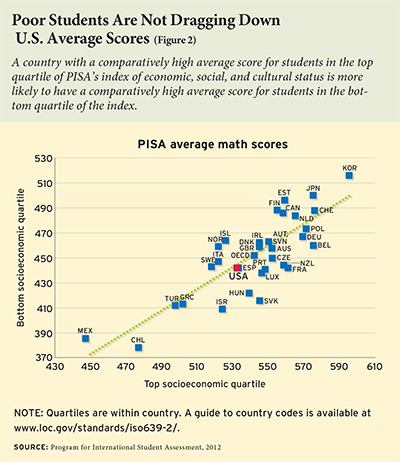
Not everyone will agree with the way the ESCS index is constructed, but the data presented in Figure 2 are nonetheless quite instructive. The test scores of students in the bottom quartile of the ESCS index are plotted against those of students in the top quartile. If students in these two quartiles did equally well in each country (as compared to similarly situated students in other countries), then the dotted regression line displayed in green would have a steeper slope, and every dot would fall exactly on that line. As you can see, the actual pattern is not that perfect, as some countries, such as Belgium and France, are relatively better at teaching the higher-status students, while other countries, such as Canada and Finland, do relatively well at instructing students from lower-status families. But notice that the United States falls almost exactly on the regression line. It does equally well (or equally poorly, if you prefer) at teaching its least well-off as those coming from families in the top quartile of the ESCS index.
If we look at a different marker of socioeconomic status, parental education levels, we find a similar pattern. In the U.S., for instance, parents without a high school diploma are much more likely to be in poverty than their better-educated peers, and their children are much more likely than their peers to be low-performing and to drop out of school themselves.
In a study that examined whether some countries are particularly effective at teaching students from disadvantaged backgrounds, Eric A. Hanushek, Paul E. Peterson, and Ludger Woessmann find little difference in the rank order of countries by the performance of students from families where a parent had a college education and the rank order of countries by the performance of students whose parents had no more than a high school diploma. They find that if a country is comparatively effective at teaching the first group, it tends to be no less effective (as compared to others) at teaching the second. The United States performs as expected, proving not to be especially effective at teaching students from the best-educated or the least-educated families. The authors write,
Overall, the U.S. proficiency rate in math places the country at the 27th rank among the 34 OECD countries that participated in the Program for International Student Assessment (PISA). That ranking is somewhat lower for students from advantaged backgrounds (28th) than for those from disadvantaged ones (20th).
There is no evidence that disadvantaged students in the United States are underperforming other countries’ disadvantaged students. If anything, it is the “advantaged” U.S. students (those whose parents have a high level of education) who are falling short in international comparisons.
Is America’s Child-Poverty High Compared to Rates Elsewhere?
So far we’ve acknowledged that poverty is, in fact, strongly (and negatively) related to achievement. But we’ve also demonstrated that disadvantaged students in the United States are performing as expected, given the performance of better-situated U.S. students.
But if more students are poor in the U.S. than in other countries, it is still possible that students from low-income families are dragging down U.S. national averages. If that is true, poverty could still be the elephant in the classroom.
But does the U.S. have a greater proportion of low-income students than other countries?
For those educators quoted at the beginning of this essay, the answer is yes. They assert that the U.S. has a sky-high child-poverty rate compared to other developed countries.
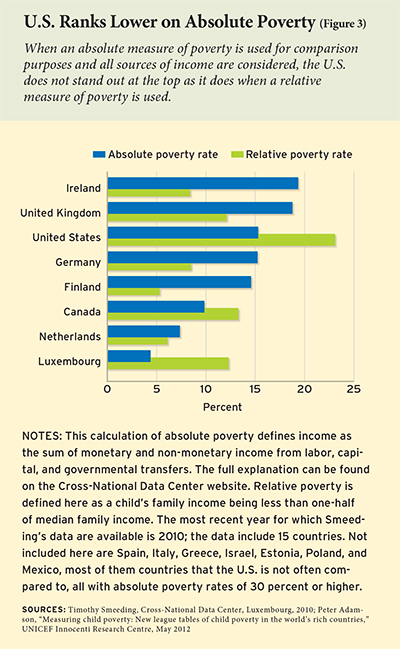
To support their claim, they use a measure that assumes all families with less than half the median income in the country are by definition “poor.” Figure 3 shows relative child-poverty rates for selected countries.
In the U.S., median family income is about $52,000 per year, so any family earning less than $26,000 a year is said to be poor. The measure excludes any income from governmental transfers.
Relying on measures of relative poverty is appealing for its simplicity, but it is a highly misleading approach because it’s more a measure of income inequality than of poverty.
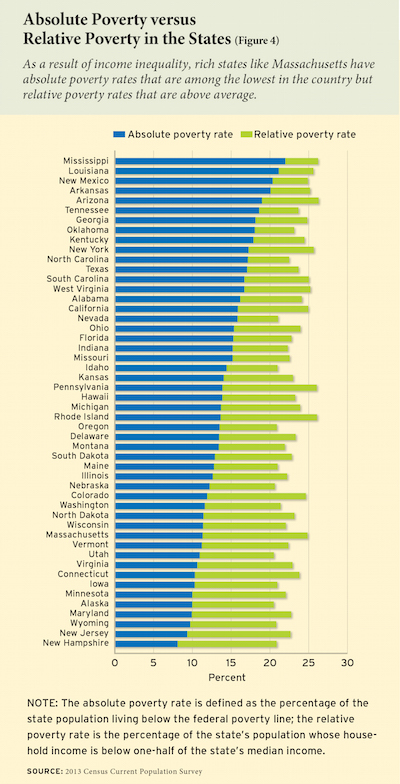
To see how relative poverty rates can mislead, let’s look at how they compare to absolute poverty rates for the general population in the American states. In Figure 4, we report the proportion of people living in households that earn less than half of their own state’s median income (basing state median incomes on the 2013 Census Current Population Survey). We also show each state’s absolute poverty rate as it is traditionally defined: the percentage of all people in the
state living in households below the federal poverty line, which is currently set at $24,250 for a family of four.
For some states, whether one looks at relative poverty or at absolute poverty makes little difference. Arizona, Mississippi, and Louisiana have a lot of poor people however you slice the data.
But notice where wealthier states like Massachusetts and Connecticut appear on the graph. Their absolute poverty rates are among the lowest in the country. But their relative poverty rates are above average—higher than Texas, Tennessee, and Oklahoma. Massachusetts has a higher relative poverty rate than Georgia, Kentucky, and Alabama.
Of course, Massachusetts doesn’t really have more poverty than Alabama—but it does have more income inequality.
The same dynamic plays out when we use relative poverty rates to compare countries. Many of the U.S. households that are counted as poor on a relative measure would be considered middle class on an absolute measure.
Using 2010 data, Timothy Smeeding, founder of the Cross-National Data Center in Luxembourg, reports absolute poverty using a methodology that takes into account all forms of income, including social welfare benefits (see Figure 3). By this measure, the U.S. absolute poverty rate is lower than the United Kingdom’s, virtually the same as Germany’s, and just barely higher than Finland’s. To be sure, the U.S. still has too much poverty. But once social welfare benefits are included, and we look at absolute instead of relative poverty, the U.S. is hardly an outlier.
It’s important to note that the absolute poverty rates shown in Figure 3 are for the general population, not for children. It’s possible that absolute child-poverty rates would look quite different. But we have no way of knowing, because the data to calculate those rates across a large number of countries do not currently exist.
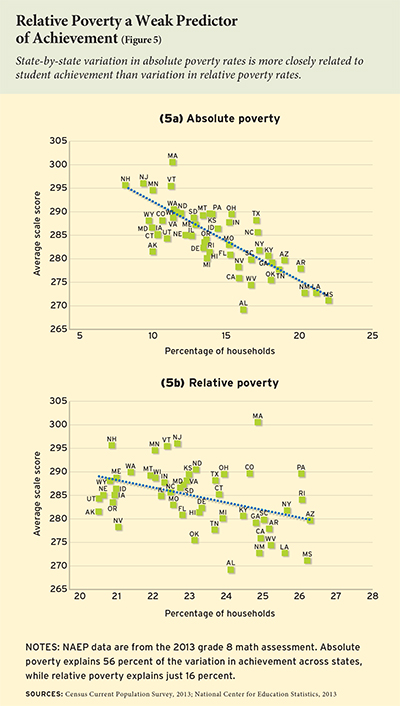
What we can say definitively is that relative poverty rates can be highly misleading. We ran a regression analysis to estimate the relationship between states’ absolute and relative poverty levels and student achievement, and the result was clear: absolute poverty is a powerful predictor of achievement, while the relationship between relative poverty and test scores in the U.S. is weak and not statistically significant (see Figure 5).
Relative poverty is also a weak predictor of student achievement internationally. In another analysis, we compared relative child-poverty rates to PISA mean math scores in 2009—and once again found only a weak and statistically insignificant relationship.
In short, relative poverty rates, which are only weakly related to student achievement both in the U.S. and abroad, are erroneously used to explain America’s academic struggles. They seem to indicate that the U.S. has an unusually large population of low-income individuals, but in fact they simply demonstrate an unusually high degree of income inequality. Using absolute poverty rates—which are related to student achievement within the U.S.—we see that the proportion of Americans who are poor is quite typical by international standards.
Conclusion
Critics of education reform are certainly correct when they say that poverty is a major factor in lackluster academic performance.
Still, poverty is an issue for virtually every nation on the planet. Where reform critics get it wrong is when they claim that America’s average scores are dragged down by the particularly poor performance of low-income students, or that the advantaged kids are doing just fine.That is objectively untrue. And its scores are not dragged down by an unusually high proportion of poor students, as measures of absolute poverty find the U.S. not to be an outlier at all.
America’s mediocre performance is remarkably consistent. Yes, affluent students outperform poor students. But they don’t outperform their peers overseas.
This doesn’t imply that reform, as currently formulated, is on the right track. Why U.S. student performance is mediocre is a topic worthy of study and debate, as is how to help students at all points on the economic spectrum perform better.
What it does show is that poverty can’t explain away America’s lackluster academic performance. That excuse, however soothing it may be to educators, politicians, and social critics, turns out to be a crutch that’s unfounded in evidence. We need to stop using it and start getting serious about improving the achievement of all the nation’s students.
Michael J. Petrilli is president of the Thomas B. Fordham Institute, where Brandon L. Wright is managing editor and policy associate.
Update, November 18, 2015:
The method used to calculate absolute poverty rates in 2010, as reported in Figure 3 of “America’s Mediocre Test Scores,” required estimations from data made available by Timothy Smeeding. The note to Figure 3 does not include the estimating procedures used to calculate absolute poverty rates for 2010, which are available here. Some commentators have questioned those procedures, but similar results are obtained for 1999-2000 by Smeeding when poverty rates are calculated as 125% of the U.S. Department of Agriculture’s poverty line in his 2006 paper, “Poor People in Rich Nations: The United States in Comparative Perspective.” In both cases U.S. poverty rates are only modestly above that in several comparable countries. Differences are unable to explain the much larger differences in student achievement between the United States and other countries. For further discussion, please see “Is America’s Poverty Rate Exceptional? It depends on how you define poverty.”
| Percentages as given in Figure 3, “America’s Mediocre Test Scores,” Petrilli and Wright, 2015 | Percentages as given in “Poor People in Rich Nations: The United States in Comparative Perspective,” Timothy Smeeding, 2006 (Using data from 1999-2000 and calculating poverty as 125% of U.S. poverty line) | |
| United Kingdom | 18.8 | 32.8 |
| United States | 15.3 | 19.5 |
| Canada | 9.9 | 17.5 |
| Finland | 14.6 | 17.5 |
| Germany | 15.2 | 17.3 |
| Netherlands | 7.4 | 17.3 |
| Austria | * | 15.3 |
| Sweden | * | 13.8 |
| Belgium | * | 12.2 |
* Not mentioned in Figure 3, “America’s Mediocre Test Scores,” Petrilli and Wright, 2015
Comment on this article
Comment on this Article
Sponsored Results
Sponsors
Sign Up To Receive Notification
when the latest issue of Education Next is posted
In the meantime check the site regularly for new articles, blog postings, and reader comments


“Relative poverty is also a weak predictor of student achievement internationally. In another analysis, we compared relative child-poverty rates to PISA mean math scores in 2009—and once again found only a weak and statistically insignificant relationship.”
I’m sorry, where are the figures for this? You provide graphs for national relative poverty (which, by the way, “weaker predicotr” seems like a more approrpiate phraase than “weak predictor”) and then gloss over the international PISA rates similar to Seinfeld’s “yada yada yada” technique. Why?
Perhaps you are all simply over thinking the problem. Perhaps the lower test scores are simply do to test taking fatigue. The NAEP is given in the midst of what have become weeks of other standardized tests, what exactly did you think was going to happen? It doesn’t take great amounts of research to understand the phenomena, simply remember being a school age child and how you felt about tests and especially tests that had no real meaning for your future success.
Has anyone compared the qualitative aspects of US education vs. the 26 countries that outperform us? What are they doing? Do they offer more arts instruction than the US? More sports? Do they have a longer school day? More teacher preparation time during a school week? Better pre-service teacher standards and preparation? More equitable funding? What are they doing that we do not do?
This analysis does not differentiate between different types of poverty…i.e., rural, urban, generational, situational, refugees, etc. Are all types of “poverty” the same in their affects on learning?
Perhaps identifying factors that go beyond “absolute” and “relative” would provide further insight into what it is about “poverty” that interferes with learning. For example, is there a sense of hopelessness that accompanies generational poverty that affects learning in a particular way? How do the attitudes associated with rural poverty affect learning?
Perhaps interventions designed to mitigate the effects of poverty need to be more specifically tailored to these still unidentified cultural and psychological factors.
The authors start with a fallacious premise, that 2 of the following must be true. Why?
To prove that poverty is the major factor driving America’s meager academic achievement, at least two of the following three claims need to be established:
1. Poverty is related to lower levels of student learning.
2. America’s poor students perform worse than other countries’ poor students.
3. The poverty rate in the United States is substantially higher than the rates in countries with which it is compared.
I agree with the article. Apathy is the biggest problem with my students.
I disagree with Randi Weingarten that poverty is “the elephant in the room”. I believe that it educators and policy makers have become comfortable in discussing student achievement gaps from the standpoint of poverty. The real elephant in the room in my opinion is race. As Hispanic students gain ground African American students continue to lag behind not just at the low-income level. I believe that it is time to stop accepting this as the norm and engage in National discussions that move towards a mandate of accountability such as Bilingual and ELL policies, Title 1 has not produced the results that these other policies have.
I also believe that the lack of parental engagement is an issue among poor students. Much research has been conducted in this area, there are some viable options with proven results available to impact families. Frameworks for parental engagement have been developed at the federal and state level in most states. As a widespread intervention to impact student outcomes school systems must make a concerted effort to implement these policies. Unfortunately, many educators believe they know better than the parents of their disadvantaged students and miss the opportunity to build relationships and take advantage of this goldmine. Our education system is changing the way we communicate, use natural resources to be more environmentally conscious, and deliver instruction through the use of technology, it is time that we move from the traditional in our parent engagement efforts as well.
“Yes, affluent students outperform poor students. But they don’t outperform their peers overseas.”
This seems like the obvious first approach (and easiest based on the results) to answering the question of whether or not poverty is the driving force in mediocre test scores. This article and study could have been a lot shorter. Affluent students’ test scores are mediocre compared to their peers overseas ==> poverty is not the driving force. Am I missing something?
While poverty is partially to blame. I believe that students of poverty lack positive role models (other than sports or music professionals) in their lives. We need to praise and laud the success of people of poverty who have broken the bonds of poverty and have become successful. The institutionalized poverty that exists will never end until education is valued in the home and the community. Parents must be assisted with helping their students succeed, but they need to make an effort. They need to value education and see that a good education will break the bonds of poverty. We need educational institutions to meet the social, cultural and medical needs of our students and create a welcome for parents to take a more active part in their child’s educational success.
Other analyses of PISA tests compare nations on scores of students at similar poverty levels. On such comparisons, US poor students outperform most other nations, and our disaggregated results that compare US schools with low poverty rates to other nations (where the entire country has low poverty rates) look pretty darn good. See http://www.epi.org/publication/us-student-performance-testing/ and see Diane Ravitch’s summary of Wydo’s analysis http://dianeravitch.net/2013/12/05/daniel-wydo-disaggregates-pisa-scores-by-income/.
This analysis does recognize absolute poverty as a major issue, and also recognizes other community and familial issues that relate to low poverty. But it’s choice of methodology masks much of the realities of teaching in schools with very high poverty levels. The US is the only nation among the PISA tests which educates all students and which has high concentrations of poverty in large urban districts.
Downplaying poverty, as this article attempts to do with this kind of selective analysis, is a disservice to communities who are under-resourced in every aspect that correlated to low performance: the school resources, job opportunities for families, health care, neighborhood safety, out of school programs for kids, etc. It is, however, consistent with other work by Petrilli and others that promotes a blame the teacher mentality.
Apropos of this article: “A similar pattern shows up within the United States: Adjusting for differences in demography and access to academic resources — including variables like language spoken at home, eligibility for free and reduced-price lunch and parental education — reduced performance gaps between states on the National Assessment of Educational Progress by 40 to 50 percent.”
http://www.nytimes.com/2015/11/04/business/economy/school-vs-society-in-americas-failing-students.html
U.S. students are disadvantaged because their teachers are asked to teach about 6/7 of the school day, while in most of the countries that are doing better with poor students, the teachers teach a smaller proportion of the day. They have more time (about half the day in Japan) to work together to improve instruction, provide feedback to students, and plan engaging lessons.
Of course using poverty as an all-encompassing excuse is a crutch. But what can be done in schools is not as difficult as you might think. What I have seen as a principal of a Title I school is when you have high expectations for students: when you challenge them – especially with high level questioning; when you discipline to build relationships of respect and responsibility; when you prod and push and don’t accept excuses – you build bridges to achievement. Students know when a teacher has labeled them (overtly or covertly) as lacking in potential. Is this hard for teachers to do with all the risk factors and behaviors students from poverty bring to school? Of course. Does it work? Absolutely! This has been well-researched going as far back as the Teacher Expectations and Student Achievement (TESA) program developed in Los Angeles County Schools in the early 1970s. Check out a blog that I posted on Ruby Payne’s website dealing with this issue: Breaking the Cycle of Poverty: What Can Teachers Do?
If you follow, best practices, research, that is proven to advance individual learning, for at risk, traditional and gifted students, the common sound bite excuses given for why education isn’t working for students (poverty, money, parents) are dis-proven.
The big picture, consistent with your article above, is that traditional education’s, one size fits all, teaching methodology, lecture, e.g., at best, only works for 30%
of the student audience, and at best, only provides that 30%, superficial, short term, understanding that is soon forgotten.
The one size fits all teaching approach is too fast for the at risk students so they fall off and is too slow for the gifted students, so they zone out.
Wealth and personal persistence that comes from wealth allows those traditional and gifted students to somehow succeed, not because the teaching fits how they learn, but by pure grit and determination.
Traditional education, one size fits all teaching, works fine for the subject matter expert, one and done, but is terribly ineffective and inefficient for the individual learners, as you have identified above.
Okay, what is proven to work for everyone, but is underutilized?
Adaptive, ongoing, truly personalized, facilitated and reinforced learning,; differentiated learning, with spaced reinforcement, delivered via educationally innovative technology, and reinforced not only by the technology outside of class, but reinforced by the learning professional, inside the class withing a flipped or blended learning environment.
This is a complete paradigm change from teaching to learning.
First, individual learning happens for each individual far more effectively and efficiently.
Second, learning becomes deep, the information is learned to fluency, appropriate and relevant application is shown to advance sustained individual performance improvement.
Third, each individual learns at their own pace, facilitated by a professional
Under this approach ALL learners, at rick, traditional and gifted learn deeply, learn more effectively and learn more efficiently.
The proper learning pedagogy, (research proven methodology, consistent with how everyone learns) is the big issue.
Poverty, parents, money can be contributing factors to learning, but are sub issues, that can be addressed AFTER the proper learning pedagogy is implemented.
I have seen with the proper pedagogy very poor children excel in difficult subjects (they are brought up to grade level and excel from there)
The primary issue to fix is replacing teaching with 21st century learning.
Suggesting that fixing poverty, parental involvement, and lack of money, first are diversion tactics to the real issue.
Traditional educators are willing to blame everything else for educations woes.
They need to understand, embrace and implement 21st century learning methodologies, and expand their subject matter expertise to include research proven, best practices pedagogy, as well as gaining expertise in education reform.
Do schools exist where students outperform peers despite higher levels of poverty? Yes. Then, poverty can be overcome through education. Let’s do that. By the way, it does not necessarily require more money.
As Noel stated above the argument is based on false reasoning. The issue is complex: socioeconomic status, race, school funding/location, unfunded mandates, school and district policies, social factors, standards, methods of teaching, student accountability, and more. The way math has been taught in the past, even recent past.
It’s not poverty but school organization. Schools are not structured to deal with the demands of the 21st century school district. So it’s not the kids but the adults who need to decide to fix it.
While there are several identifiable reasons for lower achievement, the local culture must be considered as a major factor–but with many variables. One huge aspect is vocabulary development beginning at an early age as documented by Hart and Risely at Kansas University. Vocabulary is key to understanding/comprehending. Obviously, English learners are at a disadvantage in this regard, but generally speaking, subcultures outside the mainstream culture and time outside of school in dull, boring, slang language, texting, chat, gaming, poor language models that reify present levels, and lack of parent involvement or academic zeal experience conspire agains students of any culture but restrict student abilities of those in poverty. Mainstream families seek enriching activities that engage students with development of skills and knowledge outside of school. Analysis of data is beguiling. Children from poverty cultures can succeed, but each child has strengths and deficiencies that require direct attention from the teacher, and many students today compete for the teacher’s attention because the teachers’ attention is diffused with issues other than teaching. Individualization must somehow take place. Let teachers teach.
We already know that scores, disaggregated by state, tell a different story than the one told here. Students in Massachusetts, where per pupil spending is higher than most states, has Pisa scores better than most countries. States with low spending have low achievement.
http://www.forbes.com/sites/jamesmarshallcrotty/2014/09/29/if-massachusetts-were-a-country-its-students-would-rank-9th-in-the-world/
So…you’d like to use absolute poverty rather than relative poverty, with no adjustments for cost of living differences.
Yes, relative poverty does reflect the level of income inequality…which is entirely relevant. With absolute poverty, you conveniently overlook the fact that purchasing power is much lower when income inequality is higher. The cost of goods and services is higher when the purchaser must compete within a more affluent consumer base.
Real life example: I left a teaching job that paid $90K for another that paid $42K. My purchasing power skyrocketed, because the first job was in Silicon Valley and the new job was in South Carolina. I left in part because I could not afford to purchase a condo in a sketchy neighborhood. Now I live waterfront on a half-acre lot and go kayaking from my backyard.
So, it’s all about tradeoffs. You can use absolute poverty, as long as you understand that you’re distorting the picture of people’s real-life living conditions.
By placing income in some sort of wider context, relative poverty at least attempts to reflect this. Maybe that’s why OECD uses it to rank countries. Did anyone think to ask them, or was the alternative data too rhetorically useful to resist?
There were several findings in this article and other resources I studied that was alarming to me such as the statistical information indicating the numbers of children being affected by child poverty along with the ratio of one in five children being in poverty today. The United States was mentioned to be in possession of one of the highest child poverty rates in the developed world. Lots of Americans were reported to live below the poverty line. Plus, almost half of the children with single mothers were suffering from poverty. These factors were a surprise mainly because they all served as a representation of the issue that a good number of students are coping with outside of the school environment. These particular students are lacking adequate resources that are critical for any individual to be stable emotionally, mentally, and physically. Armstrong (2010) points out that a full stomach and clear mind are requirements for learning. Furthermore, this should serve as a reminder to teachers that the school building is some children’s most optimal environment to work, learn, and study within.
Armstrong, A. (2010). Myths of Poverty–Realities for Students. Education Digest: Essential Readings Condensed for Quick Review, 75(8), 49-53.
America has yet to find a solution to poverty or many of its other crises such as hunger. In fact, there is no one true solution. I don’t doubt that a child in poverty faces significant challenges in comparison to their affluent peers. However, I don’t think it’s fair to necessarily blame poverty on being the sole reason as to why students have mediocre test scores in the U.S. Perhaps the students are just tested out due to the number of tests they are required to take. If you want to attribute it to poverty perhaps they didn’t eat or sleep last night and the test they’re taking doesn’t even compare to the challenges they’re facing at home.
It’s always interesting to me how articles such as these points out the deficiencies of an issue, but never really focus on what can be done to combat the issue. If “…poverty is the major factor driving America’s meager academic achievement,” what are we doing to combat it? Yes we do have programs such as Teach For America that is a data driven organization that seeks top quality college graduates to go into urban areas, many of them believed to be places where “..children can’t learn” to give students the education that they deserve. Since I believed that all children weren’t receiving the education that they deserved I myself joined the corps and have been in the classroom ever since.
Furthermore, as a product of a single parent household and two-time college graduate, I believe that it’s unfair to say, “…children in poverty are much more likely to be living in single-parent families headed by young, poorly educated mothers.” With the growing number of single parent households I would love to see the data behind this. Just because the household is headed by a single parent doesn’t necessarily leave the mother young and poorly educated and to make a statement like this is quite demeaning. If all of the data is in fact rue and we know that children in poverty may be facing “toxic” conditions and may not be able to afford toe services, resources, and extra curricular activities as their affluent peers what are we going to do about it? When are we going to stop complaining about the data and blaming it on poverty and actually put in to action resources or something in schools to help close the gap? Of course the scores won’t get better if all that’s constantly being done is ongoing revelations about the data. It’s easy to find the graphs and have a pity party but actually coming up with a solution is what needs to be done. These students are not just numbers so while we sit and linger over the disparaging facts a child is yet again being left behind.
I agree with the author on one point: we need to stop using poverty as a crutch for low academic performance and get serious about educating all children. While those “risk factors” exist for some students living in poverty, those students are not fated to have low academic achievement. We have always had students from single-parent homes and children living with grandparents, but have these students had effective teachers consecutively to make a difference? Studies have shown that the most important factor impacting student achievement is the teacher (http://bit.ly/1KR5YqR).
Since we know the obstacles facing children living in poverty, our schools must be the place where we give those students the best of what we have to give. Perhaps if we rethink how we do school for students AND schools in low-poverty districts – schools/districts provide wrap-around services (psychologists, social workers, job training for parents, etc.) for students and their families living in poverty – we may stem the tide of low performance and possibly mitigate generational poverty.
“Where reform critics get it wrong is when they claim that America’s average scores are dragged down by the particularly poor performance of low-income students, or that the advantaged kids are doing just fine.That is objectively untrue.”
This statement is itself untrue. The author has selected a small sample of complex data reports that provide *some* level of evidence that supports their statement. However, it is foolish and unsupportable to boldly claim that these few select pieces of evidence negate all of the many contradictory studies on this topic, and the author undermines his credibility by doing so.
The issue of poor academic performance is not a new one. It is only the most recent in a decades long complaint about American students. Yes, poverty, whether absolute or relative is a factor. Certainly, if a child is hungry or cold, it will be harder for them to learn, but that is certainly not the norm. Other factors must be considered, including parental support and the quality of the teachers. I believe that parent’s should have some accountability in their own children’s education. In this day and age, you can not expect to go to school and never practice what was introduced in the classroom. If children are not involved in conversations about topics or put in situations where they need to use the skills taught in school, they will never master it. In addition, I feel as though there is always a blame game and the scapegoat are the teachers. Perhaps if the profession was held in higher regard, more talented people would want to become teachers.
I tend to believe the reason the US is under-performing is not due to poverty, but due to lack of realistic tracking for students based on strengths. In the US, students are in an industrialized model that attempts to make them a “master of all”. Well, we all know the phrase, “a jack of all trades, a master none.” If a student is inclined to a certain skill, foster that skill. Not every career requires a degree, most skills can (and should) be learned on the job, and those in charge need to stop pushing the current agenda.
The teaching method is crucial! Modeling Instruction is effective. http://modelinginstruction.org . A young high school science teacher in a high-poverty urban community wrote this week: “Coming from the Roosevelt school district [extreme poverty & lowest standardized test scores in the state], most of my students have never taken a science course before they enroll at our school. Traditionally this makes learning things like chemistry and physics extremely difficult for them, since they don’t have the background knowledge and experience in science that most students have. However, since I’ve come here to AAEC, my principal has noted a complete 180 when it comes to our students’ experience with chemistry and now physics. They used to struggle in chemistry, learn to hate it — and the vast majority of students failed the course. Now our students, with my arrival at this school and through using Modeling Instruction, enjoy chemistry and are successful in the course, with the vast majority of students passing the course.
I am seeing the same thing this year in physics. In both classes the students construct their own understanding of science concepts by actually doing science experiments and learning the necessary principles from their results. They engage with each other in whiteboarding sessions and further explore the scientific models and principles through these discussions. They have to work hard to overcome the disadvantage they come in with, but now they have the opportunity to actually succeed, and they are doing it.
Several students who took my chemistry course are now in CHM 151 (general chemistry) at the community college, and all of them are doing extremely well. These students have come back and told me that they find the CHM 151 course easy after taking my class. This is completely different than before I came, when teachers taught traditionally; our students used to really struggle in CHM 151 under our previous instructors. Modeling Instruction is working with my students at my school!
Our school was rated this year by Newsweek magazine as the 82nd best high school in the nation serving low income students and the second best in Arizona. I would like to think that my addition helped with that, since this is the first year we’ve had this rating.
http://www.newsweek.com/high-schools/beating-odds-2015
One of the factors that was not analyzed in this article is the effect of heterogeneous grouping. Low income students frequently arrive at school without the same educational foundation as children from higher income families. Currently most school systems place these children together in the hopes that the high end students will “bring up” the low end ones. Unfortunately, this does not happen. Instead the teacher is forced to “teach to the middle” which basically serves no student on either end of the spectrum. Students on the high end are not challenged and can get by without any real effort. Students on the low end, discouraged about being behind most of their peers, feel they are too stupid to learn. This results in low achievement for all. We need to meet students where they are and scaffold learning so that they become confident in their ability to learn. Constant testing is not the solution.