

<?xml version="1.0" encoding="UTF-8"?>
<rss version="2.0"
	xmlns:content="http://purl.org/rss/1.0/modules/content/"
	xmlns:wfw="http://wellformedweb.org/CommentAPI/"
	xmlns:dc="http://purl.org/dc/elements/1.1/"
	xmlns:atom="http://www.w3.org/2005/Atom"
	xmlns:sy="http://purl.org/rss/1.0/modules/syndication/"
	xmlns:slash="http://purl.org/rss/1.0/modules/slash/"
	xmlns:itunes="http://www.itunes.com/dtds/podcast-1.0.dtd"
xmlns:rawvoice="http://www.rawvoice.com/rawvoiceRssModule/"
>
<channel>
	<title>Education Next &#187; Chester E. Finn, Jr.</title>
	<atom:link href="http://educationnext.org/author/cfinn/feed/" rel="self" type="application/rss+xml" />
	<link>http://educationnext.org</link>
	<description>Education Next is a journal of opinion and research about education policy.</description>
	<lastBuildDate>Fri, 10 Feb 2012 21:46:55 +0000</lastBuildDate>
	<language>en</language>
	<sy:updatePeriod>hourly</sy:updatePeriod>
	<sy:updateFrequency>1</sy:updateFrequency>
	<generator>http://wordpress.org/?v=3.0.1</generator>
<!-- podcast_generator="Blubrry PowerPress/2.0.4" -->
	<itunes:summary>Education Next is a journal of opinion and research about education policy. Our podcasts include stories, interviews, and discussions of the latest developments in education policy. 

The Education Next Book Club features in-depth interviews by Mike Petrilli with authors of new and classic books about education.

 For more information visit educationnext.org</itunes:summary>
	<itunes:author>Education Next</itunes:author>
	<itunes:explicit>clean</itunes:explicit>
	<itunes:image href="http://educationnext.org/images/itunes.jpg" />
	<itunes:owner>
		<itunes:name>Education Next</itunes:name>
		<itunes:email>education_next@hks.harvard.edu</itunes:email>
	</itunes:owner>
	<managingEditor>education_next@hks.harvard.edu (Education Next)</managingEditor>
	<itunes:subtitle>Education Next is a journal of opinion and research about education policy.</itunes:subtitle>
	<itunes:keywords>ednext, educationnext, education, school, reform, k-12, charter, voucher, teacher, NCLB, curriculum</itunes:keywords>
	<image>
		<title>Education Next &#187; Chester E. Finn, Jr.</title>
		<url>http://educationnext.org/images/rss.jpg</url>
		<link>http://educationnext.org</link>
	</image>
	<itunes:category text="Education">
		<itunes:category text="K-12" />
	</itunes:category>
		<item>
		<title>Jack Jennings and a Half-Century of School Reform</title>
		<link>http://educationnext.org/jack-jennings-and-a-half-century-of-school-reform/</link>
		<comments>http://educationnext.org/jack-jennings-and-a-half-century-of-school-reform/#comments</comments>
		<pubDate>Thu, 02 Feb 2012 15:36:02 +0000</pubDate>
		<dc:creator>Chester E. Finn, Jr.</dc:creator>
				<category><![CDATA[Blog]]></category>
		<category><![CDATA[Editorial]]></category>
		<category><![CDATA[State and Federal]]></category>
		<category><![CDATA[federal education policy]]></category>

		<guid isPermaLink="false">http://educationnext.org/?p=49646637</guid>
		<description><![CDATA[Much as I respect and admire Jack Jennings, in spite of all his experience in this field, his main tool remains federal legislation, which I've come to believe is almost always wielded clumsily in pursuit of nails that either won’t budge at all or end up bent.]]></description>
			<content:encoded><![CDATA[<p>Jack Jennings started working on federal education policy in December 1967, about eighteen months before I did. He&#8217;s never stopped—and few have wielded greater influence. For the past seventeen years (a history that roughly parallels Fordham&#8217;s), he&#8217;s led a small but influential Washington-based ed-policy think tank called the Center on Education Policy (CEP). He&#8217;s now retiring from that role and, as he exits, the Center has brought out two publications. One is a nicely crafted (and very flattering) <a href="http://www.cep-dc.org/displayDocument.cfm?DocumentID=393" target="_blank">profile of CEP itself</a>, as well as Jack and his work there, written by veteran ed-writer Anne Lewis. The other is Jack&#8217;s own <a href="http://www.cep-dc.org/displayDocument.cfm?DocumentID=392." target="_blank">ten-page reflection</a> on recent education reforms, what has and hasn&#8217;t worked, and what, in his view, the future ought to hold, particularly at the federal level.</p>
<p>It&#8217;s vintage Jennings, perceptive about both what has happened and why and how it has (and hasn’t) worked, then incurably and relentlessly over-ambitious—in a classic, big-government, big-spending, liberal sort of way—about what federal policy should do tomorrow.</p>
<p>As to the past, and oversimplifying some points that he makes more subtly,</p>
<ul>
<li>Equity-based reform didn&#8217;t get very far because it amounted to add-on programs, suffered from limited funding, and failed to &#8220;generally improve the broader educational system.&#8221;</li>
<li>School choice pleases parents but doesn&#8217;t raise achievement much, &#8220;an interesting case of convictions trumping evidence.&#8221;</li>
<li>Standards-based reform has had more traction but has &#8220;gone astray&#8221;: too much testing, too much labeling, not enough real alteration in the quality of what&#8217;s taught and learned.</li>
</ul>
<p>None of that is wrong. But his prescription for the future comes across as wishful thinking even if you’re disposed to agree with it. (I’m not.) Jennings favors a federal law declaring that &#8220;no child in the United States will be denied equal educational opportunity in elementary and secondary education through the lack of a challenging curriculum, well-prepared and effective teachers, and the funding to pay for that education.&#8221;</p>
<p>This would, of course, have the effect of transferring the responsibility for educating (and financing the education of) 55 million kids to Washington. I guess one might term this a &#8220;governance reform&#8221; but I don&#8217;t think it&#8217;s going to happen or that it would work well if it did. (Jack has done just about everything during the course of his long career EXCEPT work in the executive branch. If he had, he might harbor fewer illusions about its capacity in the realm of education.)</p>
<p>It&#8217;s notable, too, that he continues after all these years to put his faith in Uncle Sam to fix what ails American education. There&#8217;s no mention here of changes in the delivery system (e.g. technology), the system’s efficiency/productivity, or its structures and governance (except as noted above). He also downplays the value of &#8220;outsiders&#8221; (e.g. governors, mayors) as agents of change in K-12 education.</p>
<p>It is said that if your only tool is a hammer, everything looks like a nail. Much as I respect and admire Jack Jennings, in spite of all his experience in this field, his main tool remains federal legislation, which I&#8217;ve come to believe is almost always wielded clumsily in pursuit of nails that either won’t budge at all or end up bent.</p>
<p>-Chester E. Finn, Jr.</p>
<p>This blog entry originally appeared on the Fordham Institute&#8217;s <a href="http://www.edexcellence.net/commentary/education-gadfly-weekly/2012/february-2/jack-jennings-and-a-half-century-of-school-reform.html">Flypaper </a>blog.</p>
<img src="http://educationnext.org/?ak_action=api_record_view&id=49646637&type=feed" alt="" />]]></content:encoded>
			<wfw:commentRss>http://educationnext.org/jack-jennings-and-a-half-century-of-school-reform/feed/</wfw:commentRss>
		<slash:comments>0</slash:comments>
		</item>
		<item>
		<title>Can Schools Rekindle the American Work Ethic?</title>
		<link>http://educationnext.org/can-schools-rekindle-the-american-work-ethic/</link>
		<comments>http://educationnext.org/can-schools-rekindle-the-american-work-ethic/#comments</comments>
		<pubDate>Thu, 26 Jan 2012 14:28:16 +0000</pubDate>
		<dc:creator>Chester E. Finn, Jr.</dc:creator>
				<category><![CDATA[Blog]]></category>
		<category><![CDATA[Editorial]]></category>
		<category><![CDATA[Apple]]></category>
		<category><![CDATA[Charles Murray]]></category>
		<category><![CDATA[competition]]></category>
		<category><![CDATA[industriousness]]></category>
		<category><![CDATA[President Obama]]></category>
		<category><![CDATA[self-esteem]]></category>
		<category><![CDATA[state of the union]]></category>

		<guid isPermaLink="false">http://educationnext.org/?p=49646457</guid>
		<description><![CDATA[To do this our teachers and policymakers will need to reverse now-widespread practices and beliefs. ]]></description>
			<content:encoded><![CDATA[<p>The front page of Sunday’s <em>New York Times</em> featured a pair of articles, each of which was informative and alarming in its way but which, taken together, produced (in my head at least) a winter storm—as did Tuesday evening’s <a href="http://www.washingtonpost.com/politics/state-of-the-union-2012-obama-speech-excerpts/2012/01/24/gIQA9D3QOQ_story.html">State of the Union message</a> by President Obama.</p>
<p>The longer, more informative, and more alarming of the articles was an extensive account of why Apple’s iPhones are <a href="http://www.nytimes.com/2012/01/22/business/apple-america-and-a-squeezed-middle-class.html">now made in China rather than the U.S.</a> The short version is that “the flexibility, diligence and industrial skills of foreign workers have so outpaced their American counterparts that ‘Made in the U.S.A.’ is no longer a viable option for most Apple products.”</p>
<p>Flexibility, diligence, and industrial skills. Hold that thought.</p>
<p>The second article previewed the President’s speech which, as predicted, focused heavily on the U.S. economy and ways to boost it. His proposals do, in fact, include some education and job-training initiatives, as well as macro-economic policies, several of them noted in the speech itself. But mostly what Mr. Obama did was trot out a bunch of government programs and rattle on about ways by which Uncle Sam should enhance the “fairness” of the U.S. economy, particularly its income distribution. (He used the words “fair,” “fairness,” or “unfair” eight times.) He didn’t talk about its efficiency, productivity, or industriousness. And his only reference to “hard work” was historical. Simply put, although the President spoke of restoring millions of manufacturing jobs to U.S. shores, it’s hard to picture Apple (or similar firms) responding, since the steps he has in mind to attract them are federal spending and tax programs and have little to do with the “diligence” of American workers, only a bit to do with “flexibility,” and a bit more to do with “skills.”</p>
<p>He deserves some credit on the skills front—a word he used five times. Instead of calling for everyone to complete college, for example, he called on community colleges and private firms—duly mustered and disciplined by Uncle Sam, of course!—to equip two million people with usable, job-related skills.</p>
<p>He addressed K-12 education, too, but only on the “compulsory attendance” and “teacher quality” fronts—and while the latter hinted at merit pay and nodded at schools having the flexibility to “replace” instructors “who just aren&#8217;t helping kids learn”—mostly what he did was urge more money for schools-as-we-know-them and those who teach in their classrooms.</p>
<p>As for “flexibility” and “diligence,” qualities important to Apple and myriad other firms—and qualities they’re apparently finding abroad—you didn’t hear anything about those in the State of the Union. My ear heard the opposite, actually, for all the talk about federal programs and tax policies enhancing “fairness” will exacerbate our nanny-state tendencies, our habit of assuming that government will provide and that we need not redouble our efforts to provide for ourselves. Instead, the President signaled that we should <em>resent</em> those who are better provided-for—and look to Washington to tug the levers of “fairness.”</p>
<p>Tuesday’s address was, in this regard, a reprise of Mr. Obama’s widely noted remarks in Osawatomie, Kansas last month. Here’s an excerpt. (You can find the whole speech at the <a href="http://www.whitehouse.gov/the-press-office/2011/12/06/remarks-president-economy-osawatomie-kansas" target="_blank">White House website</a>.) He began by recalling the values of what Tom Brokaw termed “the greatest generation” before fast-forwarding to the present.</p>
<blockquote><p>Today, we&#8217;re still home to the world&#8217;s most productive workers. We&#8217;re still home to the world&#8217;s most innovative companies. But for most Americans, the basic bargain that made this country great has eroded. Long before the recession hit, hard work stopped paying off for too many people.</p></blockquote>
<p>Read that last sentence again: “Hard work stopped paying off for too many people.”</p>
<p>What lesson were his listeners supposed to draw? Seems pretty clear to me: under the current rules, there’s no point in working hard. It doesn’t “pay off.”</p>
<p>Then read Charles Murray’s fine essay in Saturday’s <em>Wall Street Journal</em> (derived from a forthcoming book): “<a href="http://online.wsj.com/article/SB10001424052970204301404577170733817181646.html?mod=googlenews_wsj" target="_blank">The New American Divide</a>.” Murray contends that “the American way of life” has decayed and what he calls “the new lower class” (pretty much what we used to call the “working class”) has lost the value of “industriousness.”</p>
<p>Now put them together. Murray says that core value has badly eroded. The President says it no longer “pays off”—and the government must do something to foster “fairness.” And Apple says it has moved production to China because Americans lack “diligence.”</p>
<p>What has any of this to do with our schools? Could K-12 education contribute significantly to a revival of industriousness in the U.S. population? Could it lead our young people to believe—and act on the belief—that hard work <em>does</em> pay off? I believe so, even if Mr. Obama didn’t mention it, but to do this our teachers and policymakers will need to reverse now-widespread practices and beliefs. They will, to begin, have to reward rather than discourage hard work and actual achievement. They will have to make kids work harder than most are accustomed to doing. They will even have to foster competition and honor winners—while helping others to boost their own performance.</p>
<p>Today, as has been widely noted, U.S. schools and educators discourage competition in favor of “collaboration” (which has its place, albeit a limited one). They have short days and years and don’t assign much homework. They resist singling anyone out as better than others; hence the animus toward valedictorians and such. They generally engage in social promotion lest youngsters “fall behind their peers.”(Observe what a big deal it is when a state insists that children must be able, say, to read by the end of third grade in order to move on to fourth.) They inflate grades. They lower “proficiency” cut scores. And in the name of self-esteem-building they praise everybody all the time no matter whether the fruits of a student’s efforts are worth praising or not.</p>
<p>Stanford’s Carol Dweck and UVa’s Dan Willingham are leaders within a growing band of serious education scholars who have determined that the opposite is closer to the truth: <a href="http://nymag.com/news/features/27840/index2.html" target="_blank">unearned praise</a> and <a href="http://www.aft.org/newspubs/periodicals/ae/winter0506/willingham.cfm" target="_blank">unwarranted self-esteem</a> are <a href="http://www.washingtonpost.com/local/education/in-schools-self-esteem-boosting-is-losing-favor-to-rigor-finer-tuned-praise/2012/01/11/gIQAXFnF1P_story.html" target="_blank">bad for kids</a>. Instead, teachers should praise and reward students for genuine accomplishment—and the harder kids work and the more they learn and accomplish the more praise (and reward) they earn.</p>
<p>Will that make them more “diligent” and “industrious”? Maybe. It might also boost their knowledge and skills. It may even make the U.S. more competitive—and grow the economy by making firms likelier to locate jobs in this country. In the long run, it will boost opportunity and maybe even “fairness” within our economy. It won’t be enough to reverse what Charles Murray views as a vast deterioration of the civic culture in general. But I’ll wager that it would do more good than another federal program—or a war of resentment over income distribution.</p>
<p>-Chester E. Finn, Jr.</p>
<p>The post originally appeared on the Fordham Institute&#8217;s <a href="http://www.edexcellence.net/commentary/education-gadfly-weekly/2012/january-26/can-schools-rekindle-the-American-work-ethic.html?utm_source=feedburner&amp;utm_medium=feed&amp;utm_campaign=Feed%3A%20flypaper%20%28The%20Education%20Gadfly%20Daily%3A%20Ideas%20that%20stick%20from%20the%20Fordham%20Institute%29&amp;utm_content=Google%20Reader">Flypaper </a>blog.</p>
<img src="http://educationnext.org/?ak_action=api_record_view&id=49646457&type=feed" alt="" />]]></content:encoded>
			<wfw:commentRss>http://educationnext.org/can-schools-rekindle-the-american-work-ethic/feed/</wfw:commentRss>
		<slash:comments>5</slash:comments>
		</item>
		<item>
		<title>Should Schools Turn Children into Activists? And Should Uncle Sam Help?</title>
		<link>http://educationnext.org/should-schools-turn-children-into-activists-and-should-uncle-sam-help/</link>
		<comments>http://educationnext.org/should-schools-turn-children-into-activists-and-should-uncle-sam-help/#comments</comments>
		<pubDate>Fri, 20 Jan 2012 15:01:51 +0000</pubDate>
		<dc:creator>Chester E. Finn, Jr.</dc:creator>
				<category><![CDATA[Blog]]></category>
		<category><![CDATA[Editorial]]></category>
		<category><![CDATA[civic participation]]></category>
		<category><![CDATA[civics]]></category>
		<category><![CDATA[democracy]]></category>
		<category><![CDATA[government]]></category>

		<guid isPermaLink="false">http://educationnext.org/?p=49646347</guid>
		<description><![CDATA[Schools have a special responsibility to the young people in their care, which is to be exceptionally careful about providing lessons and activities of a political nature or enlisting them in adult causes, however worthy some may deem them. ]]></description>
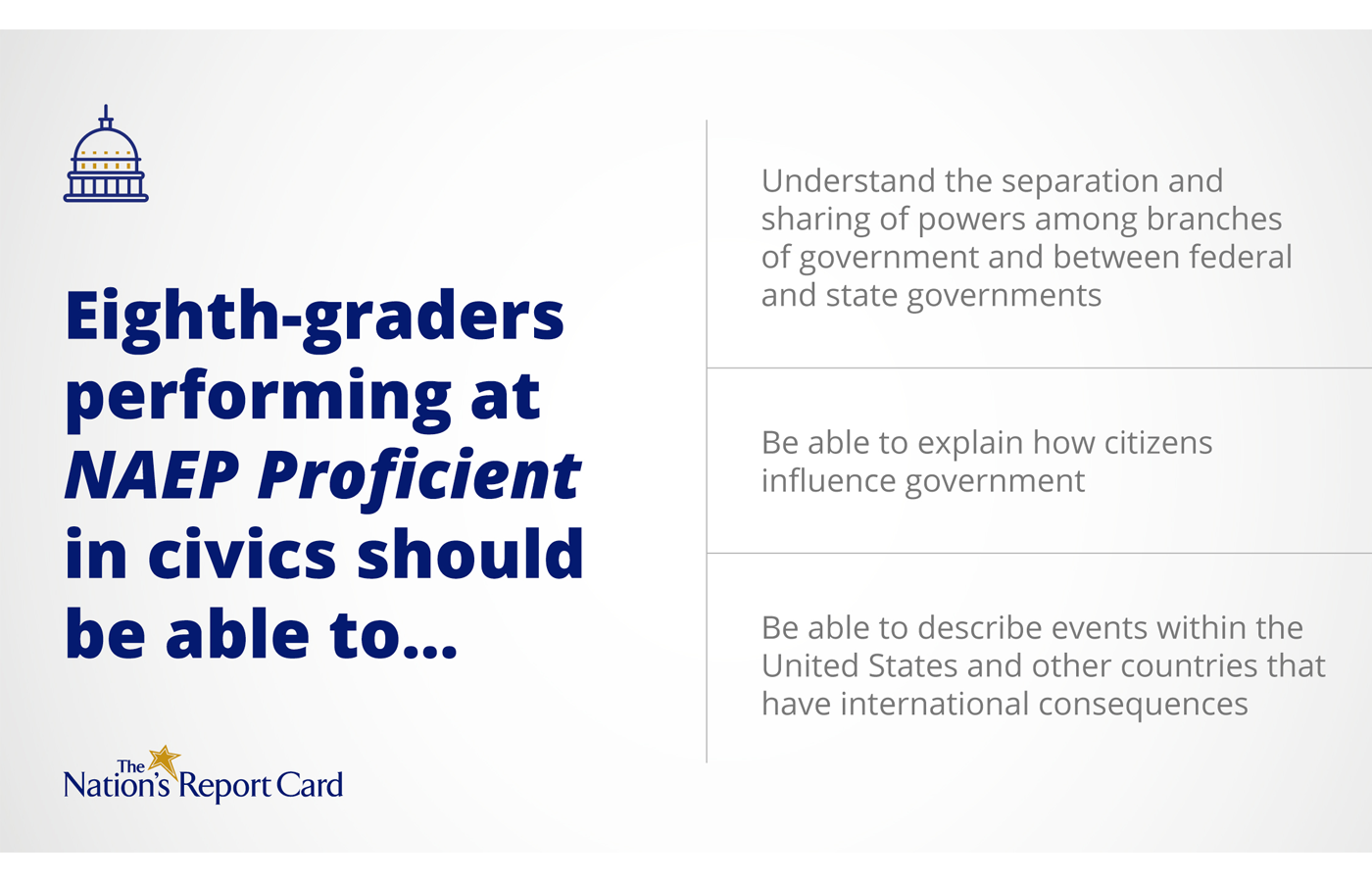
			<content:encoded><![CDATA[<p>Pretty much everybody favors better “civics education” in our schools and colleges. Pretty much everybody who thinks about such matters is alarmed that barely a quarter of U.S. school kids were at or above the “proficient” level on the 2010 NAEP assessment of civics—and that achievement at the twelfth-grade level is slipping even though just about all students “take civics” in high school. Almost everyone has encountered ample examples of students (and adults!) who cannot answer the most rudimentary questions about how the government is organized, what “separation of powers” or “checks and balances” means, how many senators their states have (much less their names), and more.</p>
<p>It is, indeed, a modern platitude that “we must do something to improve Americans’ knowledge of civics and government.”</p>
<p>But there is a problem in civics education, a sort of dividing line, about which there is far less agreement across society. On one side, we find an emphasis on infusing kids with basic knowledge about government, an understanding of the merits (as well as the shortcomings) of American democracy, and a sense of what can still be called patriotism: the belief that this country and its values need to be defended. (Stanford’s Bill Damon does a terrific job of elaborating on this viewpoint in his recent book, <em><a href="http://www.hooverpress.org/productdetails.cfm?PC=1524" target="_blank">Failing Liberty 101</a></em>.)</p>
<p>On the other side, we find much greater emphasis on civic participation and activism, on voluntarism and “service learning,” and on what is often termed “collective decision making” (or problem solving) and “democratic engagement,” which often boils down into the communitarian view that issues facing society are best dealt with through group action, by people joining hands and working together rather than through the political process.</p>
<p>I will admit, after watching the antics of Congress, many state legislatures, and the current GOP presidential candidates, that American society would benefit from more “working together” than our elected officials have displayed of late. (And I keep recalling the late David Broder’s remark that the death of Ted Kennedy marked the passing of the last of the Senate’s great “deal makers,” willing to compromise and work across party lines to accomplish something worthwhile, even if it wasn’t everything that either party wanted.)</p>
<p>Still and all, schools have a special responsibility to the young people in their care, which is to be exceptionally careful about providing lessons and activities of a political nature or enlisting them in adult causes, however worthy some may deem them. And Uncle Sam has a special responsibility not to “take sides” in the big debate—or, if it does, to come down on the side of patriotism. Unfortunately, a new report out of the U.S. Department of Education, one that appears to enjoy Arne Duncan’s strong personal backing, suggests that the executive branch is tilting toward the other side.</p>
<p>One is reminded, without pleasure, the ruckus that President Obama stirred up with his first back-to-school address in 2009—and the <a href="http://www.cbn.com/cbnnews/politics/2009/September/Obamas-Back-to-School-Talk-Raises-Concerns/" target="_blank">controversial “lesson plan”</a> that the Education Department prepared to accompany it.</p>
<p>The “democratic engagement” faction within civics education has recently re-energized—even without Mr. Duncan’s help—and is pressing hard on schools to push kids into activism. You can see a vivid example of this in a recent publication called (cutely) <em><a href="http://www.aacu.org/civic_learning/crucible/documents/crucible_508F.pdf" target="_blank">A Crucible Moment</a></em> and billed as “a national call to action.” Although it’s primarily aimed at colleges and universities, its authors make plain that its message is meant for primary and secondary schools, too. (Those authors, however, include absolutely nobody from the K-12 world.)</p>
<p>The publication sets forth a quintet of “essential actions,” among which I find three at least a bit troublesome, particularly when applied to compulsory public education of impressionable children rather than the voluntary education of young adults:</p>
<ul>
<li>“Advance a contemporary, comprehensive framework for civic learning—embracing U.S. and global interdependence—that includes historic and modern understandings of democratic values, capacities to engage diverse perspectives and people, and commitment to collective civic problem solving.”<em>Global interdependence? Collective civic problem solving?</em></li>
<li>“Capitalize upon the interdependent responsibilities of K–12 and higher education<strong> </strong>to foster progressively higher levels of civic knowledge, skills, examined values, and action as expectations for every student.”<em> Values examined by whom? What sort of “action”?</em></li>
<li>“Expand the number of robust, generative civic partnerships and alliances, locally, nationally, and globally to address common problems, empower people to act, strengthen communities and nations, and generate new frontiers of knowledge.” <em>What exactly are “generative civic partnerships” and who in particular is supposed to be “empowered” to do what?</em></li>
</ul>
<p>Are you with me so far? But you may be thinking that this is all kind of academic and irrelevant, isn’t it, just one more pious commission report?</p>
<p>Well, it would be, but for one big attention-getter: Uncle Sam putting his thumb on this side of the civics-education scale.</p>
<p>Check out the Education Department’s brand-new official publication, <em><a href="http://www.ed.gov/sites/default/files/road-map-call-to-action.pdf">Advancing Civic Learning and Engagement in Democracy: A Road Map and Call to Action</a>. </em>Although this thirty-pager comes out of the Department’s postsecondary wing and is, once again, meant mostly for higher education, it, too, makes no real age-specific distinctions and explicitly urges the nation’s K-12 schools to, for example, “both expand and transform their approach to civic learning and democratic engagement, rather than engage in tinkering at the margins. At no school, college, or university should students graduate with less civic literacy and engagement than when they arrived.”</p>
<p>Duncan himself made a pretty big deal of this at a recent White House conference where he remarked that “Unlike traditional civic education, civic learning and democratic engagement 2.0 is more ambitious and participatory than in the past. To paraphrase Justice O&#8217;Connor, the new generation of civic education initiatives move beyond your ‘grandmother&#8217;s civics’ to what has been labeled ‘<a href="http://www.ed.gov/news/speeches/secretary-arne-duncans-remarks-democracys-future-forum-white-house">action civics</a>.’&#8221;</p>
<p>Hmm, “action civics”?</p>
<p>To be sure, most of what the Department proposes to do itself in this realm is consistent either with longstanding federal practice (e.g. research, data) or with ingrained Obama-administration priorities (e.g. “public-private partnerships”). But there are policy hints that go farther, such as suggesting that the forthcoming ESEA/NCLB reauthorization should include a program to “assist states, local education agencies, and nonprofits in developing implementing, evaluating, and replicating evidence-based programs that contribute to a well-rounded education—including civics, government, economics, and history. Other disciplines included in the program could incorporate evidence-based civic learning and democratic engagement approaches—such as service-learning.”</p>
<p>Read that last bit again and ask yourself if this is really a proper federal role in K-12 education, keeping in mind that the kids to be affected probably cannot even name the mayor of their town or the governor of their state, nor have much idea what political parties are and how legislation gets passed (or not).</p>
<p>It’s well and good for the Education Department to seek a broadening of the K-12 curriculum and an overdue consolidation of too many discipline-specific curriculum-related programs into a single block grant. It’s not acceptable, however, for them to push “action civics” on our nation’s schools.</p>
<p>-Chester E. Finn Jr</p>
<p><em>This post was originally published in the Fordham Institute’s <a href="http://www.edexcellence.net/commentary/education-gadfly-weekly/2012/january-19/should-schools-turn-children-into-activists-and-should-uncle-sam-help-1.html">Education Gadfly Weekly</a></em></p>
<img src="http://educationnext.org/?ak_action=api_record_view&id=49646347&type=feed" alt="" />]]></content:encoded>
			<wfw:commentRss>http://educationnext.org/should-schools-turn-children-into-activists-and-should-uncle-sam-help/feed/</wfw:commentRss>
		<slash:comments>7</slash:comments>
		</item>
		<item>
		<title>The Green-Tea Party</title>
		<link>http://educationnext.org/the-green-tea-party/</link>
		<comments>http://educationnext.org/the-green-tea-party/#comments</comments>
		<pubDate>Thu, 29 Dec 2011 13:06:41 +0000</pubDate>
		<dc:creator>Chester E. Finn, Jr.</dc:creator>
				<category><![CDATA[Blog]]></category>
		<category><![CDATA[Editorial]]></category>

		<guid isPermaLink="false">http://educationnext.org/?p=49645946</guid>
		<description><![CDATA[Coming out of a year that has left me ever less enamored of both our major political parties, their polarized and gridlocked behavior on Capitol Hill, their uninspiring candidates and ratty presidential campaigns, not to mention their antics in many a statehouse, I’m ready for a promising, credible third party. ]]></description>
			<content:encoded><![CDATA[<p>Coming out of a year that has left me ever less enamored of both our  major political parties, their polarized and gridlocked behavior on  Capitol Hill, their uninspiring candidates and ratty presidential  campaigns, not to mention their antics in many a statehouse, I’m ready  for a promising, credible third party. You could call me a recovering  Democrat (adulthood to about 1980) and increasingly disaffected  Republican (the past three decades), the latter made more painful by the  fact that the several live Republicans who would make superb presidents  are the ones who decided not to run.</p>
<p>Until something better comes along, I’m going to fancy myself a  member of the Green-tea Party. Here are its seven tenets, one for each  day of the week:</p>
<ul>
<li>Low taxes, efficient government, a balanced budget, a vigorous  foreign policy (no more “leading from behind”), and a strong national  defense.</li>
<li>A full-bore, full-throated war on terrorism, terrorists, pirates and other such menaces, wherever they are.</li>
<li>Decent provision for the truly dependent—and no help at all for  those who can and should provide for themselves, their families and  their neighbors.</li>
<li>Decent respect for the environment—I’ve seen those glaciers melt and  trash in the ocean—and for conservation of non-renewable resources.</li>
<li>Minimal government regulation of just about everything else.</li>
<li>That includes governments (and politicians) keeping out of adults’  lives, bedrooms, beliefs, orientations and practices. (Children are  another story.)</li>
<li>High education standards, plenty of quality school choices and lots more bang for the education buck.</li>
</ul>
<p>Anybody want to join me? To run on this platform? You might even get more than one vote.</p>
<p>-Chester E. Finn, Jr.</p>
<p>This post also appears on <a href="http://www.educationgadfly.net/flypaper/2011/12/the-green-tea-party/?utm_source=feedburner&amp;utm_medium=feed&amp;utm_campaign=Feed%3A+flypaper+%28Flypaper%3A+Ideas+that+stick+from+the+Education+Gadfly+team%29">Flypaper</a>.</p>
<img src="http://educationnext.org/?ak_action=api_record_view&id=49645946&type=feed" alt="" />]]></content:encoded>
			<wfw:commentRss>http://educationnext.org/the-green-tea-party/feed/</wfw:commentRss>
		<slash:comments>1</slash:comments>
		</item>
		<item>
		<title>Unsolved Problems—and Signs of Hope—as 2012 Dawns</title>
		<link>http://educationnext.org/unsolved-problems%e2%80%94and-signs-of-hope%e2%80%94as-2012-dawns/</link>
		<comments>http://educationnext.org/unsolved-problems%e2%80%94and-signs-of-hope%e2%80%94as-2012-dawns/#comments</comments>
		<pubDate>Fri, 23 Dec 2011 14:38:51 +0000</pubDate>
		<dc:creator>Chester E. Finn, Jr.</dc:creator>
				<category><![CDATA[Blog]]></category>
		<category><![CDATA[Editorial]]></category>

		<guid isPermaLink="false">http://educationnext.org/?p=49645912</guid>
		<description><![CDATA[We need to focus on the barriers that keep us from making major-league gains--not cultural issues, parenting issues, demographic issues, or other macro-influences on educational achievement, but obstacles that competent leaders and bold policymakers could reduce or eradicate if they were serious.
]]></description>
			<content:encoded><![CDATA[<p>The central problem besetting K-12 education in the United States today is still—as for almost thirty years now—that far too few of our kids are learning nearly enough for their own or the nation’s good. And the gains we’ve made, though well worth making, have been meager (and largely confined to math), are trumped by gains in other countries, and evaporate by the end of high school.</p>
<p>This much everybody knows. But unless we want to live out the classic definition of insanity (“doing the same thing over again with the expectation that it will produce a different result”), we need to focus laser-like on the barriers that keep us from making major-league gains. If we don’t break through (or circumnavigate) these barriers, academic achievement will remain stagnant.</p>
<p>The barriers I’m talking about are not cultural issues, parenting issues, demographic issues, or other macro-influences on educational achievement. Those are all plenty real, but largely beyond the reach of public policy. No, here I refer to obstacles that competent leaders and bold policymakers could reduce or eradicate if they were serious.</p>
<p>How much difference would that really make? It’s possible, of course, that we’re pursuing the wrong core strategies. Maybe standards-based reform has exhausted its potential (as Mark Schneider suggests in <a href="http://www.edexcellence.net/publications-issues/publications/the-accountability-plateau.html"><em>The Accountability Plateau</em></a>). Perhaps choice and competition really cannot lift all boats. Possibly technology is overrated, alternate certification can never amount to much, teacher quality is doomed to mediocrity, principals don’t truly want authority, etc.</p>
<p>Could be. But from where I sit, the basic strategies aren’t ill-conceived. Rather, they’ve been stumped, stymied, and constrained by formidable barriers that are more or less built into the K-12 system as we know it.</p>
<p>Those barriers aren’t accidents. They’ve been erected by adult interests, bureaucratic routine, structural rigidity, and political stalemate. And they function to keep anything in education from changing very much. Eight such barriers are especially troublesome. Uninterrupted, they are likely to keep us from making major gains. One ought not, however, despair. On several fronts, promising interruptions and interrupters are emerging. Whether they can muster what it will take to tear down these walls remains unknown.</p>
<p>First and foremost is the <em>archaic governance</em> of K-12 education. I’ve<a href="http://www.nationalaffairs.com/publications/detail/beyond-the-school-district"> written elsewhere</a> <a href="http://www.edexcellencemedia.net/publications/2011/20111201_RethinkingEducationGovernance/FinnPetrilli-FordhamCAP-Governance-ConferenceDraft.pdf">about this problem</a>, but it’s <a href="http://www.hoover.org/publications/defining-ideas/article/83137">so fundamental and ubiquitous</a> that we tend not even to notice it, much less to think that anything could be done about it. Instead, we take for granted (like it or not) that we’re stuck forever with local control in the form of school districts, separate from the rest of government and run by school boards that are particularly vulnerable to capture by adult interests, as well as with a marble cake of federal, state, and local decisions, regulations, and funding streams.</p>
<p>There are beginning to be exceptions, however, that illustrate what could be possible. Mayoral control of the schools in D.C., New York, Chicago, and several other major cities is one example. <a href="http://support.edexcellence.net/site/MessageViewer?pgwrap=n&amp;em_id=2865.0#a1">State-operated “recovery” school districts</a> in Louisiana, Tennessee, and Michigan are another. The “parent trigger” idea is a third.</p>
<p>Second, our <em>dysfunctional system of school finance</em> puts the brakes on just about every reform while perpetuating inequity. We don’t fund learning, we fund programs. We don’t fund kids, we fund adult job slots. We don’t fund schools, we fund district-wide categoricals. We don’t blend the money from multiple sources into a single, flexible stream; rather, we leave it in discrete programs and silos, each with its own rules, uses of funding, and accounting obligations.</p>
<p>Here, too, small cracks can be seen in the glacier. Several states (notably Michigan, Indiana, and Vermont) have shifted their funding systems to mostly state dollars. Voucher programs, though still limited (but growing!), enable at least some of the money to accompany individual kids to the schools of their choice. A few cities have devolved as much budgetary authority as they can—district-wide teacher contracts are a huge constraint here—to the building level. Waivers can be sought (though seldom are) from states and Washington that allow enterprising superintendents to combine and redirect some of the categorical funds. And a few brave school-finance experts are probing deep into district budgets to see how much things really cost and where the dollars really flow.</p>
<p>Third, our <em>academic standards are too low</em> almost everywhere. It’s not just that too little is being achieved; it’s that too little is <em>expected</em>. Even where a state’s standards look great on paper—a few do—its “cut scores” for passing the tests aligned with those standards <a href="http://www.edexcellence.net/publications-issues/publications/theproficiencyillusion.html">are rarely ambitious</a>, and NCLB hasn’t helped one bit on that front. <a href="http://support.edexcellence.net/site/R?i=cXlcRam544srlrmSXZ95mg" target="_blank">Fordham</a> <a href="http://support.edexcellence.net/site/R?i=RmgEhAD4bfL7ypRxZIxKZQ" target="_blank">and others</a> have <a href="http://support.edexcellence.net/site/R?i=AwZPd1SY1ul3JKbRYUhz6A" target="_blank">been documenting</a> these problems forever.</p>
<p>The silver lining in this cloud is widespread adoption of the Common Core State Standards for math and reading, and work now underway to produce a kindred set of multi-state standards for science. The Common Core itself turned out well, superior to the academic standards of most states and more or less <a href="http://www.edexcellence.net/publications-issues/publications/the-state-of-state.html">on par with the best of them</a>. The big questions now are whether it will be properly implemented, which means accompanying it with suitable curricula, assessments, and more—and whether public officials will have the fortitude to stick with it after scads of their current students turn out to be no match for it. Several state education leaders—Ohio’s Stan Heffner and Massachusetts’s Mitch Chester come to mind—are already walking the Common Core walk. In other jurisdictions, it may still be mostly talk.</p>
<p>Which brings us to <em>weak-kneed accountability</em>, the fourth great barrier to real achievement gains. About half the states have high school graduation tests that one must pass to qualify for a diploma but nearly all of these are easy—eighth- or tenth-grade content with low passing scores and multiple make-up opportunities. A few states have “promotional gates”—achievement benchmarks that determine whether you get to move on to the next grade. Many states give ratings or labels to schools according to their academic results and NCLB has added the (“made” or “failed”) AYP designation for schools and districts. Still and all, there are precious few tangible consequences for the adults in the system; it isn’t that demanding for the kids; and schools that find themselves subject to “interventions” or “reconstitutions” usually end up with the minimum-hassle version.</p>
<p>Whether the state consortia now developing Common Core-aligned assessments will be able to agree on demanding “cut scores” is an open question, to be followed by whether individual states using those tests will let those cut scores make any real difference in promotion, graduation, teacher retention (or reward), school reconstitution, and all the rest. Yes, there’s movement toward tying teacher evaluations and pay more tightly to student learning, but we’re still in the earliest stages of that ambitious project and there is much resistance to it.</p>
<p>Fifth, though choice programs of every sort are proliferating—virtual, charter, hybrid, voucher, and more—and though it can be demonstrated that more than half of all U.S. pupils now attend schools that they or their parents chose via one means or another, the facts remain that <em>too many of those choices are mediocre</em> (or worse), that the kids in greatest need of better options are least apt to be able to access them, and that our “schools of choice” for the most part labor under <a href="http://www.edexcellence.net/publications-issues/publications/charter-school-autonomy-a.html">too much input-and-process regulation coupled with insufficient resources</a>.</p>
<p>The best of the CMOs and a handful of one-off schools show that quality is possible, but even they face great difficulty replicating success and expanding their networks. The best state charter laws show that the regulatory and resource challenges can be tackled. But we’ve got a long way to go.</p>
<p>Sixth, although <em>instructional technology</em> holds enormous promise to transform education—in both its fully virtual and blended forms—it <em>is stoutly opposed</em> by the usual interest groups, is pushed (perhaps too hard) by politically connected profit seekers who care little about academic achievement, is ill-suited to existing governance and financing arrangements, and is shackled by absurd regulatory provisions that make scant sense even in a brick-and-mortar environment. The Digital Learning Council and others (including the Foundation for Excellence in Education and <a href="http://www.edexcellence.net/publications-issues/publications/creating-sound-policy-for-digital-learning.html">Fordham itself</a>) are showing where and how paths through these thickets could be cut but politicians and policymakers will have to do the heavy cutting.</p>
<p>Seventh, <em>our human resource practices and policies are sorely antiquated</em> and anti-quality, particularly as regards teachers, whether one is looking at seniority provisions, uniform pay schedules, overly rich pension-and-benefit plans, licensure-and-certification rules, or a hundred other parts of public education’s HR system. There have been bold moves in several states to limit the scope of collective bargaining (a pillar of archaic HR practices), to modernize benefit structures, to make employment hinge more on effectiveness than on credentials and seniority, and to evaluate teachers (and sometimes principals) more on the basis of student achievement. But, once again, <a href="http://www.nctq.org/p/publications/docs/nctq_stateOfTheStates.pdf">we have a very long way to go</a>.</p>
<p>Eighth and finally, <em>our preoccupation with “at risk” populations</em> and with achievement gaps defined as the distance between demographic groups <em>has led to the benign neglect of millions of kids</em>,<a href="http://www.city-journal.org/2011/21_4_academic-excellence.html"> including but not limited to </a><a href="http://www.edexcellence.net/publications-issues/publications/high-flyers.html">gifted students and high-achieving learners</a>. America will never solve its international-competitiveness problem just by raising the bottom of the achievement distribution. Though a number of states and districts are trying to enlarge their Advanced Placement programs and to reward top students with college financial aid and other initiatives aimed at high achievers, it’s also the case that tight budgets have shrunk gifted-and-talented programs in many places. (And Congress has zero-funded the <a href="http://www.nagc.org/index2.aspx?id=572">only federal initiative that tries to encourage such activities.</a>) Note, too, that <a href="http://www.edexcellence.net/publications-issues/publications/growing-pains-in-the-advanced.html">widening access to AP</a> and such isn’t necessarily a good thing for the “talented tenth” who were already taking those courses and passing those exams.</p>
<p>With these eight problems unsolved—and more that could be added to the list—as well as gridlocked policymaking in Washington and open warfare in many state capitals, is there reason to be optimistic about the future of K-12 education?</p>
<p>I say yes, albeit cautiously. What gives me the greatest hope today is the emergence—and steadfastness—of a new cadre of change-minded people in positions of influence (think Jeb Bush, the “Chiefs for Change,” Joel Klein, Wendy Kopp, Kevin Huffman, Michelle Rhee, and yes, Arne Duncan) and the birth of a number of new-and/or-improved advocacy organizations, mostly operating at the state level (think 50CAN, Advance Illinois, PIE-Network, Democrats for Education Reform, Students First, Stand for Children, BAEO, the American Federation for Children, Parent Revolution). They’re still no match for the protectors of the status quo—i.e. bulwarks of the barriers enumerated above—but they’re slowly gaining. Let us wish them much clout in the New Year and beyond.</p>
<p>-Chester E. Finn, Jr.</p>
<p>This also appears in <a href="http://www.edexcellence.net/news-commentary/education-gadfly.htmlhttp://">The Education Gadfly</a>.</p>
<img src="http://educationnext.org/?ak_action=api_record_view&id=49645912&type=feed" alt="" />]]></content:encoded>
			<wfw:commentRss>http://educationnext.org/unsolved-problems%e2%80%94and-signs-of-hope%e2%80%94as-2012-dawns/feed/</wfw:commentRss>
		<slash:comments>0</slash:comments>
		</item>
		<item>
		<title>Texas Hit the Accountability Plateau, Then the Rest of the Country Followed</title>
		<link>http://educationnext.org/texas-hit-the-accountability-plateau-then-the-rest-of-the-country-followed/</link>
		<comments>http://educationnext.org/texas-hit-the-accountability-plateau-then-the-rest-of-the-country-followed/#comments</comments>
		<pubDate>Thu, 15 Dec 2011 14:25:03 +0000</pubDate>
		<dc:creator>Chester E. Finn, Jr.</dc:creator>
				<category><![CDATA[Blog]]></category>
		<category><![CDATA[Editorial]]></category>
		<category><![CDATA[No Child Left Behind]]></category>
		<category><![CDATA[Accountability Plateau]]></category>
		<category><![CDATA[Mark Schneider]]></category>

		<guid isPermaLink="false">http://educationnext.org/?p=49645819</guid>
		<description><![CDATA[“Consequential accountability” corresponded with a significant one-time boost in student achievement. As an early adopter, Texas got a head start on big achievement gains, and also a head start on flat-lining thereafter.]]></description>
			<content:encoded><![CDATA[<p>&#8220;<a href="http://educationnext.org/the-accountability-plateau">The Accountability Plateau</a>,&#8221; by Mark Schneider,  just published by Education Next and the Fordham Institute, makes a big point: that “consequential accountability,” à la No Child Left Behind and the high-stakes state testing systems that preceded it, corresponded with a significant one-time boost in student achievement, particularly in primary and middle school math. Like the meteor that led to the decline of the dinosaurs and the rise of the mammals, results-based accountability appears to have shocked the education system. But its effect seems to be fading now, as earlier gains are maintained but not built upon. If we are to get another big jump in academic achievement, we’re going to need another shock to the system—another meteor from somewhere beyond our familiar solar system.</p>
<p>So argues Mark Schneider, a scholar, analyst, and friend whom we once affectionately (and appropriately) named “Statstud.” Schneider, a political scientist, served as commissioner of the National  Center for Education Statistics from 2005 to 2008, and is now affiliated with the American Institutes for Research and the American Enterprise Institute. In his new analysis, he digs into twenty years of trends on the National Assessment of Educational Progress—the “Nation’s Report Card.”</p>
<p>We originally asked Schneider to investigate the achievement record of the great state of Texas. At the time—it feels like just yesterday—Lone Star Governor Rick Perry was riding high in the polls, making an issue of education, and taking flak from Secretary Arne Duncan for running an inadequate school system. We wondered: Was Duncan right to feel “very, very badly” for the children of Texas? Had the state’s schools—once darlings of the standards movement and prototypes for NCLB—really slipped into decline since Perry took office? What do the NAEP data really show?</p>
<p>Schneider agreed to take on the project but quickly concluded that there’s a larger and more interesting story to tell than simply the saga of Texas. It was true, he noted, that Texas’s achievement slowed during the Perry years, particularly as compared to the rest of the country. But rather than pin that development on the governor, Schneider saw a more likely explanation: As an early adopter of standards, testing, and accountability, Texas got a head start on big achievement gains, most of which it realized in the 1990s when George W. Bush was governor—and also a head start on flat-lining thereafter, during Rick Perry’s tenure.</p>
<p>Indeed, the Lone  Star State made Texas-sized gains from the early- to mid-1990s, as its accountability system got traction. But as other states followed suit, they too hit the achievement fast-track, leading to sizable national gains from 1998 to 2003. Since then, however, Texas’s progress has cooled, and the same is now happening to the country as a whole. It’s not that Perry was a worse “education governor” than Bush (or, for that matter, Ann Richards) before him, but that he presided over an accountability strategy that was running out of steam.</p>
<p>It’s an intriguing argument, and one that deserves serious consideration, even more so as the U.S. marks the tenth anniversary of the enactment of NCLB and tries to figure out what the next version of that law should entail. If school-level accountability, as currently practiced, is no longer an effective lever for raising student achievement, then what is? If we need another “meteor” to disrupt the system, where should we look? Mark suggests that the Common Core and rigorous teacher evaluations have potential. We also see promise in the digital-learning revolution. But other shocks to the system might work even better. What are they?</p>
<p>-Chester E. Finn, Jr. and Michael Petrilli</p>
<img src="http://educationnext.org/?ak_action=api_record_view&id=49645819&type=feed" alt="" />]]></content:encoded>
			<wfw:commentRss>http://educationnext.org/texas-hit-the-accountability-plateau-then-the-rest-of-the-country-followed/feed/</wfw:commentRss>
		<slash:comments>1</slash:comments>
		</item>
		<item>
		<title>The Euro and the Common Core</title>
		<link>http://educationnext.org/the-euro-and-the-common-core/</link>
		<comments>http://educationnext.org/the-euro-and-the-common-core/#comments</comments>
		<pubDate>Fri, 09 Dec 2011 11:15:30 +0000</pubDate>
		<dc:creator>Chester E. Finn, Jr.</dc:creator>
				<category><![CDATA[Blog]]></category>
		<category><![CDATA[Editorial]]></category>
		<category><![CDATA[national standards]]></category>

		<guid isPermaLink="false">http://educationnext.org/?p=49645693</guid>
		<description><![CDATA[If you hope the Euro crashes, that this week’s Brussels summit fails, and that European commerce returns to francs, marks, lira, drachma, and pesetas, you may be one of those rare Americans who also seeks the demise of the Common Core State Standards Initiative in U.S. education.]]></description>
			<content:encoded><![CDATA[<p>If you hope the Euro crashes, that this week’s Brussels summit fails,  and that European commerce returns to francs, marks, lira, drachma, and  pesetas, you may be one of those rare Americans who also seeks the  demise of the Common Core State Standards Initiative in U.S. education.  Crazy analogy? Please read on.</p>
<p>To be sure, the Euro already exists in the real world—you can hold  one in your hands and buy things with it—and its demise would likely  trigger a worldwide economic crisis, whereas the Common Core so far  exists only on paper and all of its implementation challenges lie ahead.  If it fails to gain traction, the sky won’t fall; we’ll simply stick  with the status quo.</p>
<p>If you find the status quo in American K-12 education acceptable,  bully for you. I find it akin to the condition of Europe and its economy  after World War II: weak, battered, and fragmented, in need of a major  tune-up and tone-up. It needs more focus, too—and greater capacity to  help states pull in the same direction instead of pulling apart.</p>
<p>Recognizing those woes, and sensing that their war-torn nations would  be better served by joining forces, the post-war years saw a half-dozen  visionary European leaders striving to construct something more  coherent and viable. In 1957, six core countries signed the Treaty of  Rome, creating the “common market,” or the European Union as it’s been  known since 1967, which has slowly grown to include twenty-seven  countries allied in a federation of shared economic and political  interests. (Several more are “candidates” for admission.) Almost all of  western and central Europe now participates, save Norway and  Switzerland. Within the EU, a subset of seventeen countries (not  including Britain, Sweden, Poland, Denmark, etc.) share the common  currency known (since 1999) as the Euro.</p>
<div>Like Europe in 1950, the nation remains at grave risk, educationally and economically.</div>
<p>Today finds the Euro (and, by association, the European Union) in  jeopardy, because participating countries have handled their economies  in radically different ways. Worsened by the 2008 recession, the  real-estate collapse, and the banking crisis, some of them (Ireland,  Portugal, Greece, and maybe more) have needed major outside help to keep  going, while the better managed, less-indebted, and more prosperous  nations (above all Germany and France) have been reluctant to “bail out”  their embattled counterparts. That may change in the coming weeks—if  the “Merkozy” <a href="http://www.theaustralian.com.au/business/wall-street-journal/merkel-sarkozy-outline-treaty-changes/story-fnay3ubk-1226216825612" target="_blank">plan to rewrite the treaties</a> and reshape Europe’s political and economic structures finds favor across the continent.</p>
<p>Our states are not educationally inter-dependent in the same way, of  course, and some may implement the Common Core well while others don’t.  Unless Congress or the Education Department makes a dumb move and  entangles the Common Core with ESEA reauthorization and federal funding,  participation in it will remain voluntary and its implementation will  likely be uneven.</p>
<p>That unevenness will be harder to sustain, however, when common  assessments come on line, particularly if the multi-state consortia  developing those assessments can actually (as their RTTT grant says they  must) agree on common “cut scores” to denote student proficiency—and  “college-career readiness”—in every participating state.</p>
<p>Those cut scores will be more like the Euro, a sort of common  currency that moves across state borders much as EU passport holders are  able to move across national borders. It will certainly make for easier  comparisons of student and school performance than we’ve ever had  before and is apt to forge various new uniformities in curriculum,  teacher preparation, textbooks, and more. (It will also be a huge  benefit to providers of virtual education for whom district and state  borders have been an irksome and archaic obstacle.)</p>
<p>Texas, Virginia, Alaska, and Nebraska have not wanted to participate  at all. Like Norway and Switzerland, they prefer to go it alone. So be  it. The Common Core enterprise, like the EU, is voluntary and its main  selling point is that participants will be better off in various ways  than will the outliers.</p>
<p>The small but noisy band of Common Core critics and kvetchers, however,  clearly wants the whole enterprise to go away. They mistrust claims of  voluntarism and find the potential loss of state sovereignty a bigger  threat to America’s educational wellbeing than today’s uneven standards  and slipshod academic performance. They use scary language akin to the <em><a href="http://www.nytimes.com/2011/12/07/business/global/economic-troubles-in-europe-and-us-start-to-affect-asia.html" target="_blank">New York Times </a></em><a href="http://www.nytimes.com/2011/12/07/business/global/economic-troubles-in-europe-and-us-start-to-affect-asia.html" target="_blank">correspondent describing</a> the major changes in treaties and governance that Merkel and Sarkozy  hope the entire EU will agree to: “The changes…would effectively  subordinate economic sovereignty to collective discipline enforced by  European technocrats in Brussels.”</p>
<p>That’s what Common Core critics fear will happen here. They worry  especially that the U.S. equivalent of “Brussels technocrats” (i.e.  Uncle Sam) will end up taking over—and they’re mindful that no durable  governance mechanism yet exists for maintaining the Common Core,  managing the new assessments over time, keeping it all voluntary while  keeping the states in charge. Nor has anyone made a serious move to  create such a mechanism. (When we at Fordham <a href="http://www.edexcellence.net/publications-issues/publications/now-what-imperatives-and.html" target="_blank">suggested that something of the sort is needed</a>, we were <a href="http://www.nga.org/cms/home/news-room/news-releases/page_2010/col2-content/main-content-list/title_nga-and-ccsso-comment-on-ccssi-governance-suggestions.html" target="_blank">admonished by NGA and CCSSO to butt out</a>.)</p>
<p>The critics’ angst is not baseless. The absence of a Common Core  management mechanism for the long term—for the standards and especially  for the assessments—is a problem and creates a vacuum that the “Brussels  technocrats” may well be tempted to fill. It’s also true that uneven  implementation by states, like uneven implementation of sound economic  policy by the countries of Europe, could lead to a Merkozy-like call for  greater centralization.</p>
<p>But is that grounds to abort the whole project—for states to pull  back from it and presidential aspirants to denounce it? Depends, I  think, on your view of the status quo and the risks you are willing to  take to see it altered. Like Europe in 1950, the nation remains at grave  risk, educationally and economically, and almost nobody looking at our  long term prospects thinks we can climb out of this ditch without a  major boost in educational effectiveness and productivity.</p>
<p>No, the Common Core does not assure that boost. Plenty of other  things need to change, too—and every one of them has critics, kvetchers,  and hostile interest groups. (So did the European Union: DeGaulle, for  example, really didn’t want Britain allowed in.) It may be that  Massachusetts and a few other states can do as well or better on their  own. Perhaps the “Chiefs for Change” will eventually have fifty members.  Or perhaps it’s acceptable for Arkansas and California and others to  continue wallowing in mediocrity. Maybe we’re not a “nation” at risk,  just fifty states with varying degrees of risk.</p>
<p>I for one hope this week’s summit in Brussels leads them to rewrite  the treaties. And that the Common Core prevails over its critics. The  people of Europe—and the world—are better off with the Euro than without  it. And the people of the United States would be better off if all our  kids were held to the same high educational expectations.</p>
<p>-Chester E. Finn, Jr.</p>
<p>This post also appears on <a href="http://www.educationgadfly.net/flypaper/2011/12/the-euro-and-the-common-core/">Flypaper</a>.</p>
<img src="http://educationnext.org/?ak_action=api_record_view&id=49645693&type=feed" alt="" />]]></content:encoded>
			<wfw:commentRss>http://educationnext.org/the-euro-and-the-common-core/feed/</wfw:commentRss>
		<slash:comments>1</slash:comments>
		</item>
		<item>
		<title>Too Many Cooks, Too Many Kitchens</title>
		<link>http://educationnext.org/too-many-cooks-too-many-kitchens/</link>
		<comments>http://educationnext.org/too-many-cooks-too-many-kitchens/#comments</comments>
		<pubDate>Fri, 02 Dec 2011 12:11:56 +0000</pubDate>
		<dc:creator>Chester E. Finn, Jr.</dc:creator>
				<category><![CDATA[Blog]]></category>
		<category><![CDATA[Editorial]]></category>
		<category><![CDATA[education governance]]></category>
		<category><![CDATA[school boards]]></category>

		<guid isPermaLink="false">http://educationnext.org/?p=49645565</guid>
		<description><![CDATA[It’s well past time to rethink, re-imagine, and reinvent education governance for the twenty-first century.]]></description>
			<content:encoded><![CDATA[<p>Despite America’s romantic attachment to “local control of public education,” the reality is that the way it works today offers a worst-of-both-worlds scenario. On the one hand, district-level power constrains individual schools; its standardizing, bureaucratic, and political force ties the hands of principals, stopping them from doing what’s best for their pupils with regard to budget, staffing, and curriculum. On the other, local control isn’t strong enough to clear the obstacles that state and federal governments place before reform-minded board members and superintendents in the relatively few locales where these can even be observed.</p>
<p>Sure, remarkable individuals can sometimes make it work, at least for a while: Michelle Rhee (backed by Adrian Fenty) in the District of Columbia; Joel Klein (backed by Michael Bloomberg) in New York City; Arne Duncan (backed by Richard Daley) in Chicago; Jerry Weast (abetted by a rising budget) in Montgomery County, Maryland. Readers can surely cite additional examples. But these are the exceptions that prove the rule.</p>
<p>The rule is that education-policy decisions are made in so many places—each with some capacity to initiate change but with even greater capacity to block it—that there’s really nobody “in charge.” Some will say that’s a tribute to our traditions of democratic control, checks and balances, pluralism, and federalism. Others will say it’s just a mighty wasteful and ineffectual way to run a system that is widely believed to need a thorough makeover.</p>
<p>Some have described education governance in the United   States as a “layer cake,” others as a “marble cake” (because the jurisdictions and zones of control of different governments and agencies are so jumbled). Still others favor the image of a “loosely coupled train” where movement at one end doesn’t necessarily produce any motion at the other. We find a more apt analogy in a vast restaurant or food court with multiple kitchens, each thronged with many cooks, yet with no head chef in command of even a single establishment much less the entire enterprise.</p>
<p>Consider so seemingly straightforward a decision as which teacher will be employed to fill a seventh-grade opening at the Lincoln School, located in, let us say, Metropolis, West Carolina. One might suppose that Lincoln’s principal, or perhaps the school’s top instructional staff, should decide which candidate is likeliest to succeed in that particular classroom. But under the typical circumstance, the most the principal might be able to do is veto wholly unsuitable candidates. (And often not that, considering seniority and “bumping rights” within districts, their collective-bargaining contracts, and, frequently, state law.) The superintendent’s HR office does most of the vetting and placing, but it is shackled by the contract, by state licensure practices (which may be set by an “independent”—and probably union and ed-school dominated—professional-standards board), by seniority rules that are probably enshrined in both contract and state law, and by uniform salary schedules that mean the new teacher (assuming similar “credentials”) will be paid the same fixed amount whether the subject most needed at Lincoln is math or music.</p>
<p>Washington gets into the act, too, with “highly qualified teacher” requirements that constrain the school. By the end of the process, at least a dozen different governing units impede the principal’s authority to staff his school with the ablest (and best suited) teachers available.</p>
<p>And teacher selection is but one of many examples of the “too many cooks” problem. Much the same litany can be invoked for special education, for the budgeting and control of a school’s funds, or for approved approaches to school discipline. (Not to mention a more literal “too many cooks” issue: What to serve for lunch in the school cafeteria?)</p>
<p>What great leader or change-agent would want to become a school principal under these circumstances? Or a local superintendent? Or even a teacher? Well, maybe in a comfy (and probably smug) suburban setting. But not in the places that most need outstanding talent.</p>
<p>No, American education doesn’t need czars or dictators. Separation-of-powers and checks-and-balances are important elements of our democracy. Kids and communities do differ and there needs to be flexibility in the system to adapt and adjust to singular circumstances, changing priorities, and dissimilar needs. But today, our public-education system lacks flexibility and nimbleness of all sorts. Surely that’s not what the founders—or Horace Mann—had in mind. And it’s most definitely not what our children need.</p>
<p>It’s well past time to rethink, re-imagine, and reinvent education governance for the twenty-first century. We’d better get moving.</p>
<p>-  Chester E. Finn, Jr. and Michael Petrilli</p>
<img src="http://educationnext.org/?ak_action=api_record_view&id=49645565&type=feed" alt="" />]]></content:encoded>
			<wfw:commentRss>http://educationnext.org/too-many-cooks-too-many-kitchens/feed/</wfw:commentRss>
		<slash:comments>3</slash:comments>
		</item>
		<item>
		<title>On Abolishing the Department of Education</title>
		<link>http://educationnext.org/on-abolishing-the-department-of-education/</link>
		<comments>http://educationnext.org/on-abolishing-the-department-of-education/#comments</comments>
		<pubDate>Fri, 11 Nov 2011 15:40:17 +0000</pubDate>
		<dc:creator>Chester E. Finn, Jr.</dc:creator>
				<category><![CDATA[Blog]]></category>
		<category><![CDATA[Editorial]]></category>

		<guid isPermaLink="false">http://educationnext.org/?p=49645200</guid>
		<description><![CDATA[Maybe it never should have been carved out of the old Department of Health, Education and Welfare in the first place, but the fact is that Jimmy Carter, politically indebted to the N.E.A. for his election (and unable to get out from the commitment he had made to them in return), winkled it through Congress in 1979.]]></description>
			<content:encoded><![CDATA[<p>Maybe it never should have been carved out of the old Department of Health, Education and Welfare in the first place, but the fact is that Jimmy Carter, politically indebted to the N.E.A. for his election (and unable to get out from the commitment he had made to them in return), winkled it through Congress in 1979.  I helped Pat Moynihan in his (obviously unsuccessful) effort to keep this from happening. (If you want the gory details, read chapter 7 of <a href="http://books.google.com/books/about/Troublemaker.html?id=nom5aDJPwhQC">Troublemaker</a>.</p>
<div class="wp-caption alignright" style="width: 170px"><a href="http://www.flickr.com/photos/mikafowler/5509947068/"><img title="ed dept" src="http://farm6.static.flickr.com/5215/5509947068_494340ea14_m.jpg" alt="" width="160" height="240" /></a><p class="wp-caption-text">Photo by A Florida Studio</p></div>
<p>Reagan vowed to undo this abomination, but Ted Bell could not find a single Senator willingeven to introduce the bill. (Howard Baker vowed to vote AGAINST the repeal!)</p>
<p>After the 1994 GOP sweep of Congress, a bunch of Gingrich’s feisty young House members vowed to try again. They got absolutely nowhere, not least because Bill Clinton, political magician, managed to make being against the Department of Education like being against small children and friendly teachers. (He did the same thing to Bob Dole in the 1996 presidential campaign when Dole said something critical of teacher unions.)</p>
<p>Undaunted, Rick Perry would try again. (Education, and Commerce and, er, uh, something else, maybe the National Zoo?)</p>
<p>This is, frankly, symbolic politics at its silliest. One could make a powerful case, and I (and many others) have, for radically altering the federal ROLE in education to make it more targeted, less controlling, smarter, more efficient. But that involves the heavy lifting of programs, authorizing statutes, regulations, bureaucracy, budgets and appropriations, not the name over the building’s front door. One could abolish the “Department” of education and absolutely nothing would change except that those hundreds of programs and tens of billions of dollars would be administered somewhere else in Washington, maybe back in a reincarnated Department of H.E.W.</p>
<p>Serious candidates will–and should–talk about the federal ROLE in education and how it ought to change. The current election campaign is impoverished by the fact that practically nobody is doing so. But just changing the sign over 400 Maryland Ave SW is a great big nothing burger.</p>
<p>-Chester E. Finn, Jr.</p>
<p>This post also appeared on <a href="http://www.educationgadfly.net/flypaper/2011/11/on-abolishing-the-department-of-education/">Flypaper</a></p>
<img src="http://educationnext.org/?ak_action=api_record_view&id=49645200&type=feed" alt="" />]]></content:encoded>
			<wfw:commentRss>http://educationnext.org/on-abolishing-the-department-of-education/feed/</wfw:commentRss>
		<slash:comments>0</slash:comments>
		</item>
		<item>
		<title>The Unilateral Repeal of NCLB and the 2012 Election</title>
		<link>http://educationnext.org/the-unilateral-repeal-of-nclb-and-the-2012-election/</link>
		<comments>http://educationnext.org/the-unilateral-repeal-of-nclb-and-the-2012-election/#comments</comments>
		<pubDate>Fri, 23 Sep 2011 22:23:07 +0000</pubDate>
		<dc:creator>Chester E. Finn, Jr.</dc:creator>
				<category><![CDATA[Blog]]></category>
		<category><![CDATA[No Child Left Behind]]></category>
		<category><![CDATA[waivers]]></category>

		<guid isPermaLink="false">http://educationnext.org/?p=49644209</guid>
		<description><![CDATA[The Obama administration’s new waiver plan doesn’t officially repeal the No Child Left Behind Act, but it is tantamount to making large-scale amendments to it. Which it does unilaterally, without even a thumbs-up from Congress.]]></description>
			<content:encoded><![CDATA[<p>The Obama administration’s new waiver plan (officially <a href="http://www.ed.gov/news/press-releases/obama-administration-sets-high-bar-flexibility-no-child-left-behind-order-advanc" target="_blank">here</a>, and covered extensively <a href="http://www.washingtonpost.com/local/education/obama-to-issue-no-child-left-behind-waivers-to-states/2011/09/22/gIQAqGTnoK_story.html" target="_blank">here</a>, <a href="http://www.nytimes.com/2011/09/23/education/23educ.html?_r=1&amp;ref=nochildleftbehindact" target="_blank">here</a>, and <a href="http://blogs.edweek.org/edweek/campaign-k-12/2011/09/previewing_obamas_nclb_waiver.html" target="_blank">here</a>—and elsewhere, I’m sure) doesn’t officially repeal the No Child Left Behind Act, but it <em>is</em> tantamount to making large-scale amendments to it. Which it does unilaterally, without even a thumbs-up from Congress.</p>
<p>Though the specific conditions that the White House and Secretary  Duncan are attaching to statewide “flexibility waivers” are consistent  with the Administration’s long-standing <a href="http://www2.ed.gov/policy/elsec/leg/blueprint/index.html" target="_blank">“blueprint” for reauthorizing NCLB</a>,  and also happen to be conditions that I think generally have merit,  they amount to changing the law, not just waiving it. This raises  Constitutional as well as statutory issues—though the administration’s  response, not surprisingly or implausibly, is that “if a do-nothing  Congress won’t act to solve problems, we’ll solve them ourselves as best  we can.”</p>
<p>Yet the changes themselves—at least their timing and high-profile  release—are motivated at least as much by election-year political  considerations as by policy. This is not the first example, and surely  won’t be the last, of appealing to key constituencies by undoing,  suspending, or waiving government practices that they find onerous and  unpleasant. Consider <a href="http://www.usatoday.com/news/washington/2010-09-10-immigration10_ST_N.htm" target="_blank">the non-deportation of illegal aliens</a> who haven’t committed crimes. Hispanic (and other immigrant) voters  will surely applaud this move and likely thank the administration in  November 2012.</p>
<p>Today’s announcements mean that teachers and parents (and  school-board members and administrators) will also breathe a sigh of  relief at the suggestion that the President and his education secretary  are taking the heavy hand of unrealistic achievement targets, school  labels, and unwanted accountability burdens off their frail shoulders.</p>
<p>And they’ll be partly right, for the promised waivers, once issued,  really do ease the most painful parts of NCLB—provisions that analysts  and critics (ourselves included) have pointed to for a very long time as  needing revision.</p>
<p>But they’ll be only partly right. For the administration is also  imposing its own preconditions on states for waiver eligibility. Three  in particular, all of which are wrenching and controversial in their own  right, and at least one of which could result in an election-year  firestorm. Teachers and principals will be concerned about the  obligation of states to develop evaluation systems for them that  incorporate measures of student progress. A variety of groups will be  upset over the plan to impose “rigorous interventions to turn schools  around” only on a small number of really low-performing schools and let  merely-mediocre schools avoid the turnaround lash.</p>
<p>The greatest potential for political controversy, however, is the  requirement that states seeking waivers “have already adopted college-  and career-ready standards” in math and English language arts, which is  preceded (in the White House document) by reference to the Common Core  State Standards Initiative. This will surely be viewed by Common Core  skeptics as entangling Title I with the heretofore state-driven  initiative and creating new federal incentives for states to embrace  those standards. I happen to think the Common Core standards are  generally worth embracing, but I also understand that much of what’s  good about them is their separateness from Uncle Sam. That distance is  now disappearing.</p>
<p>One who might notice is the governor of Texas, who detests everything  about the Common Core and has kept his state out of it—and who just  happens to be Barack Obama’s likeliest opponent in the 2012 election.</p>
<p>—Chester E. Finn, Jr.</p>
<p>This post also appears on <a href="http://www.educationgadfly.net/flypaper/2011/09/the-unilateral-repeal-of-nclb-and-the-2012-election/">Flypaper</a>.</p>
<img src="http://educationnext.org/?ak_action=api_record_view&id=49644209&type=feed" alt="" />]]></content:encoded>
			<wfw:commentRss>http://educationnext.org/the-unilateral-repeal-of-nclb-and-the-2012-election/feed/</wfw:commentRss>
		<slash:comments>0</slash:comments>
		</item>
		<item>
		<title>Power to the Principals</title>
		<link>http://educationnext.org/power-to-the-principals/</link>
		<comments>http://educationnext.org/power-to-the-principals/#comments</comments>
		<pubDate>Thu, 22 Sep 2011 11:00:35 +0000</pubDate>
		<dc:creator>Paul E. Peterson</dc:creator>
				<category><![CDATA[Podcast]]></category>

		<guid isPermaLink="false">http://educationnext.org/?p=49644032</guid>
		<description><![CDATA[<img src="http://educationnext.org/wp-content/themes/ednxt/img/podcast_icon.jpg" height="9" width="7" border="0" style="width: 7px;height: 9px" /> Podcast: Paul Peterson and Chester Finn discuss a study of Chicago principals who were given the power to choose which teachers to fire.]]></description>
			<content:encoded><![CDATA[<p>Paul Peterson and Chester Finn discuss Brian Jacob&#8217;s <a href="http://educationnext.org/principled-principals/">study</a> examining what happened when some Chicago principals  were given the power to choose which teachers to keep and which to fire.</p>
<img src="http://educationnext.org/?ak_action=api_record_view&id=49644032&type=feed" alt="" />]]></content:encoded>
			<wfw:commentRss>http://educationnext.org/power-to-the-principals/feed/</wfw:commentRss>
		<slash:comments>0</slash:comments>
<enclosure url="http://educationnext.org/files/Peterson_Finn_Jacob_podcast.mp3" length="3159328" type="audio/mpeg" />
			<itunes:subtitle>Podcast: Paul Peterson and Chester Finn discuss a study of Chicago principals who were given the power to choose which teachers to fire.</itunes:subtitle>
		<itunes:summary>Podcast: Paul Peterson and Chester Finn discuss a study of Chicago principals who were given the power to choose which teachers to fire.</itunes:summary>
		<itunes:author>Education Next</itunes:author>
		<itunes:explicit>clean</itunes:explicit>
		<itunes:duration>5:16</itunes:duration>
	</item>
		<item>
		<title>Duncan vs. Perry</title>
		<link>http://educationnext.org/duncan-vs-perry/</link>
		<comments>http://educationnext.org/duncan-vs-perry/#comments</comments>
		<pubDate>Fri, 26 Aug 2011 15:11:21 +0000</pubDate>
		<dc:creator>Chester E. Finn, Jr.</dc:creator>
				<category><![CDATA[Blog]]></category>
		<category><![CDATA[Arne Duncan]]></category>
		<category><![CDATA[presidential]]></category>
		<category><![CDATA[Rick Perry]]></category>
		<category><![CDATA[Texas]]></category>

		<guid isPermaLink="false">http://educationnext.org/?p=49643821</guid>
		<description><![CDATA[The gloves are off. What vestiges remained of bipartisanship on education in Washington has been buried. And education may yet turn into a major issue in the 2012 presidential race.]]></description>
			<content:encoded><![CDATA[<p>The gloves are off. What vestiges remained of bipartisanship on  education in Washington has been buried. And education may yet turn into  a major issue in the 2012 presidential race.</p>
<p>All this in the wake of Rick Perry’s recent entry into that race.  Though the Governor has not (yet) put education on his campaign  agenda—it is not, for example, one of <a href="http://www.rickperry.org/issues/" target="_blank"> the four issues highlighted</a> on his new Perry for President  website—he has, on multiple occasions, depicted Texas as an  independent-minded model of educational progress. Everyone knows that he  wanted no part of Race to the Top or of the Common Core standards. <a href="http://www.educationgadfly.net/flypaper/2011/08/good-for-texas-good-for-america/" target="_blank"> Nor is it any secret</a> that he thinks the federal government should butt out of just about everything. Or that he has many bones to pick with <a href="http://www.washingtonpost.com/politics/rick-perry-wages-an-assault-on-the-ivory-tower/2011/07/26/gIQAyfrvsI_story.html" target="_blank"> higher education in the Lone Star State and beyond</a>.</p>
<p>Last week Arne Duncan, usually a nonpolitical sort of guy, went after Perry, six-guns blazing, regarding the <a href="http://www.bloomberg.com/news/2011-08-18/obama-s-education-secretary-says-perry-s-schools-left-behind.html" target="_blank"> Texas education record</a>. And the retaliation against Duncan’s attack has been swift and aggressive.</p>
<p>Perry’s folks have already responded to Duncan, as have many others (from <a href="http://www.dallasnews.com/opinion/editorials/20110823-editorial-arne-duncan-off-base-with-political-slam-on-texas-education.ece" target="_blank"> within Texas</a> and <a href="http://blogs.edweek.org/edweek/campaign-k-12/2011/08/fact_check_has_education_gotte.html" target="_blank"> without</a>). More such jousting will continue and probably intensify.  But this issue isn’t just a Perry-Duncan (or even a Perry-Obama) thing.  Shrinking the role of government—every government—in education is one of  Michele Bachmann’s favorite themes. (Though  she doesn’t yet have it on her website, either.) And it will end up  being part of the policy arsenal of every GOP candidate.</p>
<p>Until late last week, however, I thought education would itself play a  minor role in the 2012 election, as in 2008, partly because other  issues loom larger but also because Duncan and Obama stole so much of  the traditional GOP ed-policy thunder as to leave  Republican candidates with little to say that’s fresh or  differentiating on this topic. But I didn’t reckon with Perry and  Bachmann. And I surely never imagined that Duncan himself would cast the  first stone.</p>
<p>Perhaps he was glad to get even with Perry’s denunciations of RTTT.  Perhaps Duncan got into stone-hurling mode under White House orders, or  perhaps his pellets of attack just slipped out (twice). Perhaps the  Texas governor has those in the White House worried.  Perhaps they should be.</p>
<img src="http://educationnext.org/?ak_action=api_record_view&id=49643821&type=feed" alt="" />]]></content:encoded>
			<wfw:commentRss>http://educationnext.org/duncan-vs-perry/feed/</wfw:commentRss>
		<slash:comments>0</slash:comments>
		</item>
		<item>
		<title>Up With Teachers, Not So Much With Unions</title>
		<link>http://educationnext.org/up-with-teachers-not-so-much-with-unions/</link>
		<comments>http://educationnext.org/up-with-teachers-not-so-much-with-unions/#comments</comments>
		<pubDate>Fri, 19 Aug 2011 13:30:20 +0000</pubDate>
		<dc:creator>Chester E. Finn, Jr.</dc:creator>
				<category><![CDATA[Blog]]></category>
		<category><![CDATA[Editorial]]></category>
		<category><![CDATA[Public Opinion]]></category>
		<category><![CDATA[Teachers and Teaching]]></category>
		<category><![CDATA[Phil Delta Kappan/Gallup survey]]></category>

		<guid isPermaLink="false">http://educationnext.org/?p=49643667</guid>
		<description><![CDATA[The new Phi Delta Kappan/Gallup survey makes clear that most adults value their children’s teachers. ]]></description>
			<content:encoded><![CDATA[<p>Over the next couple of weeks, youngsters across the land will strap on their SpongeBob backpacks and lace up their new Converses. They’ll board school buses, sharpen their pencils (and turn on their iPads), and settle in their classroom chairs, eager-eyed and ready to learn. But for a lot of teachers in a lot of states, the 2011-12 academic year won’t begin with the same cheerful anticipation. More and more educators, we’re hearing, are dragging to school with grimaces rather than grins on their visages. September looks like worn-out June. They feel the burden of <a href="http://support.edexcellence.net/site/R?i=d9hATh93zn60ZSPwyIvSqw.." target="_blank">societal disrespect</a>, of distrust, of being blamed by the public for all that ails American education.</p>
<p>They’re wrong—fortunately. The <a href="http://support.edexcellence.net/site/R?i=7rtaIm_hSzvfM_gY6zzfXA.." target="_blank">new Phi Delta Kappan/Gallup survey</a> makes clear that most adults value their children’s teachers. Seventy-one percent say they “have trust and confidence in the men and women who are teaching children in the public schools” and 67 percent say they would like to have one of their own children become a public-school teacher.</p>
<p>That’s tons more positive than the public’s view of schools in general: Just 17 percent give A or B grades to them (though Americans continue to give high marks to <em>their</em> <em>own</em> children’s schools—and this figure, say the pollsters, is rising).</p>
<p>Respondents were also asked to grade the teachers, principals, and school board in their own community. Here again, teachers fared best: Sixty-nine percent of respondents would award their town’s teachers either an A or a B versus 54 percent for principals, and a meager 37 percent for the school board. (This widening recognition of the <a href="http://support.edexcellence.net/site/R?i=tvjMri5IVAS_WDjVlqnGoA.." target="_blank">governance failings of our public-school systems</a> is, in its way, heartening.) Parents—interestingly—rank the worst: A discouraging 36 percent of respondents would give their communities’ parents top marks for “bringing up their children.”</p>
<p>So whence cometh the perceived public ire?  PDK and Gallup lift the lid a bit: Forty-seven percent of survey respondents feel that unionization (of teachers) has hurt “the quality of public education in the United States” compared with 26 percent who say it has helped. (Are you paying attention, Randi and Dennis? Your organizations don’t have a lot of fans. Even school boards fare better!)</p>
<p>Some aspects of school teaching seem permanent, even eternal, but in many ways teaching today has changed from my own student days and it’s likely to be even more different tomorrow.</p>
<p>In the last half-century, unionization has flooded the schools (and is now slowly starting to ebb—or be pushed back). Possibly more important, though, has been the sheer growth in the number of public-school teachers. In the 1950s, the crude ratio of students to teachers across American K-12 education was 27:1. Today it’s 14:1. That doesn’t mean everybody’s classes are smaller but it does mean that we now employ an enormous number of teachers—in the ballpark of 3.5 million—and essentially all the extra money we’ve put into public education has gone to pay for their salaries and benefits. That’s why teacher pay has simply kept pace with the cost of living and why these levels of compensation in much of the U.S. today aren’t sufficient to attract and keep a great many of our ablest college graduates. (Mercifully, they attract and keep some!) If today’s ratio were still 27:1, today’s school budgets would be sufficient to pay an average teacher salary north of $100,000.</p>
<p>As for what will be different in the teachers’ world tomorrow, five developments need to be noted and taken seriously.</p>
<p>First, technology is going to have a major impact, both on what happens within traditional schools and classrooms and, more broadly, on what we mean by “school” and where and when learning occurs. Most likely, it will mean that we need fewer flesh-and-blood teachers sitting in the classroom with Johnnie and Susie—though we may need more aides and tutors and such to provide face-to-face explanations, pats on the back, and (when needed) stern looks and reminders to remain on task. (Expect a paper soon from our “<a href="http://support.edexcellence.net/site/R?i=mv8Zjsfa8j5xSvdG6Ic_6w.." target="_blank">Creating Sound Policy for Digital Learning</a>” series on the specifics of these shifts.)</p>
<p>Second, school budgets are going to be flat (or falling) for the foreseeable future—and looming deficits in retirement and pension funds almost certainly mean that the take-home pay of practicing  teachers will see no real-dollar growth and could well decline. (The only rational antidote to that is, in fact, employing fewer individuals and paying them better.)</p>
<p>Third, there’s a revolution underway in teacher evaluation and many of the HR practices associated with it, including retention, tenure, compensation, promotions, and layoffs. It’s rocky, to be sure, but we’re gradually coming to gauge teachers more by what their students learn and less by the credentials that they carry. (And this isn’t just a cause trumpeted by wonks and reform junkies. Per yesterday’s poll, 74 percent of adult Americans say that it’s important to incorporate student test-score data into teacher evaluations.)</p>
<p>Fourth, big changes are brewing in teacher preparation and licensure as ed schools come under fire, as “alternate routes” proliferate, as programs like Teach For America get greater traction, and as more attention is paid to what a teacher knows about her subject than to what pedagogy courses she took in college.</p>
<p>Fifth, though the system hasn’t quite made this adjustment yet, we’re seeing that a non-trivial fraction of teachers are people who want to do this work for a time, before or after they do something else, rather than make a lifelong career of it. We’ll likely evolve a set of arrangements that capitalizes on the short-termers as well as the classroom careerists.</p>
<p>As we contemplate this future, it will surely help if teachers themselves, with or (more likely) without their unions’ help, prove willing to experiment, to grow, to listen, and to learn. And it will help if all the rest of us—even the curmudgeonly crew at Fordham—pause to thank today’s hardworking educators for selfless, challenging, and not very well compensated work on which our kids’ future and our country’s prospects depend so heavily.</p>
<p>-Chester E. Finn, Jr.</p>
<img src="http://educationnext.org/?ak_action=api_record_view&id=49643667&type=feed" alt="" />]]></content:encoded>
			<wfw:commentRss>http://educationnext.org/up-with-teachers-not-so-much-with-unions/feed/</wfw:commentRss>
		<slash:comments>2</slash:comments>
		</item>
		<item>
		<title>NCLB Waivers</title>
		<link>http://educationnext.org/nclb-waivers/</link>
		<comments>http://educationnext.org/nclb-waivers/#comments</comments>
		<pubDate>Mon, 08 Aug 2011 17:15:08 +0000</pubDate>
		<dc:creator>Paul E. Peterson</dc:creator>
				<category><![CDATA[Podcast]]></category>
		<category><![CDATA[Arne Duncan]]></category>
		<category><![CDATA[NCLB]]></category>
		<category><![CDATA[waivers]]></category>

		<guid isPermaLink="false">http://educationnext.org/?p=49643390</guid>
		<description><![CDATA[<img src="http://educationnext.org/wp-content/themes/ednxt/img/podcast_icon.jpg" height="9" width="7" border="0" style="width: 7px;height: 9px" /> Podcast: Paul Peterson and Chester Finn discuss efforts by Arne Duncan to give states some leeway with respect to NCLB.]]></description>
			<content:encoded><![CDATA[<p>Paul Peterson and Chester Finn discuss efforts by Arne Duncan to give states some leeway with respect to NCLB.</p>
<img src="http://educationnext.org/?ak_action=api_record_view&id=49643390&type=feed" alt="" />]]></content:encoded>
			<wfw:commentRss>http://educationnext.org/nclb-waivers/feed/</wfw:commentRss>
		<slash:comments>0</slash:comments>
<enclosure url="http://educationnext.org/files/PaulChecker_NCLBWaivers.mp3" length="3749010" type="audio/mpeg" />
			<itunes:keywords>Arne Duncan,NCLB,waivers</itunes:keywords>
		<itunes:subtitle>Podcast: Paul Peterson and Chester Finn discuss efforts by Arne Duncan to give states some leeway with respect to NCLB.</itunes:subtitle>
		<itunes:summary>Podcast: Paul Peterson and Chester Finn discuss efforts by Arne Duncan to give states some leeway with respect to NCLB.</itunes:summary>
		<itunes:author>Education Next</itunes:author>
		<itunes:explicit>clean</itunes:explicit>
		<itunes:duration>6:15</itunes:duration>
	</item>
		<item>
		<title>Is the Charter-School Movement Stuck in a Rut?</title>
		<link>http://educationnext.org/is-the-charter-school-movement-stuck-in-a-rut/</link>
		<comments>http://educationnext.org/is-the-charter-school-movement-stuck-in-a-rut/#comments</comments>
		<pubDate>Fri, 29 Jul 2011 13:08:41 +0000</pubDate>
		<dc:creator>Chester E. Finn, Jr.</dc:creator>
				<category><![CDATA[Blog]]></category>
		<category><![CDATA[charter schools]]></category>
		<category><![CDATA[charter-school movement]]></category>

		<guid isPermaLink="false">http://educationnext.org/?p=49643178</guid>
		<description><![CDATA[As the U.S. charter fleet sails past the 5,000-school and two-decade markers, there is reason to worry that it’s getting complacent, unimaginative, and self-interested.]]></description>
			<content:encoded><![CDATA[<p>As the U.S. charter fleet sails past the 5,000-school and two-decade markers, there is reason to worry that it’s getting complacent, unimaginative, and self-interested.</p>
<p>This criticism is separate from the quality-and-achievement challenges that beset many current schools and the “caps,” fiscal constraints, and political/bureaucratic barriers that continue to confront far too many of them in far too many places. Here I refer to accumulating signs of resistance among the movement’s own captains and admirals to schools that would fly the charter flag but don’t behave exactly like the typical charter schools of the past twenty years.</p>
<p>It would be a pity if the charter enterprise were now to grow rigid and intolerant, considering how well it has accommodated some extraordinarily interesting and unconventional schools, institutional forms, and uses of chartering unimagined back in 1991. Think of teacher-led schools sans principal, schools for disabled kids, and schools for dropouts. “Virtual” and “hybrid” schools, some of them operating statewide, some as part of national franchises. For-profit operators and multi-campus management organizations—even single charters harboring multiple schools with distinct operators. We have single-sex schools. Early-college schools. Schools with curricular foci that range from “back to basics” to “experiential.” Schools that restore “local control” to small towns aggrieved by excessive district consolidation. Schools that experiment with unconventional union contracts, even a couple of schools run by unions.</p>
<p>To its great credit, the charter movement has flexed and stretched and managed to take in, if not always to embrace. this sort of school diversity. Which is, of course, a major rationale for its existence in the first place.</p>
<p>But that may now be changing—and not for the better. Recent examples include:</p>
<ul>
<li>National charter spokesmen recently <a href="http://www.nola.com/education/index.ssf/2009/09/national_charter_advocate_spea.html">deploring the existence</a> of selective-admission charter schools in New Orleans, even though these are conversion schools that were selective before they were charters;</li>
</ul>
<ul>
<li>Also in New Orleans, respected national groups <a href="http://www.nola.com/education/index.ssf/2011/06/new_orleans_charter_schools_wi_1.html">urging the school board</a> not to renew charters for more than five years, even though several of the schools (which had requested ten-year renewals), by virtue of being conversion charters, have actually operated for many decades and are among the highest-scoring schools in Louisiana;</li>
</ul>
<ul>
<li>Major funders and reform outfits shunning “middle class” charter schools as if those kids don’t also need better education options;</li>
</ul>
<ul>
<li><a href="http://www.npr.org/templates/story/story.php?storyId=105461721">Palpitations all over</a> at the prospect of charter schools with a religious connection. Never mind that perhaps the most promising way to salvage urban Catholic schools—with their excellent track record of educating disadvantaged kids—is to reconstitute them as charters; and</li>
</ul>
<ul>
<li>Outrage at the <a href="http://www.edweek.org/ew/articles/2011/07/20/37enc_vouchervote.html">announcement last week</a> by Douglas County, Colorado that it is going to operate its new private-school voucher program via a district-sponsored charter.</li>
</ul>
<p>This wouldn’t be the first “reform movement” in the history of education to turn into an ideologically rigid, pull-up-the-gangplank-now-that-we’re-aboard sort of vested interest. But it would still be a great pity. The basic justification for chartering rests on two legs: providing quality alternatives for youngsters stuck in bad or ill-fitting schools, and functioning as a kind of R &amp; D center or beta site for K-12 education where things can be tried that (for a hundred reasons) are hard to do in regular district schools.</p>
<p>In my view, any school that satisfies at least one of those two criteria should qualify as a charter school, so long as it’s clear—and transparent—about its mission and publicly accountable in some suitable way for its results.</p>
<p>It doesn’t have to be accountable in the “usual” way if its mission is better aligned with some other measure or mechanism. Long before NCLB, several states—<a href="http://ritter.tea.state.tx.us/aea/">Texas comes to mind</a>—allowed for “alternate accountability” for schools dealing with dropouts, at-risk youth, etc. The school and its authorizer obviously need to agree on its accountability metrics—and be public about both targets and actual attainments. The school also needs to be public about its governance and finances.</p>
<p>But it doesn’t have to look like other charter schools—or any other school we’ve come up with so far. It can be academically selective if it wants—so long as everyone knows what the criteria are. (That’s not the same as the <a href="http://www.nytimes.com/2011/07/21/nyregion/bronx-charter-school-disciplined-over-admissions.html">squalid New York charter operation</a> that was recently busted for secretly shutting out kids who have “issues.”) Lotteries make sense in some circumstances but not in all.</p>
<p>It can even have religious ties. Before- and after-school “wraparound” religious-instruction programs, and released-time programs, ought to be no-brainers when someone else pays for them. But it’s reasonable for charters themselves to try religious education so long as they thread the Zelman needle. (Keep in mind that in most of the civilized world, government schools are routinely operated by organized religions and teach those religions on the government nickel.)</p>
<p>A charter school can also be affiliated in various ways with voucher-style programs that educate kids in what we’re accustomed to calling “private schools.” How is that different, really, from outsourcing the operation of existing charter (or district) schools to private firms, many of them profit-making? The same thing can be done one student at a time, with the public money continuing to follow the kid to this school or that.</p>
<p>More <a href="http://www.claytonchristensen.com/disruptive_innovation.html">disruptive innovations</a> will arise over time, and charter-movement leaders should be grateful and welcoming, not resistant. Besides, if they don’t cooperate, they’ll eventually get end-run, much as they did to district schools once upon a time.</p>
<p>- Chester E. Finn, Jr.</p>
<img src="http://educationnext.org/?ak_action=api_record_view&id=49643178&type=feed" alt="" />]]></content:encoded>
			<wfw:commentRss>http://educationnext.org/is-the-charter-school-movement-stuck-in-a-rut/feed/</wfw:commentRss>
		<slash:comments>0</slash:comments>
		</item>
		<item>
		<title>GOP Candidates on Education</title>
		<link>http://educationnext.org/gop-candidates-on-education/</link>
		<comments>http://educationnext.org/gop-candidates-on-education/#comments</comments>
		<pubDate>Thu, 28 Jul 2011 04:01:13 +0000</pubDate>
		<dc:creator>Paul E. Peterson</dc:creator>
				<category><![CDATA[Podcast]]></category>
		<category><![CDATA[Allison Sherry]]></category>
		<category><![CDATA[Chester Finn]]></category>
		<category><![CDATA[Paul Peterson]]></category>
		<category><![CDATA[President]]></category>
		<category><![CDATA[Republican Candidates]]></category>
		<category><![CDATA[The 2012 Republican Candidates So Far: What they've said and done on education in the past and what they might do about our public schools if elected]]></category>

		<guid isPermaLink="false">http://educationnext.org/?p=49643121</guid>
		<description><![CDATA[<img src="http://educationnext.org/wp-content/themes/ednxt/img/podcast_icon.jpg" height="9" width="7" border="0" style="width: 7px;height: 9px" /> Podcast: Paul Peterson and Chester Finn discuss education policy and the Republican candidates for president.]]></description>
			<content:encoded><![CDATA[<p>Paul Peterson and Chester Finn discuss education policy and the Republican candidates (and probable candidates) for president.</p>
<p>For more on this topic, please see &#8220;<a href="http://educationnext.org/the-2012-republican-candidates-so-far/">The 2012 Republican Candidates So Far: What they&#8217;ve said and done on education in the past, and what they might do about our public schools if elected</a>,&#8221; by Allison Sherry, which will appear in the Fall 2011 issue of Education Next and is now available online. The article is summarized in <a href="http://educationnext.org/republican-governors-running-on-strong-education-records-as-candidates-for-president/">this press release</a>.</p>
<p>Please also vote in our readers&#8217; poll: <a href="http://educationnext.org/ed-next-poll-2012-presidential-candidates/">Which presidential candidate would be best for K-12 education?</a></p>
<img src="http://educationnext.org/?ak_action=api_record_view&id=49643121&type=feed" alt="" />]]></content:encoded>
			<wfw:commentRss>http://educationnext.org/gop-candidates-on-education/feed/</wfw:commentRss>
		<slash:comments>0</slash:comments>
<enclosure url="http://educationnext.org/files/PaulChecker_GOPCandidates.mp3" length="3147814" type="audio/mpeg" />
			<itunes:keywords>Allison Sherry,Chester Finn,Paul Peterson,President,Republican Candidates,The 2012 Republican Candidates So Far: What they&#039;ve said and done on education in the past and what they might do about our public schools if elected</itunes:keywords>
		<itunes:subtitle>Podcast: Paul Peterson and Chester Finn discuss education policy and the Republican candidates for president.</itunes:subtitle>
		<itunes:summary>Podcast: Paul Peterson and Chester Finn discuss education policy and the Republican candidates for president.</itunes:summary>
		<itunes:author>Education Next</itunes:author>
		<itunes:explicit>clean</itunes:explicit>
		<itunes:duration>5:15</itunes:duration>
	</item>
		<item>
		<title>This Glass is Half-Empty, Maybe Two-Thirds</title>
		<link>http://educationnext.org/this-glass-is-half-empty-maybe-two-thirds/</link>
		<comments>http://educationnext.org/this-glass-is-half-empty-maybe-two-thirds/#comments</comments>
		<pubDate>Thu, 21 Jul 2011 18:02:21 +0000</pubDate>
		<dc:creator>Chester E. Finn, Jr.</dc:creator>
				<category><![CDATA[Blog]]></category>
		<category><![CDATA[Editorial]]></category>
		<category><![CDATA[American K-12 education]]></category>
		<category><![CDATA[nation at risk]]></category>
		<category><![CDATA[poor and minority students]]></category>

		<guid isPermaLink="false">http://educationnext.org/?p=49643054</guid>
		<description><![CDATA[Sure, it’s great that minority students have made gains, but what does that do for our international competitiveness if the average score is unchanged or declining?]]></description>
			<content:encoded><![CDATA[<p><a href="http://educationnext.org/our-schools-secret-success/">Mike isn’t wrong</a> when he notes with satisfaction that, on some indicators and at some  grade levels, poor and minority students in the U.S. are doing better  today than a decade a or so back. Only a churl would say that’s not an  accomplishment worthy of notice and some pride.</p>
<p>But the big, glum headline over American K-12 education today is  essentially the same as when we were declared a “nation at risk” 28 long  years ago: our kids on average are woefully lacking in essential skills  and knowledge across every subject in the curriculum.</p>
<p>Almost all the major trend lines are flat—at least until you  decompose them by ethnicity. Sure, it’s great that minority students  have made gains, but what does that do for our international  competitiveness if the average score is unchanged or declining?  Especially in a time when many competitor nations are moving up on some  of those same metrics? And what’s the long-term payoff from early-grade  gains if scores and outcomes in high school are flat or declining? Some  say the early gains are like the pig in the python’s throat and it’ll  just take time for them to reach the tail. But we’ve had enough  experience by now with early-grade gains and high-school sags to throw  major doubt on that hypothesis. We simply haven’t found—at least on a  large scale—ways to sustain and build on academic gains as youngsters  move from 4<sup>th</sup> grade to 12<sup>th</sup>.</p>
<p>This week’s NAEP geography results (based on 2010 testing) underscore  the problem. Indeed, the National Assessment Governing Board’s own  headline says it all: “Proficiency overall remains low; lowest  performers show greatest improvement; grade 8 remains flat; grade 4  increases, while grade 12 declines since 1994.”</p>
<p>Geography, as we know, isn’t much taught in U.S. schools, a crime in  its own right. But that’s not the only reason our kids don’t know much  about it, because the NAEP geography results parallel the recent NAEP  results in civics and U.S. history, both of which <em>are</em> taught, at least in our high schools. Yet here’s how many of our 12<sup>th</sup> graders are at (or above) NAEP’s proficient level in those three subjects:</p>
<ul>
<li>Geography: 20 percent (down from 24 in 2001)</li>
<li>U.S. History: 12 percent (level since 2006)</li>
<li>Civics: 24 percent (down from 27 in 2006)</li>
</ul>
<p>It takes chutzpah to say this glass is even a third full, much less  that it’s filling. And only a naïf would say that we’re looking toward a  bright future as a self-governing polity comprised of knowledgeable  voters and discerning citizens if we’re producing high school graduates  who know this little about their world and their country.</p>
<p><a href="http://hnn.us/articles/140055.html">Critics retort</a> that  Americans have never known much of this sort of stuff but we’ve gotten  by OK over the years as the land of the free and the home of the brave,  so not to worry. Well, I worry. I look at the lousy choices we’re making  at the voting booth and in the corridors of legislatures, school boards  and Congress itself and I see plenty to worry about in this realm. I  see colleges adding little or nothing to what young people know in  fields like these. Then I see what’s on TV (including what passes for  “news” these days and on the internet and in the theaters) and I do not  conclude that our national prospects are improving.</p>
<p>The schools, of course, are not entirely, not even primarily, to  blame for this situation. Recent immigration patterns, for example, have  flooded classrooms with foreign born kids who arrive with scant  knowledge of America and must first struggle with the language of the  curriculum. But we’ve had immigrants before, lots of them, even. So that  ought not be an excuse for long. And we do need to acknowledge that  some of our education priorities aren’t helping one bit. Why teach  history or geography, for example, if all your school is held  accountable for are reading and math scores? Why do your homework for  subjects that don’t really count? Why fuss about whether state  requirements for licensing “social studies” teachers are light on  history and oblivious to geography?</p>
<p>Mike can crack open the champagne if he wants to. But don’t pour me more than a thimble full.</p>
<p>-Chester E. Finn, Jr.</p>
<img src="http://educationnext.org/?ak_action=api_record_view&id=49643054&type=feed" alt="" />]]></content:encoded>
			<wfw:commentRss>http://educationnext.org/this-glass-is-half-empty-maybe-two-thirds/feed/</wfw:commentRss>
		<slash:comments>3</slash:comments>
		</item>
		<item>
		<title>Let’s Talk Education Reform: A GOP candidate’s speech</title>
		<link>http://educationnext.org/let%e2%80%99s-talk-education-reform-a-gop-candidate%e2%80%99s-speech/</link>
		<comments>http://educationnext.org/let%e2%80%99s-talk-education-reform-a-gop-candidate%e2%80%99s-speech/#comments</comments>
		<pubDate>Tue, 12 Jul 2011 11:31:51 +0000</pubDate>
		<dc:creator>Chester E. Finn, Jr.</dc:creator>
				<category><![CDATA[Blog]]></category>
		<category><![CDATA[Editorial]]></category>
		<category><![CDATA[State and Federal]]></category>
		<category><![CDATA[Republican presidential candidates]]></category>

		<guid isPermaLink="false">http://educationnext.org/?p=49642915</guid>
		<description><![CDATA[The Republican presidential field is beginning to take shape, and candidates and maybe-candidates are figuring out where they stand and what to say. Sooner or later, they will need to say something about education. May we suggest a few talking points?]]></description>
			<content:encoded><![CDATA[<p>The Republican presidential field is beginning to take shape, and  candidates and maybe-candidates are figuring out where they stand and  what to say. Sooner or later, they will need to say something about  education. May we suggest a few talking points?</p>
<p>***</p>
<p>Folks, you know that our education system is tattered. Some of it is  fine, but too much is mediocre or worse. Once the envy of the world,  American schools are losing ground to those in Europe and Asia. Today,  many countries are out-teaching, out-learning, and out-hustling our  schools?—?and doing it for a fraction of the cost.</p>
<p>Meanwhile, failed education systems in our cities worsen the odds  that the next generation will climb out of poverty into decent jobs and a  shot at the American dream. And as much as many of us prefer not to  notice, way too many of our suburban schools are just getting by. They  may not be dropout factories, but they’re not preparing anywhere near  enough of their pupils to revive our economy, strengthen our culture,  and lead our future.</p>
<p>Turning this situation around has been the work of education reform  for the past two decades. We’ve spent a lot of money on it. We’ve had  any number of schemes and plans and laws and pilot programs. And we’ve  seen some modest success. Graduation rates are starting to inch up  again. The lowest-performing students have made gains. Many more  families are taking advantage of many more forms of school choice. And  our best public charter schools are demonstrating that tremendous  success is possible even in the most challenging of circumstances.</p>
<p>Leaders from both parties deserve credit for these gains, including  President Bush and, yes, President Obama. We need to appreciate his  support for quality charter schools, rigorous teacher evaluations, and  merit pay.</p>
<div>
<p>But we’ve got a long way to go on this front, and the past couple of  years have reminded us that breakthrough change won’t come from  Washington. It will come from our states, our communities, and our  parents. We’ve also learned that, at the end of the day, Barack Obama,  Nancy Pelosi, Harry Reid, and other Democrats will go only so far in  crossing their pals and donors in the teachers’ unions. While they may  talk the talk, how they walk?—?and especially how they spend taxpayers’  hard earned dollars?—?reveal far more about their priorities and their  loyalties.</p>
<p>Consider this: The president’s so-called stimulus bill included over  $100 billion to bail out our mediocre education system. About $4 billion  of this went to promote school reform. In other words, Obama spent 25  times as much to prop up the status quo as he did to push for meaningful  change?—?$96 <em>billion</em> just to keep our education bureaucracy  immune from the painful effects of the recession that almost everyone  else in America has had to cope with.</p>
<p>Is it any wonder we have a whopping deficit, while our schools  haven’t improved? Is it any surprise that the National Education  Association was so fast out of the gate with an endorsement for  President Obama’s reelection?</p>
<p>What did we get for all that money? Nothing. Nada. Zip. No improved  student achievement. No breakthrough innovations. No new insights into  how to close the achievement gap. No concessions from the unions on  their gold-plated health care benefits or retirement pensions or  lifetime job protections. We spent $100 billion and, poof, almost all  the money just evaporated.</p>
<p>Consider this: For $100 billion, we could have sent ten million needy  kids to private schools for two years. We could have created a thousand  new charter schools. We could have given the best 25 percent of  America’s teachers a one-time bonus north of $100,000?—?or $10,000 a  year for ten years. But what did we buy instead? Nothing. We just  delayed the inevitable budget cuts for a year or two.</p>
<p>Not that this is unusual for an education system that has perfected  the magic trick of making money disappear. We spend almost $600 billion a  year on our schools?—?more than we spend on Medicare and more than  we’ve spent over a decade in Afghanistan. Yet we know practically  nothing about where all this money goes or what it buys.</p>
<p>Can you tell me, for example, how much your local public school  spends each year? Five thousand dollars per student? Ten thousand?  Twenty thousand? I’ll win this bet because nobody knows, not even the  principal?—?that’s how opaque our system is.</p>
<div>
<p>Now, I believe firmly that the federal government has been trying to  do too much in education?—?trying to tell schools whom they should hire,  to shape the curriculum, to tie teachers in knots. None of this has  worked except in producing red tape and frustration. Under my  administration, we will turn all of this back to the states, where  authority for education resides and where it belongs. And where  Republican governors like Chris Christie, Mitch Daniels, John Kasich,  and Scott Walker are demonstrating real reform.</p>
<p>But surely our national government can ensure that we at least know  what we’re spending our money on and what we’re getting for those  dollars.</p>
<p>The cornerstone of my administration?—?in education as in other  areas?—?will be transparency. We will say to states and communities: If  you want education dollars from Uncle Sam, you need to open up your  books so everybody can see where the money is going. Taxpayers deserve  to know how much their kids’ school spends per child and be able to  compare that with the neighboring school or a school across the city,  state, or nation. Making this information available, I believe, will  have a catalytic effect, empowering school boards, taxpayer groups, and  other activists to push for greater productivity from our sheltered and  bloated education bureaucracy.</p>
<p>But transparency about money is not enough. We also need to make student achievement more visible.</p>
<p>We all know that we’re doing a ton of testing. Some of it is a  necessary pain to gather vital information about how our children and  their schools are performing. Teachers need that information about their  pupils, principals about their teachers, superintendents about their  schools. But considering all the testing our kids endure and all the  data we collect, parents and citizens and taxpayers actually know  astonishingly little about what’s working and what’s not.</p>
<p>Ten years ago, policymakers in Washington tried to address this issue  through the No Child Left Behind Act. And it did some good things. But  it made a mistake when it tried to force a one-size-fits-all  accountability system on every state in the land.</p>
<p>The proper federal role, instead, is to ask states to make their  school results transparent. That starts with rigorous academic standards  and tests you can trust?—?not watered down exams that almost everybody  passes. And, to their credit, the states are working to meet this  challenge with a set of rigorous standards for reading and math that  were developed by governors and state superintendents, not by the  federal government. I support those standards so long as they remain in  the hands of the states and so long as they remain voluntary. What I  cannot support?—?and what none of us will tolerate?—?is a top-down,  federal effort to mandate particular standards or create a national  curriculum.</p>
<p>Once good standards and decent tests are in place, states should  release test scores (and other revealing information such as graduation  rates) every which way, and they should rate their schools on an easy to  understand scale, ideally from A to F, as Florida started doing under  Governor Jeb Bush. The details of how to do this should be left to the  states, however, not micromanaged from Washington.</p>
<p>Finally, one of the best ways to get more bang for the education buck  is to strap it to the backs of individual kids and let parents decide  which schools deliver the best value for money?—?and give them as wide a  range of choice as possible. In my view, the available choices should  include private, charter, and virtual schools, and just about anything  else with the potential to deliver a quality education to kids. If a  state will do the right thing and trust parents to decide what school  should receive its money, the federal government should do the same with  its (relatively small) part of the money. Add it to the backpack and  let it travel with the kid.</p>
<p>Let me be clear: My plan won’t fix all that ails America’s schools. Because nobody can do that from Washington. What we <em>can</em> do is empower parents, states, and educators with better information and more choices. And that will be a huge step forward.</p>
<p>-Chester E. Finn, Jr. and Michael Petrilli</p>
<p><em>This piece originally appeared in  the July 18, 2011 edition of the Weekly Standard magazine, available  online <a href="http://www.weeklystandard.com/articles/let-s-talk-education-reform_576476.html" target="_blank">here</a>.</em></p>
</div>
</div>
<img src="http://educationnext.org/?ak_action=api_record_view&id=49642915&type=feed" alt="" />]]></content:encoded>
			<wfw:commentRss>http://educationnext.org/let%e2%80%99s-talk-education-reform-a-gop-candidate%e2%80%99s-speech/feed/</wfw:commentRss>
		<slash:comments>1</slash:comments>
		</item>
		<item>
		<title>How to Run Public Schools in the 21st Century</title>
		<link>http://educationnext.org/how-to-run-public-schools-in-the-21st-century/</link>
		<comments>http://educationnext.org/how-to-run-public-schools-in-the-21st-century/#comments</comments>
		<pubDate>Mon, 27 Jun 2011 13:38:31 +0000</pubDate>
		<dc:creator>Chester E. Finn, Jr.</dc:creator>
				<category><![CDATA[Blog]]></category>
		<category><![CDATA[Editorial]]></category>
		<category><![CDATA[Governance and Leadership]]></category>

		<guid isPermaLink="false">http://educationnext.org/?p=49642699</guid>
		<description><![CDATA[Almost everyone who cares about revitalizing American primary-secondary education senses that many of its fundamental structures are archaic and its governance arrangements dysfunctional. Yet any effort to address those problems typically leads either to a glazed look on the visage of the putative audience or else to eye-rolling and shoulder-shrugging.]]></description>
			<content:encoded><![CDATA[<p>Almost everyone who cares about revitalizing American  primary-secondary education senses that many of its fundamental  structures are archaic and its governance arrangements dysfunctional.  Yet any effort to address those problems typically leads either to a  glazed look on the visage of the putative audience (&#8220;governance&#8221; is such  a wonky topic, best consigned to civics courses, while we pay attention  instead to sexy issues like vouchers and merit pay) or else to  eye-rolling and shoulder-shrugging (because even if structure and  governance pose problems, it’s &#8220;politically hopeless&#8221; to do anything  about them). In the background, too, is our knee-jerk obeisance to  &#8220;local control of education,&#8221; whatever that may mean in 2011.</p>
<p>Yet not to confront the challenges of structure and governance in  public education in our time is to accept the glum fact that the most  earnest of our other &#8220;reform&#8221; efforts cannot gain enough traction to  make a big dent in America’s educational deficit, to produce a decent  supply of quality alternatives to the traditional monopoly, or to defeat  the adult interests that typically rule and benefit from that monopoly.</p>
<p>The main structures of U.S. public education date to the 19th  Century, when individual towns paid essentially all the costs of  operating whatever schools they had, and to the progressive era, when it  was deemed important to &#8220;keep education out of politics&#8221; so as to avoid  the taint of patronage and partisanship. Better to entrust its  supervision to expert professionals and to independent, nonpartisan  school boards that would surely attract the community’s leaders to tend  this crucial civic function. Don’t let the mayor or aldermen sink their  grubby mitts into school affairs. Don’t entwine public education too  closely with other governmental functions and agencies, either, lest it  be contaminated.</p>
<p>Much the same thing happened at the state level, as states began to  carve a role for themselves in the provision and regulation of public  education. The New York Board of Regents launched back in 1784, though  for decades its assignment dealt mainly with higher education.  Massachusetts got its state board of education—focused on  primary-secondary schooling—in 1837. It came in response to Governor  Edward Everett’s admonishment of lawmakers. He told them that while  locally-operated &#8220;common&#8221; schools were well and good:</p>
<blockquote><p>The school houses might, in many cases, be rendered more  commodious. Provision ought to be made for affording the advantages of  education, throughout the whole year, to all of a proper age to receive  it. Teachers well qualified to give elementary instruction in all the  branches of useful knowledge, should be employed; and small school  libraries, maps, globes, and requisite scientific apparatus should be  furnished. I submit to the Legislature, whether the creation of a board  of commissioners of schools, to serve without salary, with authority to  appoint a secretary, on a reasonable compensation, to be paid from the  school fund, would not be of great utility.</p></blockquote>
<p>The very first secretary of that &#8220;board of commissioners&#8221; was, of  course, Horace Mann, often termed the father of public education in the  United State.</p>
<p>These early state boards, and almost all of those that followed  (nearly every state now has one), were intended to be at least one step  removed if not entirely divorced from messy electoral politics. Most are  appointed—usually by the governor—for fixed terms. Most are separate  from the rest of state government. Half of them appoint a state  superintendent of schools (or &#8220;commissioner of education&#8221;) who is nearly  always a career professional in the education field.</p>
<p>Although states bear formal responsibility for educating their  citizens—the wording varies, but a typical example is Ohio’s  constitutional charge to its legislature to  &#8220;secure a thorough and efficient system of common schools throughout the  state&#8221;—all but Hawaii have opted to deliver schooling through &#8220;local  education agencies,&#8221; also known as school districts. These vary greatly  in size and number—Illinois has 1100 of them, Maryland just 24. Most are  coterminous with a county or municipal entity (town, village, etc.)  though almost never are they directly governed by that entity.</p>
<p>The four major problems with this set-up should by now begin to reveal themselves.</p>
<p><span id="more-49642699"></span></p>
<p>First, as the decades have passed, &#8220;local&#8221; has gradually become a  less accurate way to describe, much less to organize, public education  in America. Most school funding now comes from state and federal  sources. (The &#8220;local&#8221; share varies but on average is 43 percent.) So  does an ever-larger amount of regulation. In a mobile society, few  people live out their days in the town where they were born. Many cross  municipal borders every day and plenty of families move to different  cities or states. A growing number of children now attend charter  schools operated by regional or national firms with non-local &#8220;brand  names&#8221; (e.g. KIPP, National Heritage, Achievement First) and a growing  number of pupils now absorb at least part of the curriculum from online  providers at the state or national (and, in time, planetary) level.</p>
<p>These new realities raise some interesting questions: why is 6th  grade math in Portland, Maine different from that in Portland, Oregon?  And what does it mean for Cincinnati, say, to be responsible for  educating a child who is enrolled in the Ohio Virtual Academy or in a  charter school operated by a New York firm and supervised by a  Toledo-based authorizer?</p>
<p>Second, the dream of keeping education out of politics has turned  into a nightmare. There may still be corners of the countryside where  community leaders with no agendas of their own or axes to grind or  interest groups to enrich or political careers to advance get elected to  the board of education. But in far too many places, today’s school  boards consist of an unwholesome mix of aspiring politicians, teacher  union puppets, individuals with some cause or scheme they yearn to  inflict on everyone’s kids, and ex-employees of the system with scores  to settle.</p>
<p>Much the same thing happens at the state level, often with an additional  dose of partisan politics. And as for placing disinterested  &#8220;professionals&#8221; in charge, many do indeed have formal credentials th</p>
<p>Third, keeping primary-secondary education separate from the rest of  the public sector now does more harm than good. Splitting its operation  and policy-making off from early-childhood and postsecondary education  is obvious folly. For instance, individual academic records cannot be  tracked from one level of education to the next. And it is even harder  to ensure that those systems harmonize their expectations and minimize  duplication.</p>
<p>It is also folly to wall education off from juvenile justice, health  care, social services, employment services and the rest. Kids are not  compartmentalized. It should be easy to coordinate what they need to  grow up well—or at least to coordinate the portions for which government  is responsible.</p>
<p>Fourth, our inherited structures presuppose a quasi-monopoly over  K-12 education—&#8221;one best system&#8221; that delivers essentially the same  instructional package to every child in every neighborhood and that  takes little account of individual differences or preferences, much less  the potential of competing providers. In short, the public education  system takes for granted that one size does fit all. Wealthy families  have always been able to buy their way out of that system via private  schools. Some middle-class folks have opted to educate their kids at  home. But for almost everyone else, the choices were limited—and the  system was designed to keep them that way.</p>
<p>Today, however, school choice in a dozen forms has proliferated.  Public and private (both for- and non-profit) providers are educating  kids in a dizzying array of institutions. Charter schools, STEM schools,  &#8220;governor’s schools,&#8221; regional vocational schools, &#8220;tech-prep,&#8221; and  &#8220;early-college&#8221; programs are only the tip of the iceberg. Yet nothing in  the traditional governance of public education is suited to this  flowering of options and operators. All sorts of improvisations and  work-arounds have been devised to compensate for the blunt fact that the  system itself is hostile to educational diversity, competition, and  choice. As the system continues to push back against these alternatives,  it constrains, weakens, or defeats them. Nobody benefits except, maybe,  the old system.</p>
<p>We endure all this because we’re used to it. Few can imagine anything  different. Others despair of changing it. Perhaps they’re right.</p>
<p>Or maybe they’re not. We’ve seen a few experiments of late suggesting  that structural change is not totally impossible: mayoral control of  schools in New York, for example; a statewide authorizer of charters in  Colorado; the consolidation of &#8220;county superintendents&#8221; in New Jersey;  and more. True, there haven’t been many such innovations and nobody can  &#8220;prove&#8221; that they work better than the status quo. But they do  demonstrate one thing: education governance can change.</p>
<p>at  attest to the graduate degrees they earned in education schools, but far  too many of them are beholden to the status quo, to its adult  interests, and to the conventional wisdom in an enterprise that urgently  needs a fundamental makeover. (Unfortunately, those who upend apple  carts often find themselves seeking new jobs. Just consider the case of  Michelle Rhee.)</p>
<p>What would we want from a changed system? School-level autonomy is  essential, else educators become compliance-minded rather than  innovators who welcome responsibility. Diversity and choice among  schools is crucial, because kids differ, competition is productive, and  monopolies are not.</p>
<p>Voluntary school networks, not necessarily geographically based, will  often prove more efficient and do better quality-control than thousands  of isolated organizations. (Think &#8220;systems of schools&#8221; rather than  &#8220;school systems.&#8221;) Nor should individual schools have to invent  everything from scratch or buy it in small batches; they should be free  to join with others in acquiring food services, transportation, health  insurance, speech therapists, and such. They should also be free to  individualize instruction (and boost curricular quality and diversity  while saving money) by providing instruction via technology.</p>
<p>Transparency about results will prove vital for parents, taxpayers,  and policy makers alike. And when things really go off the rails in a  school, some external authority needs to be able to intervene.</p>
<p>What might this look like in reality?</p>
<p>With the governor squarely in charge of education, states would wield  most of the authority and provide most of the money, but those dollars  would follow kids to the schools of their choice, which would largely  run themselves, selecting their staffs, managing their budgets, etc.  Most would be brick and mortar structures but many classes would be  online. Some schools would be entirely &#8220;virtual.&#8221; All sorts of schools  would join together for various purposes and purchase services (if they  choose to) from regional centers that take the place of today’s school  districts. Academic standards in core subjects would be the same across  the land, as would tests and other gauges of performance.</p>
<p>Every school’s performance would be open for public inspection, as  would its financial records and its staff’s qualifications and track  record. Individual schools might have their own governing boards or turn  that job—and whatever &#8220;central&#8221; management functions are needed—over to  their networks. Schools (and networks) might entrust their education  programs to outside firms while their boards remain accountable to the  state or state-designated &#8220;authorizers.&#8221; Failed schools would lose their  license to operate. Uncle Sam, meanwhile, would concentrate on quality  data and civil rights enforcement—and federal dollars (to help educate  disabled kids, say) would accompany state dollars to the schools that  families select.</p>
<p>If people are not satisfied with their schools or their results, they  would have three main options: move their kids to different schools,  move their families to a different state, or elect a different governor.</p>
<p>Dream or pipe-dream, that’s the short version of a better way to  organize American education in the 21st century. You may think it could  never happen and you might be right. But we could get closer by passing,  changing, or repealing a handful of laws.</p>
<p>Over the last 20 years, England didn’t abolish its &#8220;local education  authorities&#8221;—Blighty’s version of school districts—but it conferred so  much autonomy on individual schools and their boards of governors that  it essentially marginalized those authorities. American states could do  the same. They could also repackage their money and make it portable  anywhere within their borders and perhaps beyond.  They could enact  &#8220;open enrollment&#8221; laws and uncap charters. They could make school  results transparent. The federal government could pull back from telling  states and districts what to do and instead focus on gathering solid,  comparable data about academics and finances.</p>
<p>Yes, that picture is messy and incomplete. More thorough change might  require some states to amend their constitutions. But that’s not needed  to get considerably closer to a governance arrangement for American  education that is better suited to today’s realities. The first step  down that path, however, is to recognize that our inherited arrangement  is archaic and dysfunctional—and that continuing to take it for granted  is to consign almost all of today’s other earnest education reforms to  frustration and failure.</p>
<p>-Chester E. Finn, Jr.</p>
<p>(This <a href="http://www.hoover.org/publications/defining-ideas/article/83137">essay </a>also appears in <a href="http://www.hoover.org/publications/defining-ideas">Defining Ideas</a>, published by the <a href="http://www.hoover.org/">Hoover Institution</a>.)</p>
<img src="http://educationnext.org/?ak_action=api_record_view&id=49642699&type=feed" alt="" />]]></content:encoded>
			<wfw:commentRss>http://educationnext.org/how-to-run-public-schools-in-the-21st-century/feed/</wfw:commentRss>
		<slash:comments>1</slash:comments>
		</item>
		<item>
		<title>Good for Texas. Good for America?</title>
		<link>http://educationnext.org/good-for-texas-good-for-america/</link>
		<comments>http://educationnext.org/good-for-texas-good-for-america/#comments</comments>
		<pubDate>Wed, 15 Jun 2011 14:33:17 +0000</pubDate>
		<dc:creator>Chester E. Finn, Jr.</dc:creator>
				<category><![CDATA[Blog]]></category>
		<category><![CDATA[Editorial]]></category>
		<category><![CDATA[Rick Perry]]></category>

		<guid isPermaLink="false">http://educationnext.org/?p=49642576</guid>
		<description><![CDATA[Deep in the heart of Texas is where some education-policy lessons might best stay. But they tend not to. Rick Perry’s imminent entry into the 2012 GOP presidential race suggests that, for the second time in less than a dozen years, we could see a Texas governor try to make the federal role in education conform to his own preconceptions and lessons learned in Austin.]]></description>
			<content:encoded><![CDATA[<p>Deep in the heart of Texas is where some education-policy lessons might best stay.</p>
<p>But they tend not to. Rick Perry’s imminent entry into the 2012 GOP  presidential race suggests that, for the second time in less than a  dozen years, we could see a Texas governor try to make the federal role  in education conform to his own preconceptions and lessons learned in  Austin.</p>
<p>That’s what happened in 2001 when Gov. George W. Bush carried with him  from Texas the essential elements of policy and practice that (after  much fiddling by Congress) became the No Child Left Behind Act.</p>
<p>And something similar could happen again in 2013 should Perry win the  Oval Office and endeavor there to implement the conclusions he has  reached about education during his dozen years running the Lone Star  State.</p>
<p>Besides (and partly due to) its enormousness, Texas is a proud,  sometimes arrogant, and seriously self-absorbed place. One need only  stand under the immense dome of the state capitol — taller than the one  in Washington — and gaze at the six flags depicted in the terrazzo  floor. All have flown over Texas. One senses that its current  affiliation with the United States is a sort of fling, another dalliance  that could one day end.</p>
<p>No surprise that Texas governors can be a bit cocky. Bush took for  granted that the standards-based education reforms that had worked  pretty well back home, particularly for poor and black and brown kids  (as even the RAND Corporation <a href="http://www.rand.org/pubs/issue_papers/IP202.html">attested back in 2000</a>),  would work for America. They entailed standards in core subjects,  plenty of testing, reams of (disaggregated) data, lots of transparency  regarding school outcomes, and accountability measures tied to those  outcomes.</p>
<p>And they had brought gains (primarily at the bottom) that the state’s leaders and educators had reason to be proud of.</p>
<p>There was no reason they shouldn’t work in other states, too, Bush  reasoned, and of course there was precedent for Uncle Sam nudging states  in that direction, initiatives like the Clinton-era “Goals 2000” and  “Improving America’s Schools” legislation.</p>
<p>With the benefit of hindsight, however, we can see that Bush didn’t  fully appreciate how much the tools available to the federal government  differ from those wielded by state leaders. That’s the main reason NCLB  has been a . . . well, choose your own term, any from “damaging flop” to  “less than complete success.” (I’m somewhere in the middle, myself.)</p>
<p>Washington simply has no capacity to compel states and districts to  follow the Texas model — or any other model. Yes, it can make them go  through the motions, submit plans, and report data. It can dole out and  (rarely) withhold money. But it cannot make anyone set rigorous  standards, select good tests, establish reasonable “cut scores” (part of  the Texas formula involved slowly <em>raising</em> those targets), or  successfully intervene in failing schools or districts. Nor can it  guarantee decent school choices or competent teachers.</p>
<p>NCLB tried. It tried harder than any federal-education law in history.  Its shortcomings are due in large measure to its architects’ failure to  distinguish between what a state government in a place like Austin can  make happen in K-12 education and what Uncle Sam can bring about.</p>
<p>Governor Perry heads into his presidential quest with a different  blind-spot, in some ways the obverse of Bush’s. He is best known in  education (and several other domains) for his adamant refusal to let  Texas be pushed or pulled at all by Washington or other forces outside  the Lone Star borders. That’s why he vehemently refused to seek Race to  the Top funding. (Texas’s share could have been $700 million.) About  RTTT he said: “We would be foolish and irresponsible to place our  children’s future in the hands of unelected bureaucrats and  special-interest groups thousands of miles away in Washington.”</p>
<p>But Uncle Sam isn’t the only education scarecrow in Perry’s wheat  field. Consider the “Common Core” standards for reading and math.  Several months before the draft product of that initiative was even  ready for inspection, he declared that that “I will not commit Texas  taxpayers to . . . the adoption of unproven, cost-prohibitive national  standards and tests.”</p>
<p>Along with Virginia, Texas is now the most prominent refusenik in the  Common Core effort. Which is its right and not necessarily a bad  decision, for Texas’s own standards are good, at least in English and  (recently) in math, and it has spent serious money implementing them.  (Having a strong economy helps a bunch — and made it easier to shun  RTTT.) In recent years, however, school outcomes in the Lone Star State  have flattened. Texas no longer ranks among the strongest states in  boosting minority-student scores — or white scores, for that matter. Its  overall performance (gauged by the National Assessment of Education  Progress) resembles treadmill-running.</p>
<p>One must ask, too, whether Perry’s Texas experience — plus his towering  self-assuredness — would blind him to the droopy reality of more  typical states and the prodding and political cover they might need from  outside if they’re ever to pull up their education socks.</p>
<p>Texas is anomalous in so many ways: a vast, growing, and relatively  prosperous place with a sophisticated state education apparatus and not  much by way of labor unions. Perry is plainly a “states’ rights”  Republican and that may be what Americans want in the Oval Office. (Some  may wonder, however, why a guy who seems to abhor just about everything  about Washington would want to move there!) But will pulling way back  on federal efforts to reform education — most likely by putting the  money on a stump and letting states do whatever they like with it —  benefit the other 49? How about gravely ill jurisdictions like Ohio and  Michigan where Uncle Sam might help reformers duke it out with  entrenched unions? Or seriously poor places like Mississippi and  Alabama, which may need some outside bucks to leverage change? Or  educationally inert states like Nebraska and South Dakota that may just  need a kick in the pants?</p>
<p>Yes, one can pledge allegiance to the 10th Amendment and declare that  such challenges are the states’ problems to solve if they want to and  can. But is that the best thing in the 21st century for a big, modern  country that is being outpaced in education (and economic growth) by  nations around the planet? And is it the best thing for 55 million kids,  many of whom today face dim futures that could be brightened by a  better education? Few deny that the federal role in K-12 schooling needs  major surgery. But with a deft scalpel, not a cleaver. If Perry brings  only a Texas chainsaw to the task, it could turn out that projecting one  more set of Lone Star precedents upon all of American education would  be another mistake.</p>
<p>— Chester E. Finn Jr.</p>
<p>(This <a href="http://www.nationalreview.com/articles/269607/good-texas-good-america-chester-e-finn-jr">post </a>also appears on National Review Online.)</p>
<img src="http://educationnext.org/?ak_action=api_record_view&id=49642576&type=feed" alt="" />]]></content:encoded>
			<wfw:commentRss>http://educationnext.org/good-for-texas-good-for-america/feed/</wfw:commentRss>
		<slash:comments>0</slash:comments>
		</item>
		<item>
		<title>Forget Finland: What Ontario Can Teach Us about Good Governance</title>
		<link>http://educationnext.org/forget-finland-what-ontario-can-teach-us-about-good-governance/</link>
		<comments>http://educationnext.org/forget-finland-what-ontario-can-teach-us-about-good-governance/#comments</comments>
		<pubDate>Mon, 06 Jun 2011 18:44:04 +0000</pubDate>
		<dc:creator>Chester E. Finn, Jr.</dc:creator>
				<category><![CDATA[Blog]]></category>
		<category><![CDATA[Finland]]></category>
		<category><![CDATA[PISA]]></category>
		<category><![CDATA[Singapore]]></category>
		<category><![CDATA[TIMSS]]></category>

		<guid isPermaLink="false">http://educationnext.org/?p=49642472</guid>
		<description><![CDATA[I’ve long admired Marc Tucker’s tireless efforts to get American educators and reformers to understand and appreciate how other nations address challenges that often resemble our own. Which isn’t to say I always agree with him. And that’s true of his latest paper, too.]]></description>
			<content:encoded><![CDATA[<p>Though American education has taken few actual steps to pattern itself  on other countries, in recent years we’ve displayed a near-obsessive  interest in how we’re doing in relation to them (e.g. on TIMSS and PISA  results), and in what they’re doing and how they do it. We at Fordham  have <a href="http://www.edexcellence.net/publications-issues/publications/international-lessons-about.html">found ourselves doing this a couple of times</a> and we’ve <a href="http://www.edexcellencemedia.net/gadfly/2010/Gadfly120210.html#b1">periodically reviewed</a> <a href="http://www.edexcellencemedia.net/gadfly/oh/2007/OH_Gadfly_10-31-2007.htm#C1">major analyses</a> of “education success stories around the world” <a href="http://sso.mckinsey.com/schools">by the likes</a> <a href="http://www.mckinsey.com/clientservice/social_sector/our_practices/education/knowledge_highlights/best_performing_school.aspx">of McKinsey</a>.  We’ve also read our share—OK, more than our share—of paeans to Finland,  Singapore, you name it. (At the U.S. Education Department, I helped  lead a study of Japanese education as long ago as 1988.) I’ve also long  admired Marc Tucker’s tireless efforts to get American educators and  reformers to understand and appreciate how other nations address  challenges that often resemble our own.</p>
<p>Which isn’t to say I always agree with him. And that’s true of <a href="http://www.ncee.org/wp-content/uploads/2011/05/Standing-on-the-Shoulders-of-Giants-An-American-Agenda-for-Education-Reform.pdf">his latest paper</a>, too—drawn from a <a href="http://www.hepg.org/hep/book/142">book coming out in September</a>. He  seeks to determine “what education policy might look like in the United  States if it was [sic] based on the experiences of our most successful  competitors.” In that role, he casts Canada (Ontario), Finland, and  three East Asian lands (Japan, Singapore, and the Shanghai region of  China.) And in fifty pages he offers a wealth of insights that are  surely perceptive yet not entirely applicable on these shores, much as  Marc would have us think they are.</p>
<p>Some are both familiar and basically applicable, such as “set clear  goals,” have checkpoints along the way to gauge (and control) student  progress, worry a lot about teacher quality (principals, too), finance  schools equitably, strike the right balance between autonomy and  accountability, strive for a coherent “system,” etc. Such observations  are not new to readers of McKinsey and others who have gone down this  path.</p>
<p>Where Marc gets into trouble (with me, anyway) is how he tries to  convert some of these lessons for domestic use—especially the part about  “consider[ing] the education system as one coherent whole.” Four of his  overseas ”benchmark” examples have national education systems, run by  the central government, and he seems at ease with America moving in that  direction, not just via voluntary comings-together of states (e.g. the  Common Core) but also through forceful actions by Uncle Sam.</p>
<p>The more useful example for us among those he has examined is  Ontario, for Canada has no federal education department nor (to my  knowledge) any involvement by the national government in the delivery or  financing or even policy-setting for primary-secondary education. Marc  never quite resolves the extent to which Ontario sticks out like a  structural sore thumb, nor does he quite draw the lesson that might be  most applicable here: American education surely needs a major overhaul  of its education governance before it can successfully put into  place the other changes in policy and practice that Marc urges (and that  these other countries do). And yes, that will lead us away from “local  control” as traditionally defined and operationalized in U.S. education.  But it will and should lead us not to Washington but to a proper  redefinition of the role of states (akin to Canadian provinces) and to  the roles of individual schools, parents, and choice. Marc’s biggest  blind spot, at least within the context of U.S. education reform circa  2011, is his “system knows best, just get the system right” mindset and  his dismissal of the potential of competition and choice, properly  structured and appropriately accountable, for accelerating the change we  need in American education.</p>
<p>—Chester E. Finn, Jr.</p>
<img src="http://educationnext.org/?ak_action=api_record_view&id=49642472&type=feed" alt="" />]]></content:encoded>
			<wfw:commentRss>http://educationnext.org/forget-finland-what-ontario-can-teach-us-about-good-governance/feed/</wfw:commentRss>
		<slash:comments>0</slash:comments>
		</item>
		<item>
		<title>Bill Bennett, James Madison, and National Curricular Materials</title>
		<link>http://educationnext.org/bill-bennett-james-madison-and-national-curricular-materials/</link>
		<comments>http://educationnext.org/bill-bennett-james-madison-and-national-curricular-materials/#comments</comments>
		<pubDate>Wed, 25 May 2011 15:33:37 +0000</pubDate>
		<dc:creator>Chester E. Finn, Jr.</dc:creator>
				<category><![CDATA[Blog]]></category>
		<category><![CDATA[Editorial]]></category>
		<category><![CDATA[academic standards]]></category>
		<category><![CDATA[Arne Duncan]]></category>
		<category><![CDATA[Bill Bennett]]></category>
		<category><![CDATA[Dick Riley]]></category>
		<category><![CDATA[Education Department]]></category>
		<category><![CDATA[Lamar Alexander]]></category>
		<category><![CDATA[national curriculum]]></category>
		<category><![CDATA[National Diffusion Network]]></category>

		<guid isPermaLink="false">http://educationnext.org/?p=49642330</guid>
		<description><![CDATA[A whole bunch of folks have spent a whole bunch of time in recent weeks declaiming that Arne Duncan is a sinner if not a lawbreaker because his Race to the Top program encouraged states to adopt the new “Common Core” academic standards. I guess people were born too late—or have short memories. Arne Duncan has plenty of precedents.]]></description>
			<content:encoded><![CDATA[<p>The big fuss about “national curriculum” has lately slid into an  argument about whether the federal government may—and should—have  anything to do with “curriculum.” Actually, it’s an argument limited to  the Education Department, which has in its founding legislation a  specific prohibition on “controlling or directing” curriculum. (Other  federal agencies such as the National Science Foundation and Arts and  Humanities endowments have engaged for decades in the funding,  development, evaluation, and encouragement of curricula.)</p>
<p>A whole bunch of folks, mainly conservative policy wonks and grumps,  have spent a whole bunch of time in recent weeks declaiming that Arne  Duncan is a sinner if not a lawbreaker because his Race to the Top  program encouraged states to adopt the new “Common Core” academic  standards and because he gave a bit of federal money to the two  assessment-development consortia to help pay for instructional supports  and curricular materials related to their forthcoming tests (which are,  in turn, supposed to be aligned with the dreaded Common Core).</p>
<p>This debate is no longer confined to the blogosphere and think tanks, however. In the last couple of days it has drawn in <a href="http://blogs.edweek.org/edweek/curriculum/2011/05/arne_duncan_on_national_curric.html">Duncan himself</a> as well as <a href="http://blogs.edweek.org/edweek/campaign-k-12/2011/05/kline_talks_esea_common_core_a.html">House education chairman John Kline</a>.</p>
<p>I guess people were born too late—or have short memories. Arne Duncan  has plenty of precedents in both parties—and none of them were jailed,  impeached, or even criticized, save perhaps for their curricular  judgment. Because there have been umpteen earlier efforts by the federal  Education Department to develop, foster, encourage, and  evaluate specific academic standards and curricular materials for U.S.  schools. Consider, just for starters, the old <a href="http://en.wikipedia.org/wiki/National_Diffusion_Network">National Diffusion Network</a> and the dollars that Secretaries Lamar Alexander and Dick Riley  committed to the early-1990’s development of national academic standards  in history, English, etc. Some of these turned out to be big wastes of  money, even damaging, but that speaks to judgment rather than law.</p>
<p>A still earlier example, with which I was involved and then-Education  Secretary Bill Bennett was deeply involved, was the promulgation of  recommended K-8 and high school curricula by Bennett and the Education  Department in the late 1980s. Dubbed “James Madison High School” (1987)  and “James Madison Elementary School” (1988), these were, in fact,  detailed and explicit curricular recommendations, developed and paid for  by the Education Department and bearing the Secretary’s very own name  as author. And pretty good curricula they were—and are—if I say so  myself.</p>
<p>This was so long ago that Al Gore hadn’t yet invented the internet  but fugitive copies of both reports can be found online if you search  hard enough. (See, for example, <a href="http://www.eric.ed.gov/PDFS/ED287854.pdf">here</a> and <a href="http://www.pcs.k12.nj.us/educators/james_madison.cfm">here</a>.)</p>
<p>And if you look on page three of the high school document, you’ll  find Bennett’s careful distinction between “recommending” a curriculum  that has merit and “imposing” one on the nation’s schools. That  distinction was genuine a quarter century ago and it remains legitimate  today.</p>
<p>The paranoids among us will reply that what Duncan is about is  trying—without acknowledging it—to IMPOSE a curriculum. The Secretary  can, of course, speak for himself, but I think—and am pretty sure Bill  Bennett thinks—that this is utter nonsense.</p>
<p>And if you want a pretty darn good example of a pretty darn good  curriculum, developed, paid for, and promulgated by the U.S. Department  of Education, check out James Madison. I wouldn’t change a word of it  today. And our kids would be better off if schools all over the land  were to put it into practice.</p>
<p>—Chester E. Finn, Jr.</p>
<img src="http://educationnext.org/?ak_action=api_record_view&id=49642330&type=feed" alt="" />]]></content:encoded>
			<wfw:commentRss>http://educationnext.org/bill-bennett-james-madison-and-national-curricular-materials/feed/</wfw:commentRss>
		<slash:comments>1</slash:comments>
		</item>
		<item>
		<title>Fordham Responds to the Common Core “Counter-Manifesto”</title>
		<link>http://educationnext.org/fordham-responds-to-the-common-core-counter-manifesto/</link>
		<comments>http://educationnext.org/fordham-responds-to-the-common-core-counter-manifesto/#comments</comments>
		<pubDate>Thu, 12 May 2011 14:23:11 +0000</pubDate>
		<dc:creator>Michael Petrilli</dc:creator>
				<category><![CDATA[Blog]]></category>
		<category><![CDATA[Editorial]]></category>
		<category><![CDATA[common core]]></category>
		<category><![CDATA[Counter-Manifesto]]></category>
		<category><![CDATA[nationalized curriculum]]></category>
		<category><![CDATA[Shanker Institute manifesto]]></category>

		<guid isPermaLink="false">http://educationnext.org/?p=49642229</guid>
		<description><![CDATA[The “counter-manifesto” released this week in opposition to national testing and a national curriculum is full of half-truths, mischaracterizations, and straw men. But it was signed by a lot of serious people and deserves a serious response.]]></description>
			<content:encoded><![CDATA[<p>The “<a href="http://www.k12innovation.com/Manifesto/_V2_Home.html">counter-manifesto</a>”  released this week in opposition to national testing and a national  curriculum is full of half-truths, mischaracterizations, and straw men.  But it was signed by a lot of serious people and deserves a serious  response.</p>
<p>First, let us dispatch some silliness. To the best of our knowledge,  and based on all evidence that we’re aware of, neither the signers of  the <a href="http://shankerinstitute.org/curriculum.html">Shanker Institute manifesto</a>,  nor leaders in the Obama/Duncan Education Department, advocate a  “nationalized curriculum” that would “undermine control of public school  curriculum and instruction at the local and state level” and “transfer  control to an elephantine, inside-the-Beltway bureaucracy.” Nor is  anybody calling for “a one-size fits all, centrally controlled  curriculum for every K-12 subject.” We certainly wouldn’t support such a  policy—and can understand why the conservative luminaries who signed  the counter-manifesto wouldn’t want it, either. As parents,  grandparents, charter-school authorizers, and champions of school choice  in almost all its forms, we believe deeply in the importance of schools  having the freedom to shape their own unique educational approaches.</p>
<p>So let us be clear: While the assessments linked to the Common Core  State Standards will be mandatory (for schools and districts in states  that <em>choose</em> to use them), the use of any common curricular  materials will be purely voluntary. We don’t see any evidence to  indicate otherwise.</p>
<p>We also find curious the attack line, penned by <a href="http://jaypgreene.com/2011/05/09/closing-the-door-on-innovation/">Jay Greene</a>,  that “centralization of education is bad for everyone except the  central planners.” This faux-populist rhetoric is compelling until you  consider that many of the counter-manifesto’s signatories have been  deeply involved in efforts to centralize education decision-making at  the <em>state</em> level for years. Weren’t Sandy Stotsky’s  (praiseworthy) struggles to ensure that all students in Massachusetts  had exposure to scientifically-based reading instruction and  high-quality literature exercises in central planning and top-down  control of curriculum and pedagogy? What about Bill Evers’s push in  California to mandate rigorous math instruction—including Algebra in  eighth grade? Some libertarian signers of the counter-manifesto may  indeed believe that we should let schools, districts, and parents make  every single educational decision no matter how irresponsible,  hare-brained, or even harmful to kids. But the vast majority of  reformers who support standards-based reform have already acknowledged  that “local control” should have its limits—beginning with academic  standards.</p>
<p>And that brings us to the substance of the attack on the Common Core  project. Its opponents’ most persuasive argument is the concern that the  Common Core standards and assessments may wrap schools into a  curricular straightjacket and diminish opportunities for educational  innovation. They might be at least partly right to worry about this. The  question is: Will it be worth it? Let’s look at this from both sides.</p>
<p>Supporters of the Common Core, ourselves included, peer out across  this vast nation and see a hodge-podge of standards, tests, textbooks,  curricular guides, lesson plans—little of it of high quality or  particularly “innovative” (with much of the “innovative” stuff being  faddish and silly), and none of it aligned with much else in any  meaningful sense. We look with some envy at other countries that can  boast curricular “coherence”—a clear vision of what students should know  and be able to do, a reasonable plan for getting teachers trained to  impart it, and rich materials to help students and teachers reach the  Promised Land. Attaining consensus on the standards and the  assessments—the core part of Common Core’s work—is a huge leap forward.  But <a href="http://blogs.edweek.org/edweek/rick_hess_straight_up/2011/05/parcc_chair_chester_on_the_anti-common_core_manifesto.html">why not go the last mile</a>?  Why repeat the mistakes of the state standards movement, in which we  demanded that teachers boost their pupils to higher levels of  achievement but failed to provide helpful tools or guidance in getting  them there? Why pretend that more than a handful of the nation’s 14,000  school districts (and 5,000 charter schools) have the capacity to create  the instructional materials that many teachers crave? And why leave it  to hegemonic textbook companies—vendors, too often, of thoroughly  mediocre stuff—to fill the gaps?</p>
<p>No, government must not mandate the particular curricular or  instructional materials that schools and teachers use. But why not make  lots of good stuff available for free? Why not work to make the  “default” option in American public education far better than it is  today, and aligned with the excellent Common Core standards? Schools  (and teachers) can veer from that default, or build upon it, or excavate  under it, if they have the interest, capacity, and drive to do so. But  by offering tools, guides, and all the rest, maybe we can bring the  floor up significantly for the vast majority of schools and classroom  practitioners that lack those traits.</p>
<p>At the same time, we can understand the heartburn this whole endeavor  gives to promoters of innovation and diversity in education. We agree  with <a href="http://blogs.edweek.org/edweek/rick_hess_straight_up/2011/02/common_core_vs_charter_schooling_waving_that_yellow_flag.html">Rick Hess</a>,  for example, that “through-course assessments”—high-stakes tests to be  taken a half dozen times a year—will pressure schools to follow a  particular scope and sequence—and that this is a serious infringement on  school-level autonomy. (That’s going to be especially hard on charter  schools.) It’s one thing to ask schools to demonstrate solid performance  on an exam once every spring. It’s quite something else to expect them  to prepare students for tests six to eight times during the year. We  agree that this is a bridge too far.</p>
<p>So here’s where we stand: First, states should be encouraged to stay  the course with the Common Core standards and assessments, at least  until we see what the tests look like. While the standards aren’t  perfect, they are vastly better than what they are replacing in most  states. Second, à la the Shanker manifesto, efforts should be made to  develop all manner of tools, materials, lesson plans, professional  development, curriculum, and more that will help teachers implement the  standards in their classrooms—and to help students master them. We have  no particular concern with the federal government—or philanthropists and  venture capitalists, big and small—helping to pay for those activities,  as has been done so often in the past. But, third, it should be made  crystal clear that the use of all such materials will be completely  voluntary for states and, we would argue, for districts within states,  schools within districts, and teachers within schools. And fourth, the  two consortia now building new Common Core assessments should take pains  not to cross the Rubicon into micromanaging schools’ curricular and  instructional decisions.</p>
<p>Now for some specific advice:</p>
<ul>
<li>Drafters of the      counter-manifesto: Make sure your  signers—including the famous      ones—understand that nobody is calling  for a single mandatory “national      curriculum,” and see how many  folks you lose.</li>
<li>Shanker      Institute: Make clearer than your original document did that you are <em>not</em> proposing that there be only      one “common” curriculum for all schools.</li>
<li>Secretary Arne Duncan: Ask      the two testing consortia to sign  agreements swearing not to      mandate—directly or indirectly—the use  of curricular materials they      develop.</li>
<li>The PARCC consortium:      Figure out a way for schools to opt out  of the through-course assessments      and take a single end-of-year  test instead.</li>
<li>Supporters of the Common      Core: Encourage states to enact laws  barring their education departments      and state boards from mandating  any particular curricular or instructional      approaches—including  those developed through the Common Core effort.</li>
<li>And big funders and      nonprofits that care about this stuff:  Devise a really powerful version of      “Consumer Reports” by which to  vet curricular materials (commercial and      “open-source” alike) that  purport to be “aligned” with the Common Core so      as to gauge their  validity—and whether they’re quality materials worthy of      the  attention of practicing educators.</li>
</ul>
<p>These steps won’t resolve all the tension between national standards  and “local control.” But they offer some reasonable safeguards and a  clear path forward. Any takers?</p>
<p>- Mike Petrilli and Checker Finn</p>
<img src="http://educationnext.org/?ak_action=api_record_view&id=49642229&type=feed" alt="" />]]></content:encoded>
			<wfw:commentRss>http://educationnext.org/fordham-responds-to-the-common-core-counter-manifesto/feed/</wfw:commentRss>
		<slash:comments>6</slash:comments>
		</item>
		<item>
		<title>The Problems of Education Governance in Twenty-First Century America</title>
		<link>http://educationnext.org/the-problems-of-education-governance-in-twenty-first-century-america/</link>
		<comments>http://educationnext.org/the-problems-of-education-governance-in-twenty-first-century-america/#comments</comments>
		<pubDate>Fri, 29 Apr 2011 13:39:34 +0000</pubDate>
		<dc:creator>Chester E. Finn, Jr.</dc:creator>
				<category><![CDATA[Blog]]></category>
		<category><![CDATA[Editorial]]></category>
		<category><![CDATA[Governance and Leadership]]></category>
		<category><![CDATA[education governance]]></category>
		<category><![CDATA[school boards]]></category>

		<guid isPermaLink="false">http://educationnext.org/?p=49642034</guid>
		<description><![CDATA[The shortcomings of elected local school boards are only the most obvious of the many problems of education governance in the United States in 2011.  ]]></description>
			<content:encoded><![CDATA[<p>The <a href="http://support.edexcellence.net/site/R?i=2srkvxqbQzAlkjXgiXk__g.." target="_blank">shortcomings of elected local school boards</a> are only the most obvious of the many problems of education governance in the United States in 2011.  To be sure, those boards are a fundamental part, maybe the largest part, of our customary governance arrangements, but <a href="http://support.edexcellence.net/site/R?i=iUUPRo0OeHXmk4MxN5ebdg.." target="_blank">my discontent with them</a> is just part of my larger dissatisfaction with all traditional governance and structural arrangements for K-12 education on these shores.</p>
<p>These arrangements, though they differ some from place to place, generally display four characteristics that make them obsolete at best and dysfunctional at their all-too-common worst:</p>
<p>First, while formal constitutional responsibility for educating kids belongs to the states, the actual delivery of that education falls squarely on local education agencies, typically called districts, which are geographically defined, most often by the boundaries of a city, town, county, or other municipality. Kids are generally educated in public schools operated by these districts.</p>
<p>Second, though states have shouldered some responsibility for financing public education, usually by decreeing a minimum or “foundation” level of per-pupil spending, sizable portions of education revenue are locally generated through property taxes, bond levies, and such. Those amounts differ enormously from place to place within the same state and are uncommonly vulnerable to interest group manipulation and local politics.</p>
<p>Third, at both the state and local levels, public education usually operates under governance arrangements that are separated from the rest of state and municipal governments, most commonly by being answerable to a separate board of education, most often elected, sometimes appointed, rather than directly to the governor, mayor, county commission, city council, or whatever. Historically, this was intended to buffer education from conventional politics and patronage.</p>
<p>Fourth, overall education governance has multiple layers, always at least three, often four and sometimes more. At minimum, these layers represent decisions made in, and funding arising from, Washington, the state level, and the local level. Besides all that, governance-type decisions may be made at the building level—and frequently at intermediate levels within a big district or region of a state.</p>
<p>I’ve come to believe that, whatever sense this set-up may have made fifty or a hundred years ago, it doesn’t make much today. Indeed, none of those four elements makes sense.</p>
<p>The multi-layer decision-making structure, while faithful in its way to American federalism, mainly serves nowadays to pull schools apart in response to funding and regulatory streams emanating from different levels of government, to foster bureaucracy, confusion, and tension and, maybe most importantly, to give every level a functional veto over reforms initiated at any other level. It doesn’t matter how much a state may want to participate in Race to the Top, for example, when each district in that state decides for itself whether to join in. Conversely, a district may yearn to bring Teach For America to town but the alternative certification rules for that district are set by the state. And these examples don’t even touch upon NCLB or the myriad other ways that Uncle Sam confounds and complicates how states and districts run their schools.</p>
<p><em>Separate</em> governance for education doesn’t make much sense, either, not when we recognize that developing kids doesn’t just involve their cognition but also their physical health, social development, character, and much else. Why is education governance divorced from health, welfare, recreation, and the rest? Observe how often we burden the schools with obligations to prevent drug abuse, make kids fit, teach them character, get them inoculated, keep them off the streets, and on and on. How much more sensible it would be to place the same folks in charge of schools, juvenile justice, nutrition, public health, family services, etc.?</p>
<p>We now live in a highly mobile society and one that’s highly metropolitanized: over 80 percent of Americans <a href="http://support.edexcellence.net/site/R?i=_ICbJk-ar6zcRtx1WUAj-A.." target="_blank">live in urban locales</a> and nearly 15 percent change residences in any given year. We’re no longer a land of small towns with geographically rooted, multi-generation families. There’s no reason for primary-secondary education to be different, or differently governed, or differently financed, from Anne Arundel County to Prince George’s County, MD, or from Arlington to Alexandria to Fairfax, VA. The same goes for Brookline to Newton in MA and Evanston to Winnetka in IL. In fact, these boundaries often impede student learning, restrict choice, and confound budgets. Think about kids attending schools across district lines, charter schools, or virtual schools that may operate statewide or in multiple states. Why are we jamming these educational realities and funding flows onto the traditional municipal system? If a kid who lives in Dayton attends the Ohio Virtual Academy, or Oakwood or Kettering High School (in nearby suburbs), or splits his time between the Ponitz Career Technology Center and Sinclair Community College, who exactly is responsible for that kid’s education? And who is paying for it? As the system is currently defined, that burden is mainly owned by the Dayton Public School district, just because that kid’s parents happen to live within the city limits of Dayton this month.</p>
<p>As for school boards, I’ll concede that in some suburbs, small towns, and rural communities, the elected board may still consist of selfless community leaders who want only the best for kids. In our cities, however, and in plenty of other places large and small, I challenge you to point me to more than a handful of examples of local districts that, over a prolonged period (e.g. a decade), have been able to devise, execute, and stick to a kid-focused, quality-driven reform agenda for their schools. Too often, imaginative, energized, and forward-looking superintendents are undermined, shackled, and distracted by seven or nine member boards, each consisting of seven or nine separate agendas.  And far too often for the good of the kids in their community, those seven or nine people fit into three types. There’s the aspiring politician for whom the school board is a step toward the legislature, county council, or wherever. Then there’s the single-issue zealot, bent on a particular curriculum, neighborhood, patronage arrangement, weird cause, or adult interest, often tugged and manipulated by outside constituencies, including teacher unions. And, third, there’s the vengeful former employee of that very district, bent on getting the superintendent or someone else fired and replaced.</p>
<p>This is no good way to run a railroad, much less our children’s educations. We need to find a better one. I’m not yet ready to spell out some possible solutions, but I’m sure ready to declare that we have an enormous problem in need of fresh alternatives, not more of the same.</p>
<p>-Chester E. Finn, Jr.</p>
<p><em>This piece is an adaptation for remarks made at Fordham’s recent event: “Are School Boards Vital in the 21st Century.” <a href="http://support.edexcellence.net/site/R?i=w1s4_z-TU-mH5JPS0BzFpA.." target="_blank">View the video of the event</a> and <a href="http://support.edexcellence.net/site/R?i=LsIi9JY-big-Sz25GjilMQ.." target="_blank">read a recap of the discussion</a>.</em></p>
<img src="http://educationnext.org/?ak_action=api_record_view&id=49642034&type=feed" alt="" />]]></content:encoded>
			<wfw:commentRss>http://educationnext.org/the-problems-of-education-governance-in-twenty-first-century-america/feed/</wfw:commentRss>
		<slash:comments>2</slash:comments>
		</item>
		<item>
		<title>Teachers Unions Here and There</title>
		<link>http://educationnext.org/teachers-unions-here-and-there/</link>
		<comments>http://educationnext.org/teachers-unions-here-and-there/#comments</comments>
		<pubDate>Mon, 14 Mar 2011 13:13:57 +0000</pubDate>
		<dc:creator>Chester E. Finn, Jr.</dc:creator>
				<category><![CDATA[Blog]]></category>
		<category><![CDATA[International]]></category>
		<category><![CDATA[Unions and Collective Bargaining]]></category>
		<category><![CDATA[teachers unions]]></category>

		<guid isPermaLink="false">http://educationnext.org/?p=49639614</guid>
		<description><![CDATA[I don’t always agree with Marc Tucker but he knows a heckuva lot about how other countries organize their education systems; and it turns out that knowledge extends to how their teacher unions have evolved, what roles the unions play, and how their bargaining processes work. The differences set forth in his exceptionally interesting new [...]]]></description>
			<content:encoded><![CDATA[<p>I don’t always agree with Marc Tucker but he  knows a heckuva lot  about how other countries organize their education systems; and it turns  out that knowledge extends to how their teacher unions have  evolved,  what roles the unions play, and how their bargaining processes work. The  differences set forth in his exceptionally interesting new  paper&#8211;between the U.S. and northern Europe&#8211;are enlightening, even  provocative. And he’s got at least 3/4 of an important point when he  describes the need to reform U.S.-style  collective bargaining without  alienating all the teachers at a time when we need their cooperation in  sundry education reforms. You can find his paper <a href="http://www.ncee.org/wp-content/uploads/2011/03/Teachers-and-Their-Unions-NCEE-March-20111.pdf" target="_blank">here</a>.</p>
<p>—Chester E. Finn, Jr.</p>
<img src="http://educationnext.org/?ak_action=api_record_view&id=49639614&type=feed" alt="" />]]></content:encoded>
			<wfw:commentRss>http://educationnext.org/teachers-unions-here-and-there/feed/</wfw:commentRss>
		<slash:comments>0</slash:comments>
		</item>
		<item>
		<title>The Rebirth of the Education Governor</title>
		<link>http://educationnext.org/the-rebirth-of-the-education-governor/</link>
		<comments>http://educationnext.org/the-rebirth-of-the-education-governor/#comments</comments>
		<pubDate>Fri, 11 Mar 2011 13:14:10 +0000</pubDate>
		<dc:creator>Chester E. Finn, Jr.</dc:creator>
				<category><![CDATA[Blog]]></category>
		<category><![CDATA[Editorial]]></category>
		<category><![CDATA[education governors]]></category>
		<category><![CDATA[governors]]></category>
		<category><![CDATA[K-12 education]]></category>

		<guid isPermaLink="false">http://educationnext.org/?p=49639612</guid>
		<description><![CDATA[A new crop of reform-minded governors is reclaiming its territory in an efflorescence of leadership and state-level initiatives. With states running out of money and education consuming so many billions, eking greater bang from the available bucks is both irresistible and unavoidable.]]></description>
			<content:encoded><![CDATA[<p>Thirty years ago, Saturn started its current revolution around the  Sun, Mt. St. Helens erupted, and Americans began to understand that  governors are the most important people in U.S. K-12 education. They  control, on average, about half of schools’ budgets. They propose,  lobby, and ultimately sign legislation that spans the spectrum from  teacher evaluations and collective bargaining to textbook adoption.  Today, with bold gubernatorial leadership on display once again, we do  well to recall some of the pioneering “education governors” of the  1980s, men and women who set about to reform their states’ public  schools—indeed, to overhaul their states’ entire K-12 system.</p>
<p>Most of them were considered political “moderates”—mind you, that was  neither a slur nor an endangered species in the ‘80s—and they  definitely came from both parties. Prominent among them were Dick Riley  (D-SC), Tom Kean (R-NJ), Lamar Alexander (R-TN), Jim Hunt (D-NC), John  Engler (R-MI), Bill Clinton (D-AR), Tommy Thompson (R-WI), Ann Richards  (D-TX), and Rudy Perpich (DFL-MN)—to name a few.</p>
<p>These leaders ushered in statewide academic standards, new tests, the  concept of results-based accountability, some fresh thinking about  teachers and principals, charter schools, and plenty more. Teamed up (in  1989) with the first President Bush in Charlottesville, they also  produced a set of “national education goals” such as this land never had  before, and they helped to comprise a new panel in Washington to  monitor the country’s progress toward those goals.</p>
<p>What charged them up at the time was the need for economic  development and competitiveness for their states, complaints from their  employers and universities about the unreadiness of local high school  graduates, and mounting costs, coupled with the frustration that  education consumed huge chunks of their budgets, yet they had relatively  minimal control over what those funds purchased. (They were also fired  up by <em>A Nation at Risk</em>.) So they exerted themselves as never before.</p>
<p>Their organizations and affiliates revved up, too. Most notable was  the National Governors Association (NGA), which had not historically had  a great deal to do with K-12 education but, beginning in 1986 with a  five year Alexander-prompted project called “Time for Results,”  bestirred itself both to push for education reform across the states and  to monitor progress made by them.</p>
<p>With the 1990s came increased federal involvement in education  reform, as governors of that time helped to activate and animate the  feds. Though Bush 41 and Lamar Alexander (as his second secretary of  education) didn’t get much through the Democratic Congress, President  Bill Clinton signed major legislation in 1994 on which George W.  Bush—Texas’s education-reform-minded governor of the late 1990s—built  when he reached the White House a few years later. The result, of  course, was No Child Left Behind (NCLB).</p>
<p>As Washington pushed harder, however, some governors backed off. By  and large, the first decade of this century was not a time of huge  gubernatorial initiative on the K-12 front. Reforming education seemed  for a while to be Uncle Sam’s job. (Massachusetts under Bill Weld and  his successors and Florida under Jeb Bush are notable exceptions.)</p>
<p>Today, however, Saturn has completed a full revolution and a new crop  of reform-minded governors is reclaiming its territory in an  efflorescence of leadership and state-level initiatives. Some of this  shift back was triggered by discontent with NCLB and some was stimulated  by Race to the Top. Either way, many have perceived that the nation is  still at risk—and so are its states; that looking to Washington to solve  problems is mostly futile and sometimes damaging; and that, in the end,  states bear primary constitutional and financial responsibility for  K-12 education. What’s more, with states running out of money and  education consuming so many billions, eking greater bang from the  available bucks is both irresistible and unavoidable.</p>
<p>The NGA is back in action, too, with the Common Core State Standards  Initiative (co-created with the CCSSO and a bunch of foundation  dollars). That happened before the 2010 election, which swept into  office a bunch of new governors who have set out to reform public  education while cutting its budget, something more or less  unprecedented. They haven’t all been Republicans (consider Phil Bredesen  in Tennessee and Jack Markell in Delaware, for example—both of their  states round one winners of Race to the Top, also before the 2010  election) but most are. Prominent among them are <a href="http://www.indianasnewscenter.com/news/video/White-House-Run-May-Be-In-Jeopardy-For-Gov-Daniels-117267068.html">Mitch Daniels</a> (R-IN), <a href="http://www.clevelandleader.com/node/15947">John Kasich</a> (R-OH), <a href="http://www.washingtonpost.com/wp-dyn/content/article/2011/03/08/AR2011030804258.html">Scott Walker</a> (R-WI) and <a href="http://www.reuters.com/article/2011/03/04/us-newjersey-teachers-idUSTRE7230W520110304">Chris Christie</a> (R-NJ). This time, however, few of them would be described as “moderates” and their states are awash in vivid partisan clashes.</p>
<p>That’s mostly due to budget cuts and related policy changes.  Austerity defines the era and the leadership and reform strategies of  these chief executives. Yes, they want to boost achievement and to  foster more school choices. Some of them murmur about governance changes  and technology. But what really seems to kindle their fires is saving  money while rewriting the ground rules by which teachers in their  schools are employed, rewriting them in ways that (a) economize in  response to diminished revenues, (b) purge the ranks of incompetents,  (c) reward merit, (d) open up both the pathways by which new teachers  enter and those by which veteran teachers exit, and (e) weaken the  public sector unions that have been stalwart supporters of the status  quo (and of their political opponents).</p>
<p>Two of the “education governors” from the 80s and 90s went on to  become president; two others became secretary of education. Will today’s  crop of state leaders ascend to those heights? Time will tell. But we  already know this: Like Saturn, the governors are back. And if they are  able to implement their reform agendas, preferably without totally  alienating their teachers, America’s kids will be the better for it. So  will our taxpayers and our competitiveness.</p>
<p>—Chester E. Finn, Jr.</p>
<p>This piece <a href="http://support.edexcellence.net/site/MessageViewer?pgwrap=n&amp;em_id=1361.0#opinion1">originally appeared</a> in today’s <em><a href="http://www.edexcellence.net/news-commentary/education-gadfly.html">Education Gadfly</a>.</em></p>
<img src="http://educationnext.org/?ak_action=api_record_view&id=49639612&type=feed" alt="" />]]></content:encoded>
			<wfw:commentRss>http://educationnext.org/the-rebirth-of-the-education-governor/feed/</wfw:commentRss>
		<slash:comments>0</slash:comments>
		</item>
		<item>
		<title>Nobody Deserves Tenure</title>
		<link>http://educationnext.org/nobody-deserves-tenure/</link>
		<comments>http://educationnext.org/nobody-deserves-tenure/#comments</comments>
		<pubDate>Fri, 04 Feb 2011 12:34:45 +0000</pubDate>
		<dc:creator>Chester E. Finn, Jr.</dc:creator>
				<category><![CDATA[Blog]]></category>
		<category><![CDATA[Editorial]]></category>

		<guid isPermaLink="false">http://educationnext.org/?p=49638869</guid>
		<description><![CDATA[Tenure didn’t come down from Mt. Sinai or over on the Mayflower. ]]></description>
			<content:encoded><![CDATA[<p>Nobody deserves tenure, with the possible exception of federal judges. University professors don’t deserve tenure; civil servants don’t deserve tenure; police and firefighters don’t deserve tenure; school teachers don’t deserve tenure. With the solitary exception noted above—and you might be able to talk me out of that one, too—nobody has a right to lifetime employment unrelated either to their on-the-job performance or to their employer’s continuing need for the skills and attributes of that particular person.</p>
<p>Tenure didn’t come down from Mt. Sinai or over on the Mayflower. Though people occasionally refer to its origins in medieval universities, on these shores, at least, it’s a twentieth-century creation. The American Association of University Professors (AAUP) began pushing for it around 1915, but tenuring professors didn’t become the norm on U.S. campuses until after World War II (when the presumption of a 7-year decision timeframe also gained traction) and it wasn’t truly formalized until the 1970’s when a couple of Supreme Court decisions made formalization unavoidable.</p>
<p>In some states, public-school teachers began to gain forms of job protection that resembled tenure as early as the 1920s, but these largely went into abeyance during the Great Depression and were not formally reinstated until states—pressed hard by teacher unions—enacted “tenure laws” between World War II and about 1980.</p>
<p>The original rationale for tenure at the university-level, articulately set forth by the AAUP, was to safeguard academic freedom by ensuring that professors wouldn’t lose their jobs because they wrote or said something that somebody didn’t like—including, on occasion, donors who paid for their endowed chairs. This justification gained plausibility during the post-war “Red Scare” and McCarthy era.</p>
<p>The corresponding rationale for school teachers was that they might lose their jobs for arbitrary and capricious reasons, such as not doing personal favors for the principals or irking some influential parents or board members. The civil-service version of tenure had more to do with establishing a “merit” system and keeping politics and patronage at bay in government employment. As for federal judges, lifetime tenure is enshrined in Article III of the Constitution. Hamilton termed it “an excellent barrier to the despotism of the prince.”</p>
<p>Speaking of the Constitution, however, various job protections for all manner of public employees, including most teachers and professors, can also be found in that document. Check out the clauses protecting individuals from actions by government (at first federal, then also state) that would “deprive any person of life, liberty, or property, without due process of law; nor deny to any person within its jurisdiction the equal protection of the laws.”</p>
<p>The “due process” concept has authentically ancient roots—a version of it appears in Magna Carta—and has developed dozens of statutory and courtroom precedents, protections, and procedures to safeguard individuals from arbitrary dismissal from their jobs.</p>
<p>Adding “tenure” on top of that is a bit like wearing both a belt and suspenders.</p>
<p>As for the alleged kinship between K-12 and higher-ed tenure, two points are noteworthy. First, on college campuses, it typically takes about seven years to “win” tenure—and by no means does everyone get it then. University faculties and administrators go through elaborate procedures to determine which instructors will be “awarded” tenure. It is in no sense a right. In public education, however, it’s pretty nearly automatic and usually comes after just two or three years of employment.</p>
<p>Second, the proportion of “tenure track” positions in higher education has been steadily <em>declining</em>. NCES data show that, across a post-secondary teaching-faculty universe of 1.3 million individuals in 2009, fewer than one in four were tenured and about two-thirds weren’t even employed in tenure-track positions.</p>
<p>In public education, on the other hand, essentially everyone with a teaching certificate is automatically a candidate for tenure as soon as he or she is hired by a school system. (Only if these instructors are really dreadful in the classroom or change their minds as to their career do they—maybe—not make it to the second- or third-consecutive contract that typically yields tenure.)</p>
<p>Federal judges aside, public-school teachers now appear to be the most heavily tenured segment of the U.S. workforce.</p>
<p>Which gives rise to all manner of problems, of which the most conspicuous and offensive, though maybe not the gravest, is the difficulty of dismissing that relatively tiny fraction of classroom instructors who are truly incompetent—and the cost, both in dollars and in pupil achievement, of keeping them on the payroll. (If they’re in class, the kids suffer. If they’re in “<a href="http://www.edexcellencemedia.net/gadfly/2009/Gadfly090309.html#c1">rubber rooms</a>” or other non-teaching duties, the taxpayers suffer, along with the reputation of the teaching profession.)</p>
<p>Tenure brings other troubles, too. Because it is nested within a set of HR practices and protections that include seniority-based job placements and reductions in force, tenure contributes to principals’ inability to determine who teaches in their schools and superintendents’ inability to let the least qualified or least needed (or most expensive) teachers go during a time of cutbacks. Because tenure—job security in general—is a valuable employment benefit that substitutes in part for salary, it tends to hold down teacher pay, which in turn affects who does and doesn’t seek to enter this line of work and who does and doesn’t stay there. Because tenure pretty much guarantees one a job regardless of performance, it reduces teachers’ incentive to see that their pupils really learn—and their incentive to cooperate in sundry reforms that might be good for their schools and their students.</p>
<p>No wonder a bunch of folks, <a href="http://www.nytimes.com/2011/02/01/us/01tenure.html">including the new crop of GOP governors</a>, want to eliminate or radically overhaul teacher tenure.</p>
<p>And so they should. To repeat, it didn’t come down from Mount Sinai—and there are <a href="http://online.wsj.com/article/SB10001424052748703440004575548320163094444.html">plenty of other ways to safeguard public employees</a> from wrongful dismissal besides guaranteeing them lifetime jobs.</p>
<p>-Chester E. Finn, Jr</p>
<img src="http://educationnext.org/?ak_action=api_record_view&id=49638869&type=feed" alt="" />]]></content:encoded>
			<wfw:commentRss>http://educationnext.org/nobody-deserves-tenure/feed/</wfw:commentRss>
		<slash:comments>17</slash:comments>
		</item>
		<item>
		<title>A Battle Begun, Not Won</title>
		<link>http://educationnext.org/a-battle-begun-not-won/</link>
		<comments>http://educationnext.org/a-battle-begun-not-won/#comments</comments>
		<pubDate>Tue, 01 Feb 2011 12:48:53 +0000</pubDate>
		<dc:creator>Paul E. Peterson</dc:creator>
				<category><![CDATA[Journal]]></category>
		<category><![CDATA[Web-Only]]></category>

		<guid isPermaLink="false">http://educationnext.org/?p=49638749</guid>
		<description><![CDATA[The following essay is part of a forum, written in honor of Education Next&#8217;s 10th anniversary, in which the editors assessed the school reform movement&#8217;s victories and challenges to see just how successful reform efforts have been. For the other side of the debate, please see Pyrrhic Victories? by Frederick M. Hess, Michael J. Petrilli, [...]]]></description>
			<content:encoded><![CDATA[<p id="postSingleSubTitle"><em>The following essay is part of a forum, written in honor of </em>Education Next&#8217;s <em>10th anniversary, in which the editors </em><em>assessed the school reform movement&#8217;s victories and challenges to see just how successful reform efforts have been. For the other side of the debate, please see </em><a href="../pyrrhic-victories/">Pyrrhic Victories?</a><em> by Frederick M. Hess, Michael J. Petrilli, and Martin West.</em></p>
<hr />
<p><a href="http://educationnext.org/files/ednext_20112_Peterson_open.jpg"><img class="alignright size-full wp-image-49638750" style="float: right; padding-top: 5px; padding-bottom: 5px; padding-left: 5px;" title="ednext_20112_Peterson_open" src="http://educationnext.org/files/ednext_20112_Peterson_open.jpg" alt="" width="300" height="210" /></a></p>
<p>Many education reformers are feeling optimistic these days, willing to claim that they have won the war of ideas and that all that remains is mopping up a few leftover messes and working out the details of the new education regime that already exists in their minds. Arkansas professor Jay Greene has declared flat-out victory, claiming the teachers unions have become indistinguishable from the tobacco industry, determined to defend turf that is now utterly indefensible.</p>
<p>Giving credit where it’s due, the reform campaign has had successes. Prodded by Bill Gates, Eli Broad, and other veteran private-sector reformers, the Obama administration has lent unexpectedly forceful support to such causes as common standards, better assessments, charter schools, merit pay, refurbished teacher preparation, and the removal of ineffective instructors. A left-leaning celebrity filmmaker has entreated viewers of <em>Waiting for “Superman”</em> to ponder the sad reality that poor students cannot attend good schools without winning a lottery in which the odds are stacked overwhelmingly against them.</p>
<p>The new federal initiative, Race to the Top, inspired statutory changes in a dozen states. Hundreds of millions of philanthropic and federal dollars are flooding toward such national organizations as KIPP and Teach For America as well as to local and state-specific ventures in a hundred places.<br />
A brigade of governors, led by New Jersey’s Chris Christie and Indiana’s Mitch Daniels, has pressed a wide school-reform agenda and many state legislators—including Democrats in places like Colorado—are participating in the process. In New York City, the mayor is replacing one reform-minded outsider, Joel Klein, with another, Cathleen Black, despite strenuous union maneuvers to block the appointment. Even the defeat of District of Columbia mayor Adrian Fenty, who backed schools chancellor Michelle Rhee’s dramatic efforts to reboot public education in the nation’s capital, has not proven too dispiriting. Rhee was too strident, it is said; a subtler, more sophisticated approach may still work. Meanwhile, she negotiated a path-breaking contract.</p>
<p>In state after state, the teachers unions are indeed besieged on multiple fronts. The momentum is with the reformers. So say some.</p>
<p><strong>The Arsenal</strong></p>
<p>Alas, we’re not so sanguine. It’s way, way too early to declare victory. Atop the cliffs and bastions that reformers are attacking, the opposition has plenty of weapons with which to hold its territory.</p>
<p>For this is no single war and nothing can be done at the national level to win it. Most of the crucial decisions about how U.S. schools run and who teaches what to whom in which classrooms are still made in 14,000 semi-autonomous school districts, nearly all of them run by locally elected school boards, often with campaign dollars supplied by those with whom they negotiate collectively, and managed by professional superintendents, trained in colleges of education and socialized over the years into the prevailing culture of public education.</p>
<p>That culture is in no way reform-minded. It believes that educators know best, that elected school boards are the embodiment of democracy in action, that colleges of education are the path to true professionalism, that collective bargaining is necessary to protect teacher rights, and that any failings visible in today’s schools, teachers, and students are either the fault of heedless parents or the consequence of incompetent administrators and stingy taxpayers.</p>
<p>Nor is it just at the local level that vested interests are entrenched. In corridors and committee rooms of state legislatures, lobbyists and campaign contributors also safeguard the interests of employees and vendors. Teachers unions are still the number-one source of political contributions and, in places like California and Minnesota, they appear stronger than either political party. Statewide tenure laws remain largely intact, as do laws that require a specific set of education-school courses before a teacher can be certified, despite the paucity of evidence that such courses (or certification) yield benefits in the classroom. Most states have set their student proficiency bars at a low level, and no state—not even Florida, which came the closest—has been able to mandate that teacher pay be calibrated to classroom performance. Few jurisdictions have passed significant voucher and tax-credit legislation, and most have hedged charter laws with one or another of a multiplicity of provisos—that charters are limited in number, can only be authorized by school districts (their natural enemies), cannot enroll more than a fixed number of students, get less money per pupil than district-run schools, and so on. Thus, the (in)famous lottery that propels the <em>Superman</em> story forward.</p>
<p>Even in Washington, where reformers place much hope for change, the push is pretty much limited to Race to the Top, an executive-branch initiative lacking a clear legislative mandate. Congress has not been able to repair and reauthorize No Child Left Behind, despite some thoughtful recommendations from the White House. All this might change with the incoming Congress, but many pundits think the odds are against it. More Republicans than ever are worshiping before the false god of local control, and too many Democrats have learned from their union friends that local control ain’t so bad after all, especially when free money flows to local districts and teacher paychecks arrive courtesy of the U. S. Treasury. In any case, neither party sees more to be gained politically from compromise than from deadlock.</p>
<p>As if this weren’t enough to force reformers to haul victory flags back down the cliffs, the U.S. education system is structured in such a way that initiatives undertaken at any level can be stymied, blocked, or derailed at the other levels. Some analysts have used the term “loosely coupled” to characterize the connections among the various levels of government. Even when the policy train’s engine is chugging mightily, no movement occurs in the caboose. A crusading local superintendent’s effort to change his district’s teacher recruitment and retention practices can be brought to a halt by the state’s seniority law, tenure law, and collective-bargaining statutes. A governor who enacts a charter law may find that no school board will actually authorize such schools or allow them access to empty buildings owned by the district. (Such problems have long frustrated charter advocates in Maryland, Florida, Colorado, and California.) A U.S. secretary of education who puts billions on the table for teacher evaluations to be tied to pupil achievement is apt to find that states and districts do better at promising than at delivering cooperation.</p>
<p>And all of this is before you even get to the fundamental fact that, when 3.5 million classroom doors swing shut on a Tuesday morning, those teachers are pretty much free to teach (or not teach) whatever they like, regardless of thunderous commands, incentives, pleadings, and resources from district, state, or Uncle Sam. Such freedom gives scope to thousands of brilliant, dedicated teachers in schools across the country, yet the mechanisms for separating out weak performers are not in place. And with the exit of Michelle Rhee, who made the design of such a system her primary objective, brave will be the superintendent who heads down that path. As a result, No Child Left Behind holds schools accountable but, when a school fails, tenure and seniority assured by statute and/or collective bargaining agreements allow lemons to dance on to the school down the street.</p>
<p><strong>In Search of Allies</strong></p>
<p>The unions show no genuine evidence of endorsing reform measures, however much their leaders may pose as agents of change. For all the artful dodging around tenure and performance pay by American Federation of Teachers president (AFT) Randi Weingarten, local union affiliates almost always kill any but the mildest changes. They oppose the accountability provisions of No Child Left Behind, they everywhere resist the formation of charter schools (and let us not even speak of vouchers), and they can be relied upon to muster their vast electoral strength and whopping campaign contributions behind whichever candidates promise not to cause them any grief. This is not new. The late Albert Shanker, president of the AFT, was a towering figure in the national standards and school accountability debates of the late 20th century, yet nearly all of the AFT’s state and local affiliates refused to buy what their own leader was selling.</p>
<p>Often, too, reform is just one passenger in a crowded vehicle. Although the Obama administration put $4 billion into its reform-minded Race to the Top contest, the bulk of its new education funding—more than $100 billion handed out in two rounds of stimulus packages—financed the status quo. If one looks strictly at the flow of federal dollars rather than the flow of talk, one sees that in 2010 maintaining jobs for teachers trumped fixing schools for kids.</p>
<p>Nor have Republicans shown much inclination to carry the reform torch forward. The 2010 elections were dominated by jobs, taxes, and deficits. Yet it’s hard to see how good jobs can be lastingly restored to the American economy without boosting the quality of the U.S. workforce. Jobs and education are complementary issues, not competitive ones. In November 2009, Republican gubernatorial candidates won office in New Jersey and Virginia in part by making education a top issue. Still the GOP leadership has not crafted a comprehensible education agenda from that success.</p>
<p>It’s early days yet for the 2012 presidential race, to be sure, but apart from Mitch Daniels, the likely GOP candidates have barely mentioned the topic. Other than former Florida governor Jeb Bush, who heads the Foundation for Excellence in Education and seems even more committed to reform than his brother was, and Lamar Alexander, another former governor who “gets” this issue and cares deeply about it, party leaders seem uncertain as to what needs to be done or how to go about it. Even on issues that conform closely to the larger Republican agenda, such as freedom of choice, teaching the talented, and creating a workforce that will preserve the nation’s role in the world economy, ideas and conviction are scarce.</p>
<p>Perhaps it’s unfair to ask politicians to reform schools if the public is not demanding it of them. Unfortunately, there is little sign that the U.S. public has embraced education reform with gusto. In the latest <em>Education Next</em> poll (published in November 2010), support for vouchers slipped. Charter and merit-pay supporters outnumbered opponents by 2:1, but a near plurality of the public refused to take a position on either issue, revealing just how much further into the public consciousness reform ideas need to penetrate. Similarly, only a quarter of those surveyed think teachers should have tenure, but more—nearly 40 percent—have no opinion on the matter. Support for holding students accountable slipped somewhat and opinion on extending No Child Left Behind remained split. As many people saw teachers unions as a positive force as thought that their role had been negative.</p>
<p>It’s true that the public thinks the country’s schools are doing poorly. Only 18 percent gave them an A or a B grade. Yet a clear majority thought <em>their own</em> elementary and middle schools were doing quite well, with 65 percent conferring honors grades on their elementary school and 55 percent awarding such marks to their middle school. The prevailing view seems to be that “schools are bad except for those in my neighborhood. These do not need changing—and they are the schools I really care about.” That provides little basis for comprehensive education reform.</p>
<p>If the public, the political parties, and the most powerful interest groups are either apathetic about or hostile to education reform, how can the reformers prevail? In the case of the tobacco industry, the courts did much of the heavy lifting, giving cancer victims standing to sue and allowing juries to award billions of dollars in punitive damages.</p>
<p>It doesn’t work that way in education. With the important exception of school desegregation, judges have more often retarded than advanced the reform agenda. When the courts declared state education systems inadequate, the only relief they provided was a pile of taxpayer cash—to be spent by the same bureaucracy that was said to be inefficient and inadequate. The Supreme Court found in the Constitution student rights to protest and to lengthy legal procedures before they could be suspended, but it has never discovered a constitutional right to a choice of school. And when it finally declared that vouchers do not violate the establishment clause of the First Amendment, <em>state</em> courts began to discover that they violate various provisions of state constitutions. Charter schools and tax credits have also suffered setbacks in state courts from Florida to Arizona. Union contracts and tenure provisions fare well in court proceedings, forcing superintendents to rehire teachers that they tried to fire and reopen schools that they tried to close. Meanwhile, today’s schools remain almost as segregated as they were in the 1970s.</p>
<p><strong>Victory Signs</strong></p>
<p>What will be the first sign that reformers are truly winning? It was clear the tobacco industry had met its match when the surgeon general made smoking a national health issue, when the mass media and entertainment industry abandoned the Marlboro man, when juries discovered that companies were responsible for the lungs of their consumers, and when powerful figures on Capitol Hill eschewed donations from tobacco magnates in favor of those contributed by trial lawyers who made billions from suing them.</p>
<p>What will be the equivalent signs of success for school reform? Will a big-time university president make K–12 education a personal cause—as Harvard presidents Charles Eliot and James Conant did decades ago? Will an election year come when Republican and Democratic candidates try to outbid one another with proposals for expanding charters, setting high standards, formulating tough accountability regimes, and curbing union power? Will a state supreme court, as part of its remedy in a fiscal equity lawsuit, decree that all children be given a choice of any school, public or private, with the state paying the cost? Will the dean of education at a high-status university campaign for the end of state-mandated certification? Will a legislature—in a state with collective bargaining—require every school system to design and implement a merit-pay plan as a precondition for continued state aid?</p>
<p>Such signs would herald victory—at least in the war of ideas. Until that day arrives, however, keep in mind that if wishes were horses, beggars would ride. It’s dangerous to think a battle is over when it has just begun.</p>
<p><em>Paul E. Peterson is editor-in-chief </em>of Education Next<em>. Chester E. Finn, Jr. is the journal’s senior editor and Marci Kanstoroom an executive editor and senior web editor.</em></p>
<img src="http://educationnext.org/?ak_action=api_record_view&id=49638749&type=feed" alt="" />]]></content:encoded>
			<wfw:commentRss>http://educationnext.org/a-battle-begun-not-won/feed/</wfw:commentRss>
		<slash:comments>4</slash:comments>
		</item>
		<item>
		<title>Have Reformers Won the War of Ideas?</title>
		<link>http://educationnext.org/have-reformers-won-the-war-of-ideas/</link>
		<comments>http://educationnext.org/have-reformers-won-the-war-of-ideas/#comments</comments>
		<pubDate>Tue, 01 Feb 2011 12:46:09 +0000</pubDate>
		<dc:creator>Michael Petrilli</dc:creator>
				<category><![CDATA[Video]]></category>

		<guid isPermaLink="false">http://educationnext.org/?p=49638720</guid>
		<description><![CDATA[Ed Next editors Mike Petrilli and Chester E. Finn, Jr. debate whether the war has been won and what needs to happen next.]]></description>
			<content:encoded><![CDATA[<p>Ed Next editors Mike Petrilli and Chester E. Finn, Jr. debate whether the war has been won and what needs to happen next.</p>
<p>Chester E. Finn, Jr. argues that the war has not yet been won, that there have been advances but a lot of pushback, and a lot of heavy lifting still to be done. Mike Petrilli argues that the war of ideas has been won, that fringe reform ideas have gone mainstream, but that reformers may be pushing the ideas in a direction that may not be productive. Should reformers be more worried about the education establishment or about their own allies?</p>
<p>In the Spring 2011 issue of Education Next, the editors of the magazine debate this topic at greater length in &#8220;<a href="http://educationnext.org/taking-stock-of-a-decade-of-reform/">Taking Stock of a Decade of Reform</a>.&#8221;</p>
<img src="http://educationnext.org/?ak_action=api_record_view&id=49638720&type=feed" alt="" />]]></content:encoded>
			<wfw:commentRss>http://educationnext.org/have-reformers-won-the-war-of-ideas/feed/</wfw:commentRss>
		<slash:comments>0</slash:comments>
		</item>
		<item>
		<title>The Rope with which We Hang Ourselves</title>
		<link>http://educationnext.org/the-rope-with-which-we-hang-ourselves/</link>
		<comments>http://educationnext.org/the-rope-with-which-we-hang-ourselves/#comments</comments>
		<pubDate>Mon, 24 Jan 2011 15:17:17 +0000</pubDate>
		<dc:creator>Chester E. Finn, Jr.</dc:creator>
				<category><![CDATA[Blog]]></category>
		<category><![CDATA[Editorial]]></category>
		<category><![CDATA[Confucius Institute]]></category>
		<category><![CDATA[Hu Jintao]]></category>
		<category><![CDATA[Walter Payton College Prep]]></category>

		<guid isPermaLink="false">http://educationnext.org/?p=49638591</guid>
		<description><![CDATA[V. I. Lenin may or may not have actually declared that “the capitalists will sell us the rope with which we will hang them,” but something of the sort is occurring nowadays between American educators and the Communist regime in Beijing. Consider what happened last week in Chicago.]]></description>
			<content:encoded><![CDATA[<p>V. I. Lenin <a href="http://books.google.com/books?id=o6rFno1ffQoC&amp;pg=PA521&amp;lpg=PA521&amp;dq=Lenin+%22sell+us+the+rope%22+misquotation&amp;source=bl&amp;ots=Qxg8IaKk20&amp;sig=aXU44gqk-GXqd1SQV_-SKPyLQzM&amp;hl=en&amp;ei=NmQ8TfXyE83UgAf3hZTsCA&amp;sa=X&amp;oi=book_result&amp;ct=result&amp;resnum=8&amp;ved=0CD0Q6AEwBw#v=">may or may not have actually declared</a> that “the capitalists will sell us the rope with which we will hang  them,” but something of the sort is occurring nowadays between American  educators and the Communist regime in Beijing. Consider what happened  last week in Chicago.</p>
<p>No doubt it was a fine thing for Sino-American relations when the  Windy City rolled out its big red carpet for Chinese President Hu Jintao  on Thursday, much as official Washington had done earlier in the week.  But the Obama administration deserves a bit of credit for engaging in  some pointed warnings and tough talk about problems that the U.S. has  with China, ranging from human rights to the undervalued renminbi to the  support that China gives rogue states like North Korea and Myanmar. For  all the glitterati (and rib-eye steaks) at the White House state dinner  in Hu’s honor, his visit to the nation’s capital was no simple love-in.</p>
<p>But then he and his entourage flew to Chicago, which <a href="http://www.nytimes.com/2011/01/22/world/asia/22hu.html?_r=1&amp;ref=michaelwines">appears to have staged a love-in pure and simple</a>,  reminiscent of the city-wide swoon and Grant Park soiree that followed  Obama’s own election two years back. Beginning with outgoing mayor  Richard Daley, community leaders fell all over the Chinese as part of  their multifaceted effort to transform Chicago from a city of meat  packers and rail yards into the hub of Sino-American commercial activity  of every sort. Chicago, it seems, yearns to be the place that  manufactures and sells today’s version of the rope to which Lenin  (maybe) referred. Included among the goodies assembled by the city was a  million dollar Pritzker Foundation grant to bring Chinese designers to  study at the Art Institute of Chicago.</p>
<p>But it isn’t just commerce and art at stake here, much less China’s  immense stash of U.S. bonds and growing leverage over our national  economy. Chicago also seems willing to turn its school kids over to  Beijing—and Beijing is only too happy to help cover these costs. It’s <a href="http://sites.asiasociety.org/nclc2011/conference/">not the only place</a> <a href="http://asiasociety.org/education-learning/chinese-language-initiatives/meet-confucius-classrooms">in America</a> <a href="http://www.edweek.org/ew/articles/2010/10/06/06chinese_ep.h30.html?qs=erik+robelen+china">where this is happening</a>, <a href="http://www.educationgadfly.net/flypaper/2011/01/2010/12/sputnik-for-the-21st-century/">to be sure</a>.</p>
<p>On Friday morning, he and his entourage <a href="http://www.wpcp.org/dnn/About.aspx">visited Walter Payton College Prep</a>,  a decade-old, high-achieving, selective-admission public high school  that focuses on science, math, and languages and which has hosted a  “Confucius Institute” since 2006. This is one of almost 300 centers like  this now operating worldwide. All are affiliated with and financially  supported by <a href="http://www.hanban.ca/hanban.php?lang=en">Hanban</a>,  the executive arm of the Chinese Language Council International, which  in turn consists of representatives of a dozen government ministries,  including foreign affairs, commerce and the “State Council Information  Office” which is responsible for, among other things, <a href="http://www.cecc.gov/pages/virtualAcad/exp/expcensors.php">internet censorship</a>.</p>
<p>Hu announced that his government would bring twenty Payton students  and teachers to China this summer, and of course the kids cheered. Who  wouldn’t relish such a trip?</p>
<p>But it’s insane to think this is only about cultural understanding  and international comity. That’s not how China works—though any number  of American educators seem oblivious or uncaring about this topic. The  Chinese regime is advancing its own interests in the West—including  Walter Payton College Prep—by, in effect, bribing school systems,  educators, and students to see the world through Chinese eyes and, of  course, to turn blind eyes and deaf ears toward anyone who might raise  concerns about the innumerable threats that Beijing poses to America’s  future.</p>
<p>I’m not sure whether senior Chinese government officials have much of  a sense of humor, but I’ll wager that they are at least smiling at the  gullibility, pliability, and naïveté of Western educators—and how  cheaply China can buy them off. They are, one might say, giving us the  rope with which they will shackle and bend us to their will.</p>
<p>—Chester E. Finn, Jr.</p>
<img src="http://educationnext.org/?ak_action=api_record_view&id=49638591&type=feed" alt="" />]]></content:encoded>
			<wfw:commentRss>http://educationnext.org/the-rope-with-which-we-hang-ourselves/feed/</wfw:commentRss>
		<slash:comments>3</slash:comments>
		</item>
		<item>
		<title>Best and Worst of 2010</title>
		<link>http://educationnext.org/best-and-worst-of-2010/</link>
		<comments>http://educationnext.org/best-and-worst-of-2010/#comments</comments>
		<pubDate>Tue, 11 Jan 2011 14:32:13 +0000</pubDate>
		<dc:creator>Michael Petrilli</dc:creator>
				<category><![CDATA[Video]]></category>
		<category><![CDATA[Best and Worst of 2010]]></category>
		<category><![CDATA[Chester E. Finn Jr.]]></category>
		<category><![CDATA[Mike Petrilli]]></category>

		<guid isPermaLink="false">http://educationnext.org/?p=49638414</guid>
		<description><![CDATA[Ed Next's Mike Petrilli and Chester E. Finn, Jr. discuss the best and worst developments for education policy in 2010, including the release of Waiting for Superman, the publication of teacher scores by the L.A. Times, the Race to the Top, and the development of Common Core standards.]]></description>
			<content:encoded><![CDATA[<p>In this video, Ed Next&#8217;s Mike Petrilli and Chester E. Finn, Jr. discuss the best and worst developments for education policy in 2010 <a href="http://www.hoover.org/taskforces/education/best-and-worst-of-2010">as identified by the Koret Task Force</a>, including the release of Waiting for Superman, the publication of teacher scores by the L.A. Times, the Race to the Top, and the development of Common Core standards.</p>
<p>Ed Next readers picked their own best and worst events for 2010 <a href="http://educationnext.org/poll-best-and-worst-developments-for-k-12-education/">here</a>.</p>
<img src="http://educationnext.org/?ak_action=api_record_view&id=49638414&type=feed" alt="" />]]></content:encoded>
			<wfw:commentRss>http://educationnext.org/best-and-worst-of-2010/feed/</wfw:commentRss>
		<slash:comments>0</slash:comments>
		</item>
		<item>
		<title>Sputnik for the 21st Century</title>
		<link>http://educationnext.org/sputnik-for-the-21st-century/</link>
		<comments>http://educationnext.org/sputnik-for-the-21st-century/#comments</comments>
		<pubDate>Tue, 07 Dec 2010 14:17:55 +0000</pubDate>
		<dc:creator>Chester E. Finn, Jr.</dc:creator>
				<category><![CDATA[Blog]]></category>
		<category><![CDATA[Editorial]]></category>
		<category><![CDATA[International]]></category>
		<category><![CDATA[China]]></category>
		<category><![CDATA[international competition]]></category>
		<category><![CDATA[PISA]]></category>
		<category><![CDATA[Shanghai]]></category>

		<guid isPermaLink="false">http://educationnext.org/?p=49637991</guid>
		<description><![CDATA[On Pearl Harbor Day 2010, the United States (and much of the rest of the world) was attacked by China.]]></description>
			<content:encoded><![CDATA[<p>On Pearl Harbor Day 2010, the United States (and much of the rest of the world) was attacked by China.</p>
<p>Too melodramatic? Maybe you’d prefer “Sixty-three years after Sputnik  caused an earthquake in American education by giving us reason to  believe that the Soviet Union had surpassed us, China delivered the  aftershock.”</p>
<p>It came via yet another wonky study, <a href="http://www.oecd.org/document/61/0,3343,en_2649_35845621_46567613_1_1_1_1,00.html">The PISA 2009 Results: What Students Know and Can D</a>o,  reporting that on a test of math, reading and science given to fifteen  year olds in sixty-five countries in 2009, Shanghai’s 15-year-olds  topped those in every other jurisdiction in ALL THREE SUBJECTS. What’s  more, Hong Kong ranked in the top four on all three assessments.</p>
<p>Though Hong Kong took part in earlier rounds of the OECD’s PISA  (Programme for International Student Assessment), the 2009 testing cycle  marked the first time that youngsters in China proper participated. To  be sure, it was only Shanghai, the country’s flagship city in so many  ways, a single megalopolis on which Beijing has lavished much investment  and attention, many favorable policies and even (for China) a  relatively high degree of freedom. But Americans—and the rest of the  world—would make a big mistake to suppose for one second that this  Shanghai result is some sort of aberration or unique case.</p>
<p>I have the gravest misgivings about China and the threat that it  poses to U.S. interests in the years ahead, but I have the utmost  respect for that nation’s capacity to accomplish its own ends and attain  its goals, however ruthless it must be. If they can produce top PISA  scorers in one city in 2009—keep in mind that Shanghai’s population of  20 million is roughly that of Florida, New York State or one-third of  France—they can do this in ten cities in 2019 and fifty in 2029. Or  maybe faster.</p>
<p>I admit to misgivings about PISA, too, about how it defines  knowledge, what it tests, and how it tries to divorce itself from school  curriculum. But its international rankings are widely trusted as a  reliable barometer of how young people in different countries compare in  core academic subjects. And what the 2009 results show is that China,  what it sets out to do well on PISA, is fully capable of doing so.</p>
<p>How did Shanghai accomplish this? The OECD folks offer some  explanations, terming Shanghai a “leader in reform” and citing in  particular its near-universal education system, its competitiveness  (including admission both to universities and to the best secondary  schools), a very high level of student engagement, a modernized  assessment system, an ambitious new curriculum, and a program of  intervention into weak schools.</p>
<p>Most of China isn’t doing those things today. Tomorrow, however, is apt to be a very different story.<br />
Also near the top on PISA in 2009 were a half dozen countries that we’re  used to seeing there: Singapore, Taipei, Finland, Korea, Japan, etc. In  reading, Canada, New Zealand, Australia, and the Netherlands also did  well. The United States was, once again, in the middle of the pack in  reading and science and a bit below the international average in math.  We didn’t do badly. We’re not getting worse. But we’re not getting  better, either, and other countries are.<br />
Plenty of people have been pointing this out for a long time now. Our  trend lines are essentially flat while others are rising. But until this  week we could at least pretend that China wasn’t one of those countries  that was a threat in education. We could treat Hong Kong as a special  case—the British legacy, you know, combined with prosperity. We could  believe that China was only interested in building dams, buying up our  currency, making fake Prada bags, underselling everybody else, and  coating our kids’ toys with toxic paint, while neglecting its education  system. Yes, we knew they were exporting Chinese teachers to teach  Mandarin (and who knows what else) in our schools while importing native  English speakers to instruct their children in our language. But we  could comfort ourselves that their curriculum emphasized discipline and  rote learning, not analysis or creativity.</p>
<p>Today that comfort has been stripped away. We must face the fact that  China is bent on surpassing us—and everyone else—in K-12 education,  too, and that they are accomplishing precisely that goal, today in  Shanghai but tomorrow in many more parts of that vast land.</p>
<p>Will this be the wake-up call that America needs to get serious about  educational achievement? Will it be the Sputnik of our time? Will it  stir us out of our torpor and get us beyond our excuse-making, our  bickering over who should do what, our prioritizing of adult interests  and our hang-ups about the very kinds of changes that China is now  making while we dither?</p>
<p>I surely hope so. You should, too. This is serious.</p>
<p>&#8211; Chester E. Finn, Jr.</p>
<img src="http://educationnext.org/?ak_action=api_record_view&id=49637991&type=feed" alt="" />]]></content:encoded>
			<wfw:commentRss>http://educationnext.org/sputnik-for-the-21st-century/feed/</wfw:commentRss>
		<slash:comments>1</slash:comments>
		</item>
		<item>
		<title>Re-Imagining Local Control</title>
		<link>http://educationnext.org/re-imagining-local-control/</link>
		<comments>http://educationnext.org/re-imagining-local-control/#comments</comments>
		<pubDate>Mon, 06 Dec 2010 14:46:47 +0000</pubDate>
		<dc:creator>Chester E. Finn, Jr.</dc:creator>
				<category><![CDATA[Blog]]></category>
		<category><![CDATA[Editorial]]></category>
		<category><![CDATA[Governance and Leadership]]></category>
		<category><![CDATA[charter schools]]></category>
		<category><![CDATA[Democrats]]></category>
		<category><![CDATA[Diane Ravitch]]></category>
		<category><![CDATA[local control]]></category>
		<category><![CDATA[republicans]]></category>
		<category><![CDATA[school boards]]></category>
		<category><![CDATA[teacher quality]]></category>
		<category><![CDATA[The Same Thing Over and Over]]></category>

		<guid isPermaLink="false">http://educationnext.org/?p=49637970</guid>
		<description><![CDATA[Writing last week in the Wall Street Journal, Diane Ravitch challenged resurgent Congressional Republicans to return K-12 education to “local control” and to repudiate and reverse the nationalizing/federalizing tendencies of No Child Left Behind, Race to the Top, Common Core standards, etc. ]]></description>
			<content:encoded><![CDATA[<p>Writing last week in the <a href="http://online.wsj.com/article/SB10001424052748703326204575617062963162080.html?KEYWORDS=GOP+education+ravitch"><em>Wall Street Journal</em></a>,   my friend and long-time former co-author, Diane Ravitch, challenged   resurgent Congressional Republicans to return K-12 education to “local   control” and to repudiate and reverse the nationalizing/federalizing   tendencies of No Child Left Behind, Race to the Top, Common Core   standards, etc. Appealing to the GOP’s history as “the party of local   control,” she urged the re-empowerment of local school boards and   teachers-as-professionals as the proper remedies for what ails American   education.</p>
<p>As in her much-discussed book, <a href="http://edexcellence.net/gadfly/index.cfm?issue=555#a5913"><em>The Death and Life of the Great American School System</em></a>,   Diane has it half right. She pinpoints genuine shortcomings in NCLB  and  failings in a number of other federal education programs, and  correctly  observes that many of the school-reform efforts and  innovations of  recent years have not yielded the desired achievement  gains.</p>
<p>But she’s wrong about the remedy for these failures and about the   course that Republicans (and, for that matter, reform-minded Democrats)   should follow in the days ahead.</p>
<p>The weak and generally stagnant academic performance of most American   school kids, our scandalous achievement gaps, the country’s sagging   performance vis-à-vis other countries, the skimpy preparation of many   teachers and principals, the shoddy curricula, the fat and junky   textbooks, the innovation-shackling union contracts, the large   expenditures with meager returns—these are not the result of an   overweening federal government. They are, in fact, almost entirely the   product of state and local control of public education—as it has   traditionally been defined and structured in the United States. They are   the product of failed governance, bureaucratic mismanagement, and the   capture of the K-12 system by powerful organizations of adults who   assign lower priority to kids’ needs than to their own interests. They   are maladies <em>caused</em> <em>by</em>, and <em>worsened under,</em> the aegis of the very system that Diane trusts to <em>cure</em> them.</p>
<p>It’s never smart to expect those who cause, or even those who   tolerate, problems to be any good at solving them. Blithely consigning   America’s education fate to the traditional structures of “state and   local control” won’t work any better tomorrow than it did yesterday, and   Republicans (and Democrats, too) should spurn such advice.</p>
<p>What they should do instead is re-imagine local control, clear out   the dysfunctional bureaucratic underbrush, disentangle the   responsibilities of different levels of government, make everyone   accountable for their performance (as gauged primarily by student   learning gains), quit throwing good money after bad, and unshackle   education innovators and entrepreneurs so they can give their all to   solving problems and creating alternatives.</p>
<p>Local control, properly re-imagined, is vested in individual   schools—“mom and pop” charters are examples—that control their own   personnel, budgets, schedules, and curricula, that are voluntarily   attended by children whose families choose them, that are fully funded   and freed from nearly all regulatory and collective-bargaining shackles,   but that are absolutely transparent and accountable with regard to  what  they do, how they spend their money, what goods and services they  buy  from where, and, above all, how well their pupils do (or don’t)  achieve.</p>
<p>Local control, properly re-imagined, is vested in parents free to   choose among—and fully-informed about—a wide array of quality schools   (and other education delivery systems, including virtual education), and   in financing systems that vary the per-pupil amounts according to  kids’  differing needs but then send every single dollar to the schools  they  actually attend, instead of allowing that money to get caught up  in  bloated central offices and unnecessary bureaucracy.</p>
<p>Local control, properly imagined, abolishes the quasi-monopolies of   “school systems,” “central offices,” and system-wide   collective-bargaining contracts. It treats every successful school as an   independent, self-propelled entity, accountable for its governance to   those who work in and attend it but accountable for its results to   state-level performance-monitoring systems with authority and   wherewithal to pull the plug on bad schools. Those state-level systems,   in turn, are united—at least those that wish to be are—by voluntary   national academic standards and high-quality tests, the results of which   can be compared from school to school and state to state, and   communicated to teachers and parents. Other unifying forces—and reasons   to discard traditional districts—include well-run CMO’s and the   burgeoning “virtual” options that leap across municipal and state   borders.</p>
<p>Yes, Uncle Sam’s future role in all this is far less intrusive than   today. Washington supplies additional funds to underwrite the education   of disadvantaged and special-needs kids, it pays for innovation through   competitive-grant programs, it conducts research and supplies a wealth   of assessment and other data, and it safeguards individuals from   violations of their civil rights. That’s about it.</p>
<p>What do such structural recommendations have to do with the successful teaching and learning that must be at the core of any <a href="http://edexcellence.net/gadfly/index.cfm?issue=614&amp;edition=N#a6629">well-functioning education system</a>?   First, they remove all sorts of obstacles and constraints. Second,  they  concentrate the resources and decision-making authority where they   belong (as close as possible to the kids—Diane has that part right).   Third, they clarify expectations and make everyone’s performance   transparent. Admittedly, in the near term that doesn’t prevent a foolish   teacher or ill-run school from selecting a bad reading program or   substituting silly social studies for real history. It doesn’t ensure   brilliant lesson planning or inspired instruction—but it does allow for   tailored instruction and flexible teaching models. In the medium term,   however, it frees principals to make changes and liberates parents to   exit. And in the long run it makes the school’s very existence hinge on   whether it delivers the goods.</p>
<p>That ought to be an approach for tomorrow that Republicans (and   reform-minded Democrats) can embrace. But it’s a very, very different   model than “restoring” the failed systems of yesterday.</p>
<p><em> </em></p>
<p>—Chester E. Finn, Jr.</p>
<img src="http://educationnext.org/?ak_action=api_record_view&id=49637970&type=feed" alt="" />]]></content:encoded>
			<wfw:commentRss>http://educationnext.org/re-imagining-local-control/feed/</wfw:commentRss>
		<slash:comments>6</slash:comments>
		</item>
		<item>
		<title>After the Election, What Will States and Districts Do?</title>
		<link>http://educationnext.org/after-the-election-what-will-states-and-districts-do/</link>
		<comments>http://educationnext.org/after-the-election-what-will-states-and-districts-do/#comments</comments>
		<pubDate>Tue, 23 Nov 2010 16:51:19 +0000</pubDate>
		<dc:creator>Paul E. Peterson</dc:creator>
				<category><![CDATA[Video]]></category>
		<category><![CDATA[local levels]]></category>
		<category><![CDATA[policymaking]]></category>
		<category><![CDATA[Republican landslide]]></category>
		<category><![CDATA[state level]]></category>

		<guid isPermaLink="false">http://educationnext.org/?p=49637659</guid>
		<description><![CDATA[Education Next’s Paul Peterson and Chester E. Finn, Jr. talk this week (Nov. 23) about how the Republican landslide will affect education policymaking at the state and local levels. Will state and local governments figure out how to downsize? Can they accomplish reform through reallocation?]]></description>
			<content:encoded><![CDATA[<p>Education Next’s Paul Peterson and Chester E. Finn, Jr. talk this week (Nov. 23) about how the Republican landslide will affect education policymaking at the state and local levels. Will state and local governments figure out how to downsize? Can they accomplish reform through reallocation?</p>
<p>Earlier, Paul Peterson and Chester E. Finn, Jr. discussed what the election  results would mean for federal education policy. That video is available <a href="http://educationnext.org/the-new-congress-and-education-policy/">here</a>.</p>
<img src="http://educationnext.org/?ak_action=api_record_view&id=49637659&type=feed" alt="" />]]></content:encoded>
			<wfw:commentRss>http://educationnext.org/after-the-election-what-will-states-and-districts-do/feed/</wfw:commentRss>
		<slash:comments>1</slash:comments>
		</item>
		<item>
		<title>Seeds of Reform Sown by Moynihan (and Coleman)</title>
		<link>http://educationnext.org/seeds-of-reform-sown-by-moynihan-and-coleman/</link>
		<comments>http://educationnext.org/seeds-of-reform-sown-by-moynihan-and-coleman/#comments</comments>
		<pubDate>Fri, 19 Nov 2010 19:02:42 +0000</pubDate>
		<dc:creator>Chester E. Finn, Jr.</dc:creator>
				<category><![CDATA[Blog]]></category>
		<category><![CDATA[Editorial]]></category>
		<category><![CDATA[Daniel Patrick Moynihan]]></category>
		<category><![CDATA[Equality of Educational Opportunity]]></category>
		<category><![CDATA[James S. Coleman]]></category>
		<category><![CDATA[Richard Nixon]]></category>

		<guid isPermaLink="false">http://educationnext.org/?p=49637791</guid>
		<description><![CDATA[The Coleman Report and its data have been exhaustively analyzed and reanalyzed. But this key finding has never been successfully challenged: School inputs have little correlation with pupil achievement and differences in achievement cannot be significantly accounted for by differences in school resources.]]></description>
			<content:encoded><![CDATA[<p>Seven years after his death, Daniel Patrick Moynihan still makes the front page of the <a href="http://www.nytimes.com/2010/10/18/us/18poverty.html?ref=daniel_patrick_moynihan"><em>New York Times</em></a>.   The immediate context one day in mid-October was an article on the   “culture of poverty” and how it is now legitimate to attend to this   ticklish topic that had been taboo for so long, indeed <a href="http://www.amazon.com/Freedom-Not-Enough-Moynihan-Life/dp/0465013570">since the ruckus</a> that began with the “Moynihan Report” of 1965.</p>
<p>Yet Pat might as easily have been featured in that day’s piece on   education reform, thanks to his role in another transformation of   American society that, as it happens, began just a year after the   Moynihan Report. I refer to James S. Coleman’s <em>Equality of Educational Opportunity</em>,   a massive study that, as Pat often recalled, was quietly released over   the Fourth of July weekend in 1966 by a Department of Health,  Education,  and Welfare that hoped nobody would notice it.</p>
<p>Well, Pat noticed it, swiftly grasped its significance, and began a   multifaceted campaign to get it noticed by others. As a result of his   efforts, American education these past four decades has been profoundly   altered.</p>
<p>The Coleman Report and its data have been exhaustively analyzed and   reanalyzed. But this key finding has never been successfully challenged:   School inputs—money, teachers, teacher credentials, etc.—have little   correlation with pupil achievement and differences in achievement cannot   be significantly accounted for by differences in school resources.</p>
<p>Pre-Coleman, the formula was simple. More money plus more teachers   (and more whatever) made for better schools which yielded better   results. Nearly everyone took this for granted. Yet Coleman showed that,   by and large, it isn’t true. And of course that conclusion is why HEW   found the report so awkward. For Lyndon Johnson was still president and   had spent the previous two years persuading Congress that the way to  end  poverty and equalize achievement in America was to lavish federal   dollars on the education system (and particularly its poorest corners)   via a host of big new programs like Title I and Headstart.</p>
<p>Coleman said, in effect, that such programs wouldn’t do much good.   Which meant, of course, that if one cared about boosting achievement one   had to find other ways to do it, beginning with a new focus on the   achievement itself rather than on resources.</p>
<p>It’s taken a while for that lesson to sink in and it still hasn’t   done so everywhere. We still find the occasional input-based initiative   like statewide mandates to reduce class size. Yet the single greatest   change in American K-12 education these past four decades is that we now   focus overwhelmingly on the results themselves—on measuring them,   understanding them, comparing them, fretting about gaps in them, setting   standards for them, creating assessment and accountability systems   keyed to them, and devising new strategies to alter them, strategies   that range from charter schools to online learning to Teach For America   and more.</p>
<p>That change can be traced pretty directly to the Coleman Report and   its foremost interpreter, the late Daniel Patrick Moynihan—and   especially his time in the White House where, as a senior policy advisor   to the President, he crafted Richard Nixon’s major education-policy   proposals of March 1970.</p>
<p>Though much of what Nixon proposed that year was initially ignored by   Congress, the basic analysis underlying it is today taken for granted   in federal, state, and even district education policy. And that was   Moynihan’s Coleman-based analysis, put into the President’s voice,   transmitted to Congress and spread across the land. Far from continuing   in Great Society mode, Moynihan—via Nixon—began to point the country in  a  very different direction.</p>
<p>As President Nixon explained in his March 1970 message to Congress on elementary and secondary education:</p>
<p style="padding-left: 30px;">We must stop  congratulating ourselves for spending  nearly as much money on education  as does the entire rest of the  world…when we are not getting as much as  we should out of the dollars  we spend.…There is only one important  question to be asked about  education: <em>What do the children learn?<ins datetime="2010-11-18T06:40" cite="mailto:Checker%20Finn"></ins></em></p>
<p>Less than four years after Coleman’s study, his central finding had   made its way to the nation’s foremost bully pulpit and had become the   basis for a substantial White House initiative.</p>
<p>Three decades before George W. Bush put the “achievement gap” and the   “soft bigotry of low expectations” indelibly onto the national agenda   with his No Child Left Behind Act, Richard M. Nixon was deploring the   same things, linking equity concerns to weak academic performance,   decrying the education system’s proclivity to focus on inputs rather   than results, and insisting that schools instead be judged on the basis   of their students’ achievement. He even demanded that the new National   Institute of Education that he proposed—this one <em>did</em> come to   pass a couple of years later and, after several reincarnations, is   today’s Institute of Education Sciences—devise “new measures of   educational output” by which “accountability” could be assured. “School   administrators and school teachers alike are responsible for their   performance,” Nixon declared, “and it is in their interest as well as in   the interest of their pupils that they be held accountable.”</p>
<p>Remarkably, he also tiptoed onto the treacherous terrain of national   standards—though without quite calling for them. “For years,” Nixon   said, “the fear of ‘national standards’ has been one of the bugaboos of   education.…The problem is that in opposing some mythical threat of   ‘national standards’ what we have too often been doing is avoiding   accountability for our own local performance. We have, as a nation, too   long avoided thinking of the <em>productivity</em> of schools.”</p>
<p>Well, standards and results—higher standards and more equitable   results—are the name of the education game today and, especially in a   time of tight resources, <a href="http://www.educationgadfly.net/flypaper/index.php/2010/11/index.php/2010/11/arne-duncan-wants-to-stretch-the-school-dollar/">productivity has never been more important</a>.</p>
<p>I cannot assert that Richard Nixon transformed American education   policy. He was ahead of his time and the transformation took decades.   Indeed, we’re still in the middle of it. But he rolled this ball forward   and that would not have happened had Pat Moynihan not placed Coleman’s   analysis in his hand, explained what it was and why it mattered, and   encouraged the President and his administration to give it a good firm   shove in the right direction.</p>
<p>-Chester E. Finn, Jr.</p>
<p><em>This piece <a href="http://edexcellence.net/gadfly/index.cfm?issue=612&amp;edition=N#a6594">originally appeared</a> in this week’s </em>Education Gadfly<em> and is adapted from a talk given at the “Moynihan in the  White House”  forum, held at AEI on November 10, 2010 and sponsored by  the Richard  Nixon Foundation. More information, including a full video  of the  event, can be found </em><a href="http://www.aei.org/event/100329"><em>here</em></a><em>.</em></p>
<img src="http://educationnext.org/?ak_action=api_record_view&id=49637791&type=feed" alt="" />]]></content:encoded>
			<wfw:commentRss>http://educationnext.org/seeds-of-reform-sown-by-moynihan-and-coleman/feed/</wfw:commentRss>
		<slash:comments>3</slash:comments>
		</item>
		<item>
		<title>Thanks but No Thanks, NAEP</title>
		<link>http://educationnext.org/thanks-but-no-thanks-naep/</link>
		<comments>http://educationnext.org/thanks-but-no-thanks-naep/#comments</comments>
		<pubDate>Thu, 18 Nov 2010 17:38:59 +0000</pubDate>
		<dc:creator>Chester E. Finn, Jr.</dc:creator>
				<category><![CDATA[Blog]]></category>
		<category><![CDATA[Editorial]]></category>
		<category><![CDATA[math]]></category>
		<category><![CDATA[NAEP]]></category>
		<category><![CDATA[National Assessment of Educational Progress]]></category>
		<category><![CDATA[proficient]]></category>
		<category><![CDATA[reading]]></category>
		<category><![CDATA[scale scores]]></category>

		<guid isPermaLink="false">http://educationnext.org/?p=49637765</guid>
		<description><![CDATA[The latest 12th grade National Assessment results were released this morning. The big news, alas, isn’t news at all, which is that proficiency levels remain dreadfully low in both reading and math.]]></description>
			<content:encoded><![CDATA[<p>The latest 12th grade <a href="http://nces.ed.gov/nationsreportcard/">National Assessment</a> results (from  2009),  released this morning, show small (but statistically  significant)  upticks  over the past four years in both reading and math,  both in  “scale scores” and in  the percentages of young people deemed   “proficient.” In math, there’s been a  slow but persistent rise, of   which these new results are part. In reading,  however, when you look   back farther than 2005, you find scores essentially flat  or slightly   down.</p>
<p>Don’t yawn yet. This report also brings the first-ever state-level   results  on 12th grade NAEP for the eleven states that opted to   participate, and no doubt  much will be made of these at a time of keen   focus on state-level education  reforms. As expected, they’re  predictable.</p>
<p>The big  news, alas, isn’t news at all, which is that proficiency   levels remain  dreadfully low in both reading and math (worse in math),   that gains have been  tiny, that college readiness is nowhere near what   it ought to be, that the  achievement gap hasn’t narrowed by a micron,   and that an awful lot of spending  and reforming and earnest hard work   has not yet paid off for a country that  needs fundamentally different   outcomes for K-12 education.</p>
<p>—Chester E. Finn, Jr.</p>
<img src="http://educationnext.org/?ak_action=api_record_view&id=49637765&type=feed" alt="" />]]></content:encoded>
			<wfw:commentRss>http://educationnext.org/thanks-but-no-thanks-naep/feed/</wfw:commentRss>
		<slash:comments>0</slash:comments>
		</item>
		<item>
		<title>How Our Best and Brightest Measure Up</title>
		<link>http://educationnext.org/how-our-best-and-brightest-measure-up/</link>
		<comments>http://educationnext.org/how-our-best-and-brightest-measure-up/#comments</comments>
		<pubDate>Wed, 17 Nov 2010 05:01:07 +0000</pubDate>
		<dc:creator>Paul E. Peterson</dc:creator>
				<category><![CDATA[Video]]></category>
		<category><![CDATA[Checker Finn]]></category>
		<category><![CDATA[high-achieving math students]]></category>
		<category><![CDATA[Paul Peterson]]></category>
		<category><![CDATA[Teaching Math to the Talented]]></category>
		<category><![CDATA[U. S. Math Performance in Global Perspective]]></category>

		<guid isPermaLink="false">http://educationnext.org/?p=49637655</guid>
		<description><![CDATA[Education Next’s Paul Peterson and Chester E. Finn, Jr. discuss a new study finding that U.S. schools are producing a smaller percentage of high-achieving math students than are schools in many other countries.]]></description>
			<content:encoded><![CDATA[<p>Education Next’s Paul Peterson and Chester E. Finn, Jr. discuss <a href="http://educationnext.org/teaching-math-to-the-talented/">a new study</a> finding that U.S. schools are producing a smaller percentage of high-achieving math students than are schools in many other countries.</p>
<p>For more on this topic, see “<a href="../teaching-math-to-the-talented/">Teaching Math to the Talented</a>,” by Eric A. Hanushek, Paul E. Peterson and Ludger Woessmann, which appears in the Winter 2010 issue of Education Next.</p>
<p>For further details, see the full report: “<a href="http://www.hks.harvard.edu/pepg/PDF/Papers/PEPG10-19_HanushekPetersonWoessmann.pdf">U.S. Math Performance in Global Perspective: How well does each state do at producing high-achieving students?</a>&#8220;</p>
<img src="http://educationnext.org/?ak_action=api_record_view&id=49637655&type=feed" alt="" />]]></content:encoded>
			<wfw:commentRss>http://educationnext.org/how-our-best-and-brightest-measure-up/feed/</wfw:commentRss>
		<slash:comments>1</slash:comments>
		</item>
		<item>
		<title>The New Congress and Education Policy</title>
		<link>http://educationnext.org/the-new-congress-and-education-policy/</link>
		<comments>http://educationnext.org/the-new-congress-and-education-policy/#comments</comments>
		<pubDate>Fri, 12 Nov 2010 16:25:37 +0000</pubDate>
		<dc:creator>Paul E. Peterson</dc:creator>
				<category><![CDATA[Video]]></category>
		<category><![CDATA[2010 election]]></category>
		<category><![CDATA[federal education policy]]></category>
		<category><![CDATA[Obama agenda]]></category>

		<guid isPermaLink="false">http://educationnext.org/?p=49637615</guid>
		<description><![CDATA[Paul Peterson and Chester E. Finn, Jr. talk about what the election results are likely to mean for federal education policy.]]></description>
			<content:encoded><![CDATA[<p>Paul Peterson and Chester E. Finn, Jr. talk about what the election results are likely to mean for federal education policy. Will the landslide be followed by gridlock? Will there be any agreement on what to do and how much to spend? Will Obama be able to advance his agenda?</p>
<img src="http://educationnext.org/?ak_action=api_record_view&id=49637615&type=feed" alt="" />]]></content:encoded>
			<wfw:commentRss>http://educationnext.org/the-new-congress-and-education-policy/feed/</wfw:commentRss>
		<slash:comments>0</slash:comments>
		</item>
		<item>
		<title>Mixed Signals on Quality for Preschoolers</title>
		<link>http://educationnext.org/mixed-signals-on-quality-for-preschoolers/</link>
		<comments>http://educationnext.org/mixed-signals-on-quality-for-preschoolers/#comments</comments>
		<pubDate>Mon, 08 Nov 2010 16:02:44 +0000</pubDate>
		<dc:creator>Chester E. Finn, Jr.</dc:creator>
				<category><![CDATA[Blog]]></category>
		<category><![CDATA[Editorial]]></category>
		<category><![CDATA[early childhood programs and centers]]></category>
		<category><![CDATA[quality instruction for preschoolers]]></category>
		<category><![CDATA[The Turf War for Tots]]></category>
		<category><![CDATA[Wall Street Journal]]></category>

		<guid isPermaLink="false">http://educationnext.org/?p=49637491</guid>
		<description><![CDATA[Open the Wall Street Journal’s recent spread on “The Turf War for Tots” and learn there that Hollywood is trying to jettison the time-tested cognitively-based “Sesame Street” approach to pre-school television in favor of Disney-style entertainments and faddish “social” skills.]]></description>
			<content:encoded><![CDATA[<p>A couple of <a href="http://www.childrenslearninginstitute.org/downloads/cbu-cli-final-highquality.pdf">fine new studies</a> attest to the importance of quality instruction for preschoolers—and  the dizzying (“stunning” says one research team) range of  bad-to-excellent offerings in today’s early childhood programs and  centers. “There is no evidence whatsoever,” <a href="http://psi.sagepub.com/content/10/2/49.full.pdf+html">we read</a>,  “that the average preschool program produces benefits in line with what  the beset programs produce.” The problem is that the input-based  measures long used as proxies for quality by the early-childhood  community—teacher credentials, child-teacher ratios, etc.—do not explain  much of the variance. It’s reminiscent of the <a href="http://media.hoover.org/sites/default/files/documents/Chester_E_Finn_Jr_Reroute_the_Preschool_Juggernaut_30.pdf">situation in K-12 education before the Coleman Report</a>.  What turns out to matter considerably more are the actual behavior of  pre-school teachers and the nature of their interactions with their wee  charges. What’s more, a couple of very different approaches to  preschool-teacher development and evaluation—one based at the University  of Virginia, the other at the University of Texas—both offer  sophisticated and well-documented paths to quality instruction.</p>
<p>Very promising, yes? Now, open the <em>Wall Street Journal’s</em> recent spread on “<a href="http://online.wsj.com/article/SB10001424052748704462704575590231467452448.html">The Turf War for Tots</a>”  and learn there that Hollywood is trying to jettison the time-tested  cognitively-based “Sesame Street” approach to pre-school television in  favor of Disney-style entertainments and faddish “social” skills. Why  this matters is that most little kids spend a lot more time watching TV  than in preschool. If the <em>Journal’</em>’s data (drawn from Nielsen) are to be believed, two-to-five-year-olds average thirty-two plus hours of television <em>per week</em>. What’s on the tube probably matters more for their development than what happens in preschool. But “Disney Junior,” says the <em>Journal</em>, soon to become a 24-hour cable channel in its own right, will “focus on feel-good stories rather than core curricula.”</p>
<p>Yikes.</p>
<p>—Chester E. Finn, Jr.</p>
<img src="http://educationnext.org/?ak_action=api_record_view&id=49637491&type=feed" alt="" />]]></content:encoded>
			<wfw:commentRss>http://educationnext.org/mixed-signals-on-quality-for-preschoolers/feed/</wfw:commentRss>
		<slash:comments>1</slash:comments>
		</item>
		<item>
		<title>The Welcome Earthquake</title>
		<link>http://educationnext.org/the-welcome-earthquake/</link>
		<comments>http://educationnext.org/the-welcome-earthquake/#comments</comments>
		<pubDate>Fri, 29 Oct 2010 15:11:21 +0000</pubDate>
		<dc:creator>Chester E. Finn, Jr.</dc:creator>
				<category><![CDATA[Blog]]></category>
		<category><![CDATA[Editorial]]></category>
		<category><![CDATA[Education Gadfly]]></category>
		<category><![CDATA[Fordham Institute]]></category>
		<category><![CDATA[teacher unions]]></category>
		<category><![CDATA[teachers]]></category>
		<category><![CDATA[U.S. politics]]></category>

		<guid isPermaLink="false">http://educationnext.org/?p=49637362</guid>
		<description><![CDATA[As Election Day 2010 arrives, the education stakes are big, even if few voters are placing this issue atop their priorities. The unions may never be the same again. Nor the Democratic Party. Nor maybe, even, the GOP.]]></description>
			<content:encoded><![CDATA[<p>(This piece <a href="http://edexcellence.net/gadfly/index.cfm?issue=608&amp;edition=N#a6544">originally appeared</a> in the Fordham Institute&#8217;s <a href="http://edexcellence.net/gadfly/index.cfm?issue=608&amp;edition=N"><em>Education Gadfly</em></a>.)</p>
<p>If a recent spate of <em>Wall Street Journal </em>articles is any   clue, a week before the election we could be sitting on a tectonic fault   with the potential to turn into an education earthquake—and that might   actually be a blessing. It has to do with teachers, their unions, and   U.S. politics—all of which would benefit from some profound movement.</p>
<p>Writing in the <em>Journal </em>on October 19, Eric Hanushek declared that “<a href="http://online.wsj.com/article/SB10001424052748703794104575546502615802206.html">there is no ‘war on teachers</a>.’” Three days later, a pair of <em>Journal </em>reporters <a href="http://online.wsj.com/article/SB10001424052702303339504575566481761790288.html?mod=WSJ_hp_MIDDLENexttoWhatsNewsTop">displayed</a> the National Education Association as the fifth biggest contributor to   2010 election races. And on the same day, in a piece headed “<a href="http://online.wsj.com/article/SB10001424052702303550904575562712354459830.html">Gov. Christie’s Ultimate Test</a>,”   reporter Monica Langley described the Garden State’s feisty chief   executive as “well aware that the fate of his fight with the teachers   union could determine his own.”</p>
<p>All three are true. Hanushek’s key insight is that “we are seeing not   a war on teachers, but a war on the blunt and detrimental policies of   teachers unions,” especially when it come to purging classroom ranks of  a  smallish number of chronically weak instructors.</p>
<p>The reporters are right, too. The campaign-finance data show that   both national teacher unions and their affiliates rank among the largest   contributors—nearly always to Democratic campaigns at both national  and  state levels. This has been true for at least two decades and is  true  again this year. Nor do such dollar tallies count the many phone  banks,  door bell ringings, backpack enclosures, and other “in kind”  offerings  they supply to chosen candidates and preferred parties.</p>
<p>As for Governor Christie, he seems to understand that his titanic   battle with the New Jersey Education Association—centering on   public-education spending, but bearing many policy ramifications—may   well be a fight to the death. Yet he appears undeterred. As Andy   Rotherham noted in the article, Christie is “on to something big—that   the huge cost for public schools is no longer sustainable.” And as both   sides surely recognize, this state-level tussle is but one front in a   nationwide war between taxpayers and teacher unions. (In the same   article, Rick Hess termed New Jersey “the canary in the coal mine.”)</p>
<p>These three examples illumine the convergence of four big   developments that could shake the bedrock of education policy and   possibly of American politics. From the teacher union standpoint, this   is seismic activity to be feared. From a reform perspective, however,   it’s a much-needed disruption of the status quo.</p>
<p>* The country has come to understand the wide range of teacher   quality and its crucial link to school effectiveness and student   achievement, thanks in part to research ranging from Hanushek back to   Bill Sanders’ early work in Tennessee. Big-name players like Barack   Obama and Arne Duncan—as well as a handful of courageous superintendents   (e.g. Michelle Rhee, Joel Klein, Terry Grier)—have picked up on this,   and federal and foundation investments have eased their way. Combine   this with the huge recent increase in longitudinal student-achievement   data, and suddenly it’s no longer taboo—or impossible—to evaluate   instructors based on the education value they add to their pupils or to   do something about those who perform dismally. Tenure and seniority are   no longer sacred, either, and the unions no longer get much traction   with their declaration that it’s inherently unfair to gauge teacher   performance on the basis of student learning. (It’s not unfair. It’s   just difficult to do well!) If you don’t believe that other influential   Democrats favor this form of evaluation, check out the Title I bill <a href="http://blogs.edweek.org/edweek/teacherbeat/2010/10/reps_polis_davis_introduce_tea.html">recently introduced</a> by Reps. Jared Polis and Susan Davis.</p>
<p>*Economic hard times are posing major challenges to state and local   treasuries, of which huge fractions consist of public education, within   which 75 to 80 percent of the money <a href="http://edexcellence.net/gadfly/index.cfm?issue=607&amp;edition=O#a6534">typically goes into salaries and benefits</a>,   mostly for teachers. Barring more big federal bailouts—which this   year’s election would seem to make ever less likely—school budgets are   going to be strapped for years to come and cost-cutting, together with   eking greater value out of the remaining dollars, is going to <a href="http://edexcellence.net/index.cfm/news_stretching-the-school-dollar">occupy the education-policy center ring</a>.   For most districts, this will force a rethinking of everything from   salaries to instructional delivery. Online learning and “hybrid” schools   are beginning to come into their own, for both quality and economic   reasons, and America may finally face up to the fact that over the past   half century we have reduced the student/teacher ratio from   twenty-seven-to-one to fourteen-to-one with no matching gains in   achievement.</p>
<p>* Recession, unemployment, and the Tea Party have fueled an   intensifying resentment of the privileged status of public employees,   their job security, their (relatively) generous pay, and their lavish   but sorely underfunded benefits, which threaten to place an   unsustainable burden on future generations of taxpayers. This one goes   far beyond teachers—and all the public-employee unions know it (and so   are pouring money into next week’s election). If Republicans do make   major gains in Congress and the statehouses on Tuesday, the public   sector may well lose some of its privileges. If <a href="http://edexcellence.net/gadfly/index.cfm?issue=608&amp;edition=N#a6545">Andrew Cuomo is serious</a>, this might happen at the hands of Democrats, too.</p>
<p>* We’re witnessing a gradual but nontrivial change in public   perceptions of teacher unions and their power over the system. Whether   it’s <em>Waiting for ‘Superman’</em> and other recent films, Oprah, NBC’s Education Nation, the <em>L.A. Times’s</em> publication of individual teacher data (and signs that something similar will <a href="http://edexcellence.net/gadfly/index.cfm?issue=608&amp;edition=N#a6546">soon happen in New York</a>),   or the emergence of a cadre of bona fide Democratic education   reformers, tremors can be felt. The unions (and other established   education interests) are scrambling to re-establish their once-solid   footing by contradictorily pushing back against reform while trying to   position themselves as champions of it (<a href="http://edexcellence.net/gadfly/index.cfm?issue=606&amp;edition=N#a6522">think Randi Weingarten</a>).</p>
<p>As Election Day 2010 arrives, the education stakes are big, even if   few voters are placing this issue atop their priorities. The unions may   never be the same again. Nor the Democratic Party. Nor maybe, even, the   GOP. Seismic events are generally feared for the damage that they do.   But sometimes they cleanse corruption (consider Noah’s flood) or make   way for new developments.  (The post-meteor dinosaur die-off enabled   mammals to flourish.) The schools our children and grandchildren attend   could benefit from something of the sort.</p>
<img src="http://educationnext.org/?ak_action=api_record_view&id=49637362&type=feed" alt="" />]]></content:encoded>
			<wfw:commentRss>http://educationnext.org/the-welcome-earthquake/feed/</wfw:commentRss>
		<slash:comments>0</slash:comments>
		</item>
		<item>
		<title>Accountability for Online Learning</title>
		<link>http://educationnext.org/accountability-for-online-learning/</link>
		<comments>http://educationnext.org/accountability-for-online-learning/#comments</comments>
		<pubDate>Thu, 21 Oct 2010 17:41:38 +0000</pubDate>
		<dc:creator>Paul E. Peterson</dc:creator>
				<category><![CDATA[Podcast]]></category>
		<category><![CDATA[accountability]]></category>
		<category><![CDATA[online learning]]></category>

		<guid isPermaLink="false">http://educationnext.org/?p=49637241</guid>
		<description><![CDATA[<img src="http://educationnext.org/wp-content/themes/ednxt/img/podcast_icon.jpg" height="9" width="7" border="0" style="width: 7px;height: 9px" /> Podcast: Education Next’s Paul Peterson and Chester E. Finn, Jr. talk this week about how online learning can solve its two accountability challenges – how to ensure that the student is submitting his own work, and how to ensure that courses are of high quality.]]></description>
			<content:encoded><![CDATA[<p>Education Next’s Paul Peterson and Chester E. Finn, Jr. talk this week (October 21) about how online learning can solve its two accountability challenges – how to ensure that the student is submitting his own work, and how to ensure that courses are of high quality.</p>
<p><a href="../peterson-and-finn-podcast-archive/">(Previous Peterson and Finn podcasts are available here.)</a></p>
<img src="http://educationnext.org/?ak_action=api_record_view&id=49637241&type=feed" alt="" />]]></content:encoded>
			<wfw:commentRss>http://educationnext.org/accountability-for-online-learning/feed/</wfw:commentRss>
		<slash:comments>0</slash:comments>
<enclosure url="http://educationnext.org/files/OnlineLearningAccountability.mp3" length="4044937" type="audio/mpeg" />
			<itunes:keywords>accountability,online learning</itunes:keywords>
		<itunes:subtitle>Podcast: Education Next’s Paul Peterson and Chester E. Finn, Jr. talk this week about how online learning can solve its two accountability challenges – how to ensure that the student is submitting his own work,</itunes:subtitle>
		<itunes:summary>Podcast: Education Next’s Paul Peterson and Chester E. Finn, Jr. talk this week about how online learning can solve its two accountability challenges – how to ensure that the student is submitting his own work, and how to ensure that courses are of high quality.</itunes:summary>
		<itunes:author>Education Next</itunes:author>
		<itunes:explicit>clean</itunes:explicit>
		<itunes:duration>6:44</itunes:duration>
	</item>
		<item>
		<title>Republicans and Education</title>
		<link>http://educationnext.org/republicans-and-education/</link>
		<comments>http://educationnext.org/republicans-and-education/#comments</comments>
		<pubDate>Fri, 15 Oct 2010 14:53:19 +0000</pubDate>
		<dc:creator>Paul E. Peterson</dc:creator>
				<category><![CDATA[Podcast]]></category>
		<category><![CDATA[federal education policy]]></category>
		<category><![CDATA[local control]]></category>
		<category><![CDATA[Obama Duncan reforms]]></category>
		<category><![CDATA[Republican]]></category>
		<category><![CDATA[state control]]></category>

		<guid isPermaLink="false">http://educationnext.org/?p=49637099</guid>
		<description><![CDATA[<img src="http://educationnext.org/wp-content/themes/ednxt/img/podcast_icon.jpg" height="9" width="7" border="0" style="width: 7px;height: 9px" /> Podcast: Education Next’s Paul Peterson and Chester E. Finn, Jr. talk this week about what Republican victories in November might mean for education policy, particularly at the federal level. Will Republicans in Congress embrace Obama/Duncan education reforms or will they become the party of local (or state) control?]]></description>
			<content:encoded><![CDATA[<p><span>Education Next’s Paul Peterson and Chester E. Finn, Jr. talk this week (October 15) about what Republican victories in November might mean for education policy, particularly at the federal level. Will Republicans in Congress embrace Obama/Duncan education reforms or will they become the party of local (or state) control?</span></p>
<p><a href="../peterson-and-finn-podcast-archive/">(Previous Peterson and Finn podcasts are available here.)</a></p>
<img src="http://educationnext.org/?ak_action=api_record_view&id=49637099&type=feed" alt="" />]]></content:encoded>
			<wfw:commentRss>http://educationnext.org/republicans-and-education/feed/</wfw:commentRss>
		<slash:comments>0</slash:comments>
<enclosure url="http://educationnext.org/files/GOP_and_Education.mp3" length="3646766" type="audio/mpeg" />
			<itunes:keywords>federal education policy,local control,Obama Duncan reforms,Republican,state control</itunes:keywords>
		<itunes:subtitle>Podcast: Education Next’s Paul Peterson and Chester E. Finn, Jr. talk this week about what Republican victories in November might mean for education policy, particularly at the federal level. Will Republicans in Congress embrace Obama/Duncan education ...</itunes:subtitle>
		<itunes:summary>Podcast: Education Next’s Paul Peterson and Chester E. Finn, Jr. talk this week about what Republican victories in November might mean for education policy, particularly at the federal level. Will Republicans in Congress embrace Obama/Duncan education reforms or will they become the party of local (or state) control?</itunes:summary>
		<itunes:author>Education Next</itunes:author>
		<itunes:explicit>clean</itunes:explicit>
		<itunes:duration>6:04</itunes:duration>
	</item>
		<item>
		<title>Is a Democratic Congress Good for School Reform?</title>
		<link>http://educationnext.org/is-a-democratic-congress-good-for-school-reform/</link>
		<comments>http://educationnext.org/is-a-democratic-congress-good-for-school-reform/#comments</comments>
		<pubDate>Thu, 07 Oct 2010 13:22:15 +0000</pubDate>
		<dc:creator>Michael Petrilli</dc:creator>
				<category><![CDATA[Blog]]></category>
		<category><![CDATA[Editorial]]></category>
		<category><![CDATA[congressional Republicans]]></category>
		<category><![CDATA[education reform]]></category>
		<category><![CDATA[Race to the Top]]></category>

		<guid isPermaLink="false">http://educationnext.org/?p=49637031</guid>
		<description><![CDATA[Republicans want to eject Uncle Sam from education; Democrats want to micromanage everything from Washington. What we need is Reform Realism.]]></description>
			<content:encoded><![CDATA[<p>Note: This article by Checker and me ran this morning in <em><a href="http://www.nationalreview.com/articles/248996/congress-and-education-reform-chester-e-finn-jr">National Review Online</a></em>. It is a complement to our piece from two weeks ago, “<a href="http://educationnext.org/would-a-republican-congress-be-good-for-school-reform/">Would a Republican Congress be good for school reform?</a>”</p>
<p><strong>Congress and Education Reform </strong><br />
<em>Republicans want to  eject Uncle Sam from education; Democrats want  to micromanage everything  from Washington. What we need is Reform  Realism.<br />
</em></p>
<p>We’ve <a href="http://www.edexcellence.net/gadfly/index.cfm?issue=600#a6431">previously noted</a> our doubts about congressional Republicans when it comes to education   reform. They don’t have much of an agenda, and Secretary of Education   Arne Duncan co-opted much of what they had. They’re mostly MIA on the   whole issue. To the extent that they’re focusing on it at all, they hint   at atavistic yearnings for states’ rights and local control, despite   ample evidence that those don’t often yield good results for kids.</p>
<p>Deep breath. The problem is that the prospect of the Democrats   retaining control of Congress is at least as unpromising and arguably   worse.</p>
<p>In the great education-policy schism of the Democratic party, while   President Obama and Secretary Duncan generally come down on the reform   side, their fellow Democrats in Congress generally land on the   establishment side. The administration wants resources <em>and</em> reform; the Hill wants to take the money and run.</p>
<p>Sure, the 111th Congress gave us Race to the Top, but that was a drop   in the bucket compared with the $100 billion “stimulus” fund it was  part  of. And just a few months ago, Democratic lawmakers put federal   taxpayers on the hook for another $23 billion in “edujobs” funds —   without demanding a scintilla of positive change from American schools   in return. The motto of leaders like Tom Harkin (D., Iowa), chairman of   the Senate Committee on Health, Education, Labor, and Pensions, could  be  “Spend more, reform less” — hardly a winning formula for our   beleaguered education system and the kids stuck in it.</p>
<p>The problem runs deeper than the sheer fiscal irresponsibility of   raiding the Treasury the way the Democrats have. This actually does harm   to our education system by encouraging state and local officials to   avoid the difficult decisions needed to put their schools back on a   sustainable path. We’ve witnessed an education-spending bubble over the   past two decades, as first a booming economy and then soaring housing   values poured tons of dollars into public-school budgets. That money got   spent (and then some) by shrinking classes, adding specialists,  beefing  up salaries, and giving lavish health-care and pension  benefits. But  now that bubble has burst. Federal support can keep the  consequences at  bay for a while, but not forever.</p>
<p>Worse, as we <a href="http://www.eiaonline.com/archives/20101004.htm">learned this week</a> from the indispensable Mike Antonucci of the Education Intelligence Agency, the education workforce actually <em>grew</em> 2.3 percent during the Great Recession. That’s right: While the private   sector slashed jobs, trimmed benefits, renegotiated contracts, cut  pay,  and sometimes declared bankruptcy, the education part of the  public  sector actually fattened. It’s as if the Democrats have created a   privileged class of Americans — akin to the old Soviet <em>nomenklatura</em> — consisting of public employees who are insulated from the normal perils and pains to which ordinary citizens are exposed.</p>
<p>And while spending John Q. Taxpayer’s hard-earned dollars to hire  more  educators and enlarge the public sector, reform-averse Democrats  on  Capitol Hill have also been quashing needed changes in our schools.   They’re chronically hostile to the Teacher Incentive Fund, willing to   dump charter-school dollars in favor of jobs bills, set against D.C.   vouchers and Reading First, allergic to another round of Race to the   Top, and broadly opposed to competitive grants while favoring an ever   more formula-driven distribution of money.</p>
<p>The few congressional Democrats with reform proclivities — one must  at  least acknowledge the large presence of Rep. George Miller (D.,  Calif.) —  can’t resist the temptation to try to regulate everything  into  submission from Washington. A decade ago, Miller pushed for the   ill-fated Highly Qualified Teachers provision of No Child Left Behind   (which now threatens to <a href="http://www.edexcellence.net/gadfly/index.cfm?issue=602#a6462">kill off</a> Teach for America in his own state). But lessons of federal   overreaching are never learned, and so he’s back with a new initiative:   protecting student athletes from the damaging effects of concussions.   (Yes, <a href="http://edlabor.house.gov/blog/2010/09/protecting-student-athletes-fr.shtml">concussions</a>.) A recently introduced bill would, according to Miller’s Education and Labor Committee,</p>
<p style="padding-left: 30px;">Make sports safer for student athletes by asking school  districts to  implement a concussion safety and management plan. The  plan that school  districts develop must educate students, parents, and  school personnel  about concussion safety and how to support students  recovering from  concussions. It would require schools to post  information about  concussions on school grounds and on school websites.  It would also  support “when in doubt, sit it out” policies for  students suspected of  sustaining a concussion during a school-sponsored  athletic activity.</p>
<p>Now Uncle Sam is to function as a sports trainer? In addition to  school  principal and student lender? Is the federal taxpayer going to  pay for  all this? Do Miller and his colleagues ever say to themselves,  “You  know, maybe this isn’t something that needs Uncle Sam’s  involvement.  Maybe it isn’t even something he can do well.”</p>
<p>Even as Republicans murmur about getting Uncle Sam out of K–12   education — and thus out of the education-reform business — altogether,   Democrats are torn between featherbedding their union pals and   micromanaging the nation’ s schools from thousands of miles away. Not a   very appealing choice.</p>
<p>We can, however, glimpse a path through this treacherous forest. Call   us naïve, but it goes like this: Come to some agreement at a national   (though not federal-government) level about what students should know   and be able to do, at least in a few key subjects. (Think Common Core.)   Develop strong assessments linked to such standards, and make sure   schools’ and students’ performance on those assessments is fully   transparent. Then empower states to figure out how to get their students   up to the standards and how to intervene in schools that aren’t making   progress. Get the feds out of their nitpicking ways: Kill the Highly   Qualified Teachers mandate, kill Adequate Yearly Progress, kill No Child   Left Behind’s “cascade of sanctions.” Provide grants to induce good   behavior if you like (à la Race to the Top and the Teacher Incentive   Fund), but mostly get off the backs of America’s schools. Push for   reform, but with a clear-eyed view of what can be achieved from   Washington. Make sure all parents know how their kids’ schools are doing   — and how everybody else’s schools are doing — on a clear, common   metric. But don’t try to run the schools from Capitol Hill or 400   Maryland Avenue.</p>
<p>We call that “<a href="http://www.edexcellence.net/index.cfm/news_an-open-letter-to-president-obama-secretary-duncan-and-the-111th-congress">Reform Realism</a>.” And it’s not so far from what the Obama administration has proposed in its <a href="http://www.edexcellence.net/index.php/2010/03/esea-proposala-blind-mans-elephant-the-gop-should-embrace/">Elementary and Secondary Education Act blueprint</a>.   If the Republicans take the House and the Democrats keep the Senate,   this blueprint could serve as the perfect tool for triangulation — and   would be a pretty decent policy outcome, too. Certainly better than what   either party on Capitol Hill is offering today.</p>
<img src="http://educationnext.org/?ak_action=api_record_view&id=49637031&type=feed" alt="" />]]></content:encoded>
			<wfw:commentRss>http://educationnext.org/is-a-democratic-congress-good-for-school-reform/feed/</wfw:commentRss>
		<slash:comments>1</slash:comments>
		</item>
		<item>
		<title>After Rhee</title>
		<link>http://educationnext.org/after-rhee/</link>
		<comments>http://educationnext.org/after-rhee/#comments</comments>
		<pubDate>Thu, 07 Oct 2010 13:14:25 +0000</pubDate>
		<dc:creator>Paul E. Peterson</dc:creator>
				<category><![CDATA[Podcast]]></category>
		<category><![CDATA[Adrian Fenty]]></category>
		<category><![CDATA[Michelle Rhee]]></category>
		<category><![CDATA[Washington DC]]></category>

		<guid isPermaLink="false">http://educationnext.org/?p=49637019</guid>
		<description><![CDATA[<img src="http://educationnext.org/wp-content/themes/ednxt/img/podcast_icon.jpg" height="9" width="7" border="0" style="width: 7px;height: 9px" /> Podcast: Education Next’s Paul Peterson and Chester E. Finn, Jr. talk this week about what the defeat of Adrian Fenty in last month’s mayoral primary is likely to mean for education reform in Washington, D.C.]]></description>
			<content:encoded><![CDATA[<p><span>Education Next’s Paul Peterson and Chester E. Finn, Jr. talk this week (October 7) about what the defeat of Adrian Fenty in last month’s mayoral primary is likely to mean for education reform in Washington, D.C.</span></p>
<p><a href="../peterson-and-finn-podcast-archive/">Peterson and Finn&#8217;s previous podcasts are available here.</a></p>
<img src="http://educationnext.org/?ak_action=api_record_view&id=49637019&type=feed" alt="" />]]></content:encoded>
			<wfw:commentRss>http://educationnext.org/after-rhee/feed/</wfw:commentRss>
		<slash:comments>0</slash:comments>
<enclosure url="http://educationnext.org/files/Rhee.mp3" length="3431473" type="audio/mpeg" />
			<itunes:keywords>Adrian Fenty,Michelle Rhee,Washington DC</itunes:keywords>
		<itunes:subtitle>Podcast: Education Next’s Paul Peterson and Chester E. Finn, Jr. talk this week about what the defeat of Adrian Fenty in last month’s mayoral primary is likely to mean for education reform in Washington, D.C.</itunes:subtitle>
		<itunes:summary>Podcast: Education Next’s Paul Peterson and Chester E. Finn, Jr. talk this week about what the defeat of Adrian Fenty in last month’s mayoral primary is likely to mean for education reform in Washington, D.C.</itunes:summary>
		<itunes:author>Education Next</itunes:author>
		<itunes:explicit>clean</itunes:explicit>
		<itunes:duration>5:43</itunes:duration>
	</item>
		<item>
		<title>A New Start for Head Start &#8212; If Congress Doesn’t Get in the Way</title>
		<link>http://educationnext.org/a-new-start-for-head-start-if-congress-doesnt-get-in-the-way/</link>
		<comments>http://educationnext.org/a-new-start-for-head-start-if-congress-doesnt-get-in-the-way/#comments</comments>
		<pubDate>Wed, 06 Oct 2010 14:41:52 +0000</pubDate>
		<dc:creator>Chester E. Finn, Jr.</dc:creator>
				<category><![CDATA[Blog]]></category>
		<category><![CDATA[Early Childhood and Preschool]]></category>
		<category><![CDATA[Editorial]]></category>
		<category><![CDATA[Head Start]]></category>

		<guid isPermaLink="false">http://educationnext.org/?p=49637007</guid>
		<description><![CDATA[The Head Start program has needed a radical overhaul for the past 45 years, i.e. ever since its founding and its near-immediate demonstration that it doesn’t do much lasting good by way of readying poor kids to succeed in school. But Head Start’s iconic status, powerful lobby and influential friends have stymied every effort to turn it into a proper school-readiness program and to purge it of its many shoddy operators.]]></description>
			<content:encoded><![CDATA[<p>The Head Start program has needed a radical overhaul for the past 45  years, i.e. ever since its founding and its near-immediate demonstration  that it doesn’t do much lasting good by way of readying poor kids to  succeed in school. But Head Start’s iconic status, powerful lobby and  influential friends have stymied every effort to turn it into a proper  school-readiness program and to purge it of its many shoddy  operators. Congress has been willing to pay only lip service to such  reforms and when the Bush administration—under  Wade Horn’s brave  leadership—sought to make them unilaterally, the lobbyists kicked up a  major ruckus and Congress <a href="http://media.hoover.org/sites/default/files/documents/Chester_E_Finn_Jr_Reroute_the_Preschool_Juggernaut_64.pdf" target="_blank">made  the HHS department back off</a>.</p>
<p>Now the Obama administration <a href="http://www.edweek.org/login.html?source=http://www.edweek.org/ew/articles/2010/10/06/06headstart.h30.html&amp;destination=http://www.edweek.org/ew/articles/2010/10/06/06headstart.h30.html&amp;levelId=2100" target="_blank">is  trying again</a> and one can only hope that they, too, aren’t blocked. <a href="http://www.federalregister.gov/articles/2010/09/22/2010-23583/head-start-program" target="_blank">Proposed  new regulations</a> would subject the least effective 25 percent of  Head Start grantees to not having their grants renewed, which in the  past has been virtually automatic. This is a big deal if done  properly—veteran Head Start observer and critic Ron Haskins terms it  “potentially…the most serious reform in the history of Head Start.” The  tricky part, of course, is determining what constitutes effectiveness.  And that’s not resolved. The draft regulation states that “we are  requesting public comments on several possible criteria to use to  strengthen the test for redesignation of poorly performing Head Start  grantees.” One path they’re considering leads to traditional  input-and-process measures while another points toward “evidence-based  rating instruments,” i.e. sophisticated gauges of student-teacher  interactions and school readiness. Settling for the first of those paths  is just another tightening of regulatory screws. By contrast, the  second path incorporates a serious and much-needed overhaul not only of  Head Start but also of how the entire  early-childhood community defines  “quality” in preschool programs, much more akin to where K-12 education  has been moving these past twenty years. The Head Start lobby won’t  like it at all. We’ll see whether Congress intervenes. Cross your  fingers.</p>
<img src="http://educationnext.org/?ak_action=api_record_view&id=49637007&type=feed" alt="" />]]></content:encoded>
			<wfw:commentRss>http://educationnext.org/a-new-start-for-head-start-if-congress-doesnt-get-in-the-way/feed/</wfw:commentRss>
		<slash:comments>3</slash:comments>
		</item>
		<item>
		<title>Cracks in the Ivory Tower? The Views of Education Professors Circa 2010</title>
		<link>http://educationnext.org/cracks-in-the-ivory-tower-the-views-of-education-professors-circa-2010/</link>
		<comments>http://educationnext.org/cracks-in-the-ivory-tower-the-views-of-education-professors-circa-2010/#comments</comments>
		<pubDate>Mon, 04 Oct 2010 01:40:23 +0000</pubDate>
		<dc:creator>Chester E. Finn, Jr.</dc:creator>
				<category><![CDATA[Blog]]></category>
		<category><![CDATA[Editorial]]></category>
		<category><![CDATA[Teachers and Teaching]]></category>
		<category><![CDATA[Cracks in the Ivory Tower. ed school professors]]></category>

		<guid isPermaLink="false">http://educationnext.org/?p=49636980</guid>
		<description><![CDATA[Fordham’s newest report, Cracks in the Ivory Tower? The Views of Education Professors Circa 2010, authored by veteran analysts Steve Farkas and Ann Duffett, surveyed over 700 education professors across the land to determine how they view their own roles and what they think of myriad K-12 policy developments that have taken place over the last decade]]></description>
			<content:encoded><![CDATA[<p>(This blog entry, which <a href="http://www.edexcellence.net/gadfly/index.cfm?issue=602&amp;edition=N">first appeared</a> in the Education Gadfly, was co-authored by Mike Petrilli and Janie Scull.)</p>
<p>Doug Lemov’s <em><a href="http://www.amazon.com/Teach-Like-Champion-Techniques-Students/dp/0470550473">Teach  Like a Champion: 49 Techniques That Put Students on the Path to College</a></em> is a publishing phenomenon. Since its release earlier this year, it has   hovered within or near the top 100 books on Amazon.com. What Lemov is   selling—forty-nine nitty-gritty tips and practical tools culled from   observing uber-effective teachers—is clearly in high demand. But why is   it in such short supply?</p>
<p>Because a majority of America’s education school professors—the   instructors responsible for preparing the lion’s share of our nation’s   teachers—remain committed to romantic/progressivist ideals and shrug off   the mission of transmitting Lemov-style tips and tools to aspiring   teachers.</p>
<p>That’s one take-away from Fordham’s newest report, <em><a href="http://edexcellence.net/index.cfm/news_cracks-in-the-ivory-tower">Cracks  in the Ivory Tower? The Views of Education Professors Circa 2010</a></em>.   The study, authored by veteran analysts Steve Farkas and Ann Duffett,   surveyed over 700 education professors across the land to determine how   they view their own roles and what they think of myriad K-12 policy   developments that have taken place over the last decade. It uncovers   some troubling trends among the professoriate. For example:</p>
<ul>
<li>Only 24 percent believe it “absolutely essential” to produce   “teachers who understand how to work with the state’s standards, tests   and accountability systems”;</li>
<li>Just 37 percent say it is “absolutely essential” to focus on   developing “teachers who maintain discipline and order in the   classroom”; and</li>
<li>Fewer than two in five find it “absolutely essential” to “create   teachers who are trained to address the challenges of high-needs   students in urban districts.”</li>
</ul>
<p>To be fair, many professors think these things are important—just not  <em>that</em> important. What’s <em>more</em> important to them is  forming “change agents”—new teachers who push back  against school  practices and resist modern reforms, reforms that have  little to do  with the romantic view of schooling that so many of Dewey’s  descendents  so ardently espouse. The professors see themselves as  philosophers and  evangelists, not as master craftsmen sharing tradecraft  with  apprentices and journeymen.</p>
<p>This is nothing new. Stanford University’s David Labaree, a respected  historian of education, <a href="http://www.stanford.edu/%7Edlabaree/publications/Progressivism_Schools_and_Schools_of_Ed.pdf">explains  that</a>,  as far back as the early twentieth century, school reformers  were  pushing for efficiency and utility, while education professors  wanted  schools to help individual children blossom and develop a  lifelong love  of learning. Eventually the professors lost that argument  and the K-12  system embraced the efficiency movement. But this outcome  cast education  professors as little more than vocational instructors,  preparing their  charges to enter a uniform teaching force and school  system—one that had  limited patience for the professors’ idealistic  educational values.</p>
<p>And they didn’t much like it. As Labaree writes, theirs was now “a   job, to be sure, but not much of a mission.” So the professors clung to   the “individual child” ideology, no matter what the system was calling   for, and no matter what children—and classroom instructors—actually   needed to succeed. By assigning a higher purpose to their   work—instilling in new teachers the estimable belief that every child’s   path is unique—they sought to legitimize their own profession in the   eyes of the public and, of course, themselves.</p>
<p>In 2010, the United States has grown only more practical and   demanding when it comes to K-12 education. Today we find little margin   for error—and less space for romanticism. That’s why real-world insights   and practical tips such as Lemov’s are in such demand. That’s why   “alternate routes” into classrooms are gaining popularity (despite a <a href="http://edexcellence.net/gadfly/index.cfm?issue=602&amp;edition=N#a6462">recent  courtroom set-back</a>.  That’s also why criticism is mounting of  traditional education schools  and teacher-preparation programs.  Americans now demand that new teachers  hit the ground running—and  continue running, dodging all obstacles in  their path, so as to boost  student achievement and help schools realize  their learning objectives.</p>
<p>Most education professors simply aren’t there yet. But to be fair,   this survey also brought modest good news—more than we found in a <a href="http://www.publicagenda.org/reports/different-drummers">similar  survey</a> thirteen years ago. Today, we find a sizable minority of  professors  that is both critical of standard ed-school practice and  also accepting  of<ins datetime="2010-09-30T11:48" cite="mailto:Laura%20Pohl"></ins><ins cite="mailto:Chester%20E.%20Finn,%20Jr."> </ins>their  role in preparing  teachers for the real world of today’s schools. We  also find “adjunct”  faculty members (vs. the full-time tenured kind) to  be more concerned  about lesson planning and classroom management.  Minority professors  tend to be more focused on the challenges of  high-needs students. And  those with recent classroom experience of their  own are more attuned to  weeding out unqualified teaching candidates  than those who have been  out of school classrooms for twenty-plus years.</p>
<p>The professors are also unexpectedly reform-minded on a few issues.   They favor tougher policies for awarding tenure to teachers, financial   incentives for those who work in tough neighborhoods, a core curriculum   that teaches the classics—even Teach For America. Most also assert that   their institutions should be held accountable for the quality of the   teachers they graduate and that teachers should be made to pass tests   demonstrating proficiency in key subjects before they are hired. The   study even identifies a faculty segment—labeled “Reformers”—that is   strongly dissatisfied with the status quo and agitating for change   across the board.</p>
<p>But there’s no widespread reform zeal, either. The ed-school   professoriate is divided in its support of value-added measures to   evaluate teacher effectiveness, for instance, and barely one-third want   to see financial incentives for extraordinarily effective teachers.</p>
<p>Still and all, these campuses contain some potential allies for   reformers—anti-pie-in-the-sky individuals in touch with what our next   generation of teachers will need to succeed. In other words, there are <em>cracks</em> in the Ivory Tower—cracks that, with a little outside encouragement,  might be widened.</p>
<img src="http://educationnext.org/?ak_action=api_record_view&id=49636980&type=feed" alt="" />]]></content:encoded>
			<wfw:commentRss>http://educationnext.org/cracks-in-the-ivory-tower-the-views-of-education-professors-circa-2010/feed/</wfw:commentRss>
		<slash:comments>2</slash:comments>
		</item>
		<item>
		<title>At the Movies with Paul and Checker</title>
		<link>http://educationnext.org/at-the-movies-with-paul-and-checker/</link>
		<comments>http://educationnext.org/at-the-movies-with-paul-and-checker/#comments</comments>
		<pubDate>Fri, 01 Oct 2010 17:33:49 +0000</pubDate>
		<dc:creator>Paul E. Peterson</dc:creator>
				<category><![CDATA[Podcast]]></category>
		<category><![CDATA[Gail Collins]]></category>
		<category><![CDATA[Waiting for Superman]]></category>

		<guid isPermaLink="false">http://educationnext.org/?p=49636955</guid>
		<description><![CDATA[<img src="http://educationnext.org/wp-content/themes/ednxt/img/podcast_icon.jpg" height="9" width="7" border="0" style="width: 7px;height: 9px" /> Podcast: Education Next’s Paul Peterson and Chester E. Finn, Jr. talk this week about Waiting for Superman—the movie and the movie reviews.]]></description>
			<content:encoded><![CDATA[<p>Education Next’s Paul Peterson and Chester E. Finn, Jr. talk this week (October 1) about Waiting for Superman—the movie and the movie reviews.</p>
<p>“<a href="http://www.nytimes.com/2010/09/30/opinion/30collins.html?hp">Waiting for Somebody</a>,” by Gail Collins, which is discussed in this podcast, appeared in the New York Times on September 29, 2010.</p>
<p><a href="http://educationnext.org/peterson-and-finn-podcast-archive/">Peterson and Finn&#8217;s previous podcasts are available here.</a></p>
<img src="http://educationnext.org/?ak_action=api_record_view&id=49636955&type=feed" alt="" />]]></content:encoded>
			<wfw:commentRss>http://educationnext.org/at-the-movies-with-paul-and-checker/feed/</wfw:commentRss>
		<slash:comments>0</slash:comments>
<enclosure url="http://educationnext.org/files/Superman.mp3" length="3558916" type="audio/mpeg" />
			<itunes:keywords>Gail Collins,Waiting for Superman</itunes:keywords>
		<itunes:subtitle>Podcast: Education Next’s Paul Peterson and Chester E. Finn, Jr. talk this week about Waiting for Superman—the movie and the movie reviews.</itunes:subtitle>
		<itunes:summary>Podcast: Education Next’s Paul Peterson and Chester E. Finn, Jr. talk this week about Waiting for Superman—the movie and the movie reviews.</itunes:summary>
		<itunes:author>Education Next</itunes:author>
		<itunes:explicit>clean</itunes:explicit>
		<itunes:duration>5:56</itunes:duration>
	</item>
		<item>
		<title>Bravo Brockton!</title>
		<link>http://educationnext.org/bravo-brockton/</link>
		<comments>http://educationnext.org/bravo-brockton/#comments</comments>
		<pubDate>Tue, 28 Sep 2010 16:04:29 +0000</pubDate>
		<dc:creator>Chester E. Finn, Jr.</dc:creator>
				<category><![CDATA[Blog]]></category>
		<category><![CDATA[Editorial]]></category>
		<category><![CDATA[Brockton High School]]></category>
		<category><![CDATA[school turnaround]]></category>
		<category><![CDATA[urban high school]]></category>

		<guid isPermaLink="false">http://educationnext.org/?p=49636924</guid>
		<description><![CDATA[Brockton High School is one of the largest in America and is now producing very strong (not yet stellar) results. More remarkably, it used to produce dreadful results. It exemplifies a successful school turnaround, one of the toughest feats in U.S. education, it exemplifies success in an urban high school attended mainly by poor and minority kids—the other toughest challenge in U.S. education.]]></description>
			<content:encoded><![CDATA[<p>A great school is a great school is a great school. It may be big, it may be small. Brockton High School is one of the largest in America and is now <a href="http://www.nytimes.com/2010/09/28/education/28school.html?pagewanted=2&amp;_r=1&amp;hp">producing very strong (not yet stellar) results</a>. More remarkably, it used to produce dreadful results. It exemplifies a successful school turnaround, one of the toughest feats in U.S. education, it exemplifies success in an urban high school attended mainly by poor and minority kids—the other toughest challenge in U.S. education. It even pulled this off without a major teachers-union hissy fit. Plenty of credit is due and applause warranted. The ingredients of such success are no mystery—they’re just scarce as hen’s teeth. Dynamic, focused, sustained leadership. Clear educational goals. A unified team effort. Lots of hard work, including nights and weekends. High aspirations for kids succeeding. “Best practices” curriculum and instruction, including serious academic content for students who once would have been tracked into “job skills.” Uniform standards for everybody, even the athletes. The policy environment played a key role, too. During the period of Brockton High School’s renaissance, Massachusetts was turning itself around educationally at the state level, too, with some of the country’s best and most rigorous standards for students AND teachers and a tough-minded “you gotta pass this test or you don’t graduate” accountability system (relatively generous per pupil funding, too). The stars aligned. The principal took charge. Change was gradual at first, then success fed on success. Pulling this off in a giant urban high school is a rare and remarkable accomplishment. At the end of the day, however, it doesn’t tell us all that much about whether “size matters” in American secondary education. Smaller high schools have some definite advantages—especially when it comes to discipline. But they have less margin for error, too; they can’t offer as many courses and extras; and their costs-per-pupil tend to be higher. But either can work. A great school is a great school. The crime of American education is that they’re so rare that a success like Brockton’s is newsworthy!</p>
<img src="http://educationnext.org/?ak_action=api_record_view&id=49636924&type=feed" alt="" />]]></content:encoded>
			<wfw:commentRss>http://educationnext.org/bravo-brockton/feed/</wfw:commentRss>
		<slash:comments>0</slash:comments>
		</item>
		<item>
		<title>Waiting for “Superman”</title>
		<link>http://educationnext.org/waiting-for-superman/</link>
		<comments>http://educationnext.org/waiting-for-superman/#comments</comments>
		<pubDate>Thu, 16 Sep 2010 14:36:33 +0000</pubDate>
		<dc:creator>Chester E. Finn, Jr.</dc:creator>
				<category><![CDATA[Blog]]></category>
		<category><![CDATA[Editorial]]></category>
		<category><![CDATA[Davis Guggenheim]]></category>
		<category><![CDATA[ed-reform]]></category>
		<category><![CDATA[lottery]]></category>
		<category><![CDATA[Waiting for “Superman”]]></category>

		<guid isPermaLink="false">http://educationnext.org/?p=49636812</guid>
		<description><![CDATA[Waiting for “Superman” is  quite a movie. See it if you haven’t. It’s emotionally wringing, as a few of these needy-earnest-capable kids with anxious, hopeful parents make it through the lottery into high-performance charter schools while others—far too many others—do not.]]></description>
			<content:encoded><![CDATA[<p>Feeling just a bit sheepish about being one of the few people in the  throng who hadn’t already seen this film, I went last  evening (with  Fordham research director Amber Winkler) to the big  Paramount/Viacom-sponsored Washington premiere of <a href="http://www.waitingforsuperman.com/">Waiting for “Superman”</a>—the  much-discussed new  education movie. It was, as they say, a glittering  crowd, at least as much as this town can muster, a sort of   Hollywood-meets-Washington-meets-education-reform soiree. It was mobbed  and sorta swanky, too.</p>
<p>Aside from all that glitz and glamor, <em>Waiting for “Superman” </em>is   quite a movie to boot. See it if  you haven’t. It’s emotionally  wringing, as a few of these needy-earnest-capable  kids with anxious,  hopeful parents make it through the lottery into  high-performance  charter schools while others—far too many others—do not.  Maybe 80  percent of today’s most compelling ed-reform issues are aired, and  nearly always from the reformers’ perspective. The cinematography is  terrific as are most of the graphics and animations.</p>
<p>The film isn’t perfect. The “superman” angle is a little hokey. The  ending is a little forced. Davis Guggenheim cannot curb  his Gore-o-phile predilections when selecting unflattering film clips of  GOP presidents. But it surely gets an A- as a high-status,  Hollywood-generated boost to the kinds of changes that a lot of us have   been pushing for a very long time. (A veteran DC pundit leaned over  during the event and suggested that my life has not been lived in  vain!) The education “blob”—mainly the teacher unions but also school  boards, bureaucracies, etc.—gets the drubbing that it richly deserves  but rarely receives from such mainstream and corporate (and left-wing)  sources. For a while, it even felt like the reformers were triumphing.</p>
<p>Then I saw how few kids were triumphing. And I looked at the  audience and saw Michelle Rhee, whose steely, kid-centered commitment to  reform—she plays a starring role in this film, along with Geoffrey  Canada—was repudiated just twenty-four hours earlier by <a href="http://www.edexcellence.net/flypaper/index.php/2010/09/dc-election-the-charter-schools-and-the-bike-lanes-will-remain/">D.C.’s Democratic  voters</a>. In  truth, the timing of this premiere in Washington was simply awful and  made the evening doubly poignant. I couldn’t bear to stick around for  the Michelle-Randi face-off in the panel discussion to follow. Besides,  the hour was late, I’m getting old, and Amber had a long subway ride  ahead of her.</p>
<img src="http://educationnext.org/?ak_action=api_record_view&id=49636812&type=feed" alt="" />]]></content:encoded>
			<wfw:commentRss>http://educationnext.org/waiting-for-superman/feed/</wfw:commentRss>
		<slash:comments>1</slash:comments>
		</item>
		<item>
		<title>You’ll be Sorely Missed, Mike Castle</title>
		<link>http://educationnext.org/youll-be-sorely-missed-mike-castle/</link>
		<comments>http://educationnext.org/youll-be-sorely-missed-mike-castle/#comments</comments>
		<pubDate>Wed, 15 Sep 2010 14:28:25 +0000</pubDate>
		<dc:creator>Chester E. Finn, Jr.</dc:creator>
				<category><![CDATA[Blog]]></category>
		<category><![CDATA[Editorial]]></category>
		<category><![CDATA[Delaware]]></category>
		<category><![CDATA[Mike Castle]]></category>
		<category><![CDATA[primary]]></category>

		<guid isPermaLink="false">http://educationnext.org/?p=49636789</guid>
		<description><![CDATA[Besides almost certainly forfeiting a Senate seat that the GOP could have taken in November, Delaware’s Republican primary voters yesterday made a colossal mistake when it comes to education policy. Mike Castle is, and for two decades has been, one of American education’s wisest, sagest and bravest reformers. ]]></description>
			<content:encoded><![CDATA[<p>Besides almost certainly forfeiting a Senate seat that the GOP could   have taken in November, Delaware’s Republican primary voters yesterday  made  a colossal mistake when it comes to education policy. Mike Castle  is, and for  two decades has been, one of American education’s wisest,  sagest and bravest  reformers.</p>
<p>I first came to know him in 1989 when, as governor of Delaware — and   already a notable education change-agent there — he served as the first  GOP  governor on the National Assessment Governing Board (NAGB), which I  then had the  privilege of chairing. He came to Congress in January  1993 and my admiration for  him has never flagged. He’s a workhorse, not  a showhorse, the kind of  pragmatist who actually likes to get things  done — and is capable of reaching  across the aisle for that purpose.  His fingerprints are on every significant  piece of federal education  legislation of the past eighteen years. (And that’s  not all he’s done  in Congress.) He has chaired or served as ranking  minority member of  the main K-12 subcommittee of the House Education  &amp; Labor Committee  for as long as I can remember, working with speakers from  Gingrich to  Pelosi, with committee chairs from Bill Goodling to George Miller,  and  with presidents from Clinton through Bush II to Obama. There have been  one  or two issues (e.g. Headstart reform) where I might have held out  for more  changes than Castle eventually settled for, but, as noted  above, he’s  a realist who would rather light a candle than yell into  the darkness. (I’m  sometimes guilty of the latter.) He learns from  experience. He adapts  to changing national needs and priorities (see,  for example, <a href="http://www.castle.house.gov/News/DocumentSingle.aspx?DocumentID=174476">his column on STEM  education</a>).  And he has never failed to put the interests of kids ahead of those of adults.</p>
<p>At 71, he could retire but I hope he doesn’t. He’d be a superb  university  president, foundation chief, even U.S. secretary of  education (if the crazies  don’t also wreck the GOP’s chances of  replacing Obama in 2012). Delaware and  America have been well and  honorably served and improved by his distinguished  public-service  career. Only a party with a death-wish would end it in this  fashion.</p>
<img src="http://educationnext.org/?ak_action=api_record_view&id=49636789&type=feed" alt="" />]]></content:encoded>
			<wfw:commentRss>http://educationnext.org/youll-be-sorely-missed-mike-castle/feed/</wfw:commentRss>
		<slash:comments>1</slash:comments>
		</item>
	</channel>
</rss>