

<?xml version="1.0" encoding="UTF-8"?>
<rss version="2.0"
	xmlns:content="http://purl.org/rss/1.0/modules/content/"
	xmlns:wfw="http://wellformedweb.org/CommentAPI/"
	xmlns:dc="http://purl.org/dc/elements/1.1/"
	xmlns:atom="http://www.w3.org/2005/Atom"
	xmlns:sy="http://purl.org/rss/1.0/modules/syndication/"
	xmlns:slash="http://purl.org/rss/1.0/modules/slash/"
	xmlns:itunes="http://www.itunes.com/dtds/podcast-1.0.dtd"
xmlns:rawvoice="http://www.rawvoice.com/rawvoiceRssModule/"
>
<channel>
	<title>Education Next &#187; James Guthrie</title>
	<atom:link href="http://educationnext.org/author/jguthrie/feed/" rel="self" type="application/rss+xml" />
	<link>http://educationnext.org</link>
	<description>Education Next is a journal of opinion and research about education policy.</description>
	<lastBuildDate>Fri, 10 Feb 2012 21:46:55 +0000</lastBuildDate>
	<language>en</language>
	<sy:updatePeriod>hourly</sy:updatePeriod>
	<sy:updateFrequency>1</sy:updateFrequency>
	<generator>http://wordpress.org/?v=3.0.1</generator>
<!-- podcast_generator="Blubrry PowerPress/2.0.4" -->
	<itunes:summary>Education Next is a journal of opinion and research about education policy. Our podcasts include stories, interviews, and discussions of the latest developments in education policy. 

The Education Next Book Club features in-depth interviews by Mike Petrilli with authors of new and classic books about education.

 For more information visit educationnext.org</itunes:summary>
	<itunes:author>Education Next</itunes:author>
	<itunes:explicit>clean</itunes:explicit>
	<itunes:image href="http://educationnext.org/images/itunes.jpg" />
	<itunes:owner>
		<itunes:name>Education Next</itunes:name>
		<itunes:email>education_next@hks.harvard.edu</itunes:email>
	</itunes:owner>
	<managingEditor>education_next@hks.harvard.edu (Education Next)</managingEditor>
	<itunes:subtitle>Education Next is a journal of opinion and research about education policy.</itunes:subtitle>
	<itunes:keywords>ednext, educationnext, education, school, reform, k-12, charter, voucher, teacher, NCLB, curriculum</itunes:keywords>
	<image>
		<title>Education Next &#187; James Guthrie</title>
		<url>http://educationnext.org/images/rss.jpg</url>
		<link>http://educationnext.org</link>
	</image>
	<itunes:category text="Education">
		<itunes:category text="K-12" />
	</itunes:category>
		<item>
		<title>Appraising Education Reform, Part 2: Has Reform Been Genuine?</title>
		<link>http://educationnext.org/appraising-education-reform-part-2-has-reform-been-genuine/</link>
		<comments>http://educationnext.org/appraising-education-reform-part-2-has-reform-been-genuine/#comments</comments>
		<pubDate>Thu, 07 Jan 2010 14:47:50 +0000</pubDate>
		<dc:creator>James Guthrie</dc:creator>
				<category><![CDATA[Blog]]></category>
		<category><![CDATA[Editorial]]></category>

		<guid isPermaLink="false">http://educationnext.org/?p=49632302</guid>
		<description><![CDATA[The end of the decade has inspired me to reflect on contemporary efforts at education reform in the U.S., and to suggest next steps. This blog entry, in which I investigate whether the U.S. has genuinely tried to reform its schools, is the second part of what will ultimately be a three-part series.]]></description>
			<content:encoded><![CDATA[<p><strong>The end of the decade has inspired me to reflect on contemporary efforts at education reform in the U.S., and to suggest next steps. This blog entry, in which I investigate whether the U.S. has genuinely tried to reform its schools, is the second part of what will ultimately be a three-part series. The first installment, in which I examined the evidence that our education system is failing, <a href="http://educationnext.org/appraising-education-reform-part-1-a-failed-system/">can be read here</a>.</strong></p>
<p><span style="text-decoration: underline"> </span></p>
<p>The lack of fundamental change to our education system and the absence of significant gains in academic achievement are not for lack of genuine effort. There is a broad national consensus on the need to reform our schools, though not everyone agrees on the path to change. <a href="#ftn1">[1]</a></p>
<p>There has been a sustained school reform movement, often with creative ideas, for more than a quarter century.  This effort, both state and federal, has expended endless amounts of energy on new legislation and program implementation. Academic researchers have contributed literally thousands of ideas and research results. Program advocates of every hue and stripe have arisen and organized themselves, each with publications, websites, lobbyists, and on-the-ground activists. Philanthropic foundations have distributed billions of dollars in incentives for school reform. The number of school personnel has doubled over the past forty years. The answer is clear.  An effort has been made. Below are a few supporting details.</p>
<p><span style="text-decoration: underline">Added Money and Personnel Suggest Resources Not A Core Problem</span></p>
<p><span style="text-decoration: underline"> </span></p>
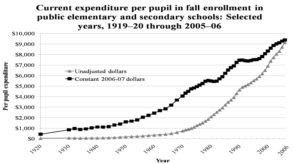
<p><em>Money</em>.  The political system, whatever its other possible deficiencies, has seen fit to provide schools with money.  Graphic #4 below (the first 3 graphics appear in <a href="http://educationnext.org/appraising-education-reform-part-1-a-failed-system/">the first installment of my analysis</a>) displays the century-long history of per pupil school funding in the United States.  For a hundred years there has been a sustained flow of additional money each year (on a per pupil basis) to America’s schools.  It is difficult to say that the funding is sufficient.  Determining what is needed financially for schools to achieve a particular set of instructional goals is a remarkably complicated topic, too extensive and arcane to be treated here.  However, the overarching picture is that America has funded its schools well&#8211;indeed, better than any other major nation in the world.  The financial costs of supporting the day-to-day operation of a stagnant school system have doubled in the past forty years.</p>
<div id="attachment_496323" class="wp-caption alignnone" style="width: 437px"><a href="http://educationnext.org/files/Graphic4.jpg"><img class="size-full wp-image-49632306 " src="http://educationnext.org/files/Graphic4.jpg" alt="Graphic4" width="427" height="234" /></a><p class="wp-caption-text">Graphic #4</p></div>
<p><span style="text-decoration: underline"> </span></p>
<p><em>Personnel</em>.  One might ask to what end the money has been put. The overwhelming answer is that it has been deployed to buy the time of people.<span style="text-decoration: underline"> </span></p>
<p>Graphic #5 below displays the steady improvement in the ratio of education professionals to pupils over the past quarter century</p>
<div id="attachment_496323" class="wp-caption alignnone" style="width: 450px"><a href="http://educationnext.org/files/Graphic5.jpg"><img class="size-full wp-image-49632307 " src="http://educationnext.org/files/Graphic5.jpg" alt="Graphic5" width="440" height="247" /></a><p class="wp-caption-text">Graphic #5</p></div>
<p><span style="text-decoration: underline"> </span></p>
<p><span style="text-decoration: underline">Nor Does Policy System Neglect Appear as a Core Problem</span></p>
<p>The past quarter century has seen cycle after cycle of policy system attention to school reform.  Education reform has been an incessant state and federal drumbeat.</p>
<p><em>A Nation at Risk.</em> The American education system’s loudest wakeup call in modern times was issued by the 1983 published report, <a href="http://www.ed.gov/pubs/NatAtRisk/index.html">A Nation at Risk</a>.<a href="#ftn2">[2]</a> Seldom has a blue ribbon report been more factually inaccurate, yet responsible for accomplishing so much good. The report’s principal theme was the lax instructional standards and low levels of academic performance of American schools, which was leading students to fall behind the foreign competition.  No persuasive evidence was provided that schools were performing any worse than they had ever been. Shortly after the report’s release, the vaunted economies of Japan, Germany, and France, nations to whom it was feared the United States would be imminently subjugated, began to wither. They have yet to recover.</p>
<p>Despite its factual inaccuracies and rhetorical hyperbole, <a href="http://www.ed.gov/pubs/NatAtRisk/index.html">A Nation at Risk</a> served an important function.  It alerted the United States to the altered competitive world then dawning outside its borders and the need to remake the nation’s education system to stay abreast of the forthcoming changes.  Moreover, the report bore reform fruit.</p>
<p>Immediately after its release, and following President Reagan’s enthusiastic endorsement of its message, policymakers throughout the states leapt into action. Virtually any reform that could be implemented without facing significant political opposition was conceived and enacted.  Intensified high school graduation standards, higher college admission standards, fewer secondary school electives, better textbooks, more required math and science courses, more Advanced Placement courses, “No Pass No Play rules,” and the re-invention of international tests for comparative purposes all came about.</p>
<p>The U.S Department of Education’s Office of Educational Research and Improvement (OERI)<a href="#ftn3">[3]</a> instituted a regular report labeled the “Wall Chart” that chronicled the progress of states toward higher academic standards. <a href="http://www.edweek.org/ew/index.html">Education Week</a>, the nation’s most widely circulated K-12 education publication, annually printed special reform status reports on which states were given grades for their progress toward reform on dimensions such as instructional standards, accountability mechanisms, uses of technology, rigorous teacher training, and levels of school funding.</p>
<p>A Nation at Risk prompted the harvesting of low-hanging reform fruit.  It did not, however, foster careful re-examination of the education system.  Its changes were incremental and seldom directed at core issues of low performance objectives for students, lack of accurate measurement of progress, concern for historically underperforming minority students, and the absence of effective accountability for schools and systems that failed to perform well.</p>
<p><em>No Child Left Behind.</em> These more fundamental conditions were left untouched until the enactment, in 2002, of <a href="http://www.ed.gov/nclb/landing.jhtml">No Child Left Behind Act</a> (NCLB).<a href="#ftn4">[4]</a> This federal government action was groundbreaking in that it altered the paradigm regarding school performance measurement.  The new criteria were outcomes, not inputs, the latter having been the ineffective coin of the accountability realm for much of the history of American education.  With NCLB, outcomes mattered; there could be consequences for persistently low performing schools.  Additionally, NCLB did not only require the measurement of student achievement, but, in a path-breaking manner, required additional metrics for conventionally underserved minority group students.</p>
<p><span style="text-decoration: underline">Plentiful Academic Attention, Research, Philanthropy, and Advocacy </span></p>
<p><span style="text-decoration: underline"> </span></p>
<p>Education reform has spawned a “Fifth Estate,” a specialized industry comprised of academic researchers, publicists, media experts, evaluators and policy analysts, lobbyists, interest group advocates, and big-money profit-seeking corporations who have evolved to serve the education reform effort.</p>
<p><em>Academic Attention</em>. A Google search reveals more than a half million articles and reports directed at contemporary education reform.  Other than the economy and combined facets of the war against terrorism, few other topics can match this volume.  This massive amount of writing occupies a spectrum of intellectual respectability ranging from pathbreaking reform ideas such as those put forth by Michael Smith and Jennifer O’Day<a href="#ftn5">[5]</a> to abject junk science.  In between are literally hundreds of serious, empirically based studies, many funded by the Institute of Education Sciences, that offer experimental and quasi- experimental research results to steer serious school reformers.</p>
<p><em>Research and Philanthropy.</em> The federal government’s Institute of Education Sciences has funneled more than a billion dollars into seriously conceived education reform research studies since 2002 alone.  This amount has been matched by large philanthropic foundations such as Gates, Ford, Carnegie, Spencer, Wallace, Ball, and Rockefeller, and hundreds of smaller and more local foundations, who have invested in reform research studies and pilot projects.</p>
<p><em>Advocacy.</em> Literally hundreds of advocacy groups, consulting firms, lobbying organizations, and think tanks now focus on education reform.  Some of these, organizations such as RAND, Mathematica, and the National Research Council, represent the finest of independent thought and rigorous analytic standards.  Others are but Potemkin Villages, holding companies established by self-serving and self-protective advocacy groups.  A cottage industry has evolved made up of for-profit and nonprofit companies established simply to undertake contract evaluations of education reform projects funded by the federal government.</p>
<p>With the exception of health and medicine, it is unlikely that any other public sector endeavor outflanks education reform as a center of gravity for research and advocacy action.</p>
<hr size="1" />
<p><a name="ftn1">[1]</a> Indeed, there is so little dissent from the view that reform is needed that those who defend the status quo are noteworthy.  Over the past quarter century, only two major apologists for the existing system have emerged, Arizona State Professor David Berliner and, now deceased, Phi Delta Kappan columnist, professional contrarian, and intellectual gadfly, Gerald Bracey.  See for example, <span style="text-decoration: underline">The Manufactured Crisis</span>, Carnegie Forum on Education and the Economy (1986).  Charles W. Fisher &amp; David C. Berliner (Eds.) and <em>Setting the Record Straight: Responses to Misconceptions About Public Education in America</em>, Association for Supervision and Curriculum Development, Washington D.C., 1997.</p>
<p><a name="ftn2">[2]</a> National Commission on Excellence in Education, “A Nation At Risk”, U.S. Department of Education, 1983.</p>
<p><a name="ftn3">[3]</a> Made a part of the Institute of Education Sciences (IES) by the 2002 Education Sciences Reform Act.</p>
<p><a name="ftn4">[4]</a> The No Child Left Behind Act of 2001 (Pub.L. 107-110, 115 Stat. 1425, enacted January 8, 2002)</p>
<p><a name="ftn5">[5]</a> Smith, Marshall S., and Jennifer O&#8217;Day. &#8220;Systemic School Reform.&#8221; in <em>The Politics of Curriculum and Testing</em>:<em> The 1990 Yearbook of the Politics of Education Association.</em> Eds. Susan Fuhrman and Betty Malen. New York: Falmer Press, 1991</p>
<img src="http://educationnext.org/?ak_action=api_record_view&id=49632302&type=feed" alt="" />]]></content:encoded>
			<wfw:commentRss>http://educationnext.org/appraising-education-reform-part-2-has-reform-been-genuine/feed/</wfw:commentRss>
		<slash:comments>0</slash:comments>
		</item>
		<item>
		<title>Appraising Education Reform, Part 1: A Failed System</title>
		<link>http://educationnext.org/appraising-education-reform-part-1-a-failed-system/</link>
		<comments>http://educationnext.org/appraising-education-reform-part-1-a-failed-system/#comments</comments>
		<pubDate>Mon, 04 Jan 2010 20:05:32 +0000</pubDate>
		<dc:creator>James Guthrie</dc:creator>
				<category><![CDATA[Blog]]></category>
		<category><![CDATA[Editorial]]></category>
		<category><![CDATA[contemporary efforts at education reform]]></category>
		<category><![CDATA[globalization]]></category>

		<guid isPermaLink="false">http://educationnext.org/?p=49632203</guid>
		<description><![CDATA[The end of the decade has inspired me to reflect on contemporary efforts at education reform in the U.S., and to suggest next steps. This blog entry, in which I review the evidence of failure of our education system and explain the challenge created by rapid globalization, is the first part of what will ultimately be a 3-part series.]]></description>
			<content:encoded><![CDATA[<p><strong>The end of the decade has inspired me to reflect on contemporary efforts at education reform in the U.S., and to suggest next steps. This blog entry, in which I review the evidence of failure of our education system and explain the challenge created by rapid globalization, is the first part of what will ultimately be a 3-part series. </strong></p>
<p>American K-12 schools, colleges, and universities underwent their formative development in earlier eras.  They matured in a time devoid of intense international competition, a time when a nation’s power was principally derived from what it could grow and extract from the ground, a time when human knowledge expanded incrementally, not exponentially, a time when individual creativity was subordinate to collective activity, and a time when most individuals prepared for life-long careers, and felt no need continually to reinvent oneself.</p>
<p>America’s historic education system was ahead of its time and has served the nation well. The nation formerly prospered and became a world power by relying upon the talents of an educated elite, a remarkably well-schooled, if slender, cadre of individuals who operated government, staffed colleges and universities, captained industry, and led the military.  In those times, a young man could fail to finish school, obtain a well-paying manufacturing job, marry his childhood sweetheart, and confidently pursue the American Dream.</p>
<p>Little of such a comforting convention continues.  The economy and the surrounding society have changed, and the change has occurred in a rapid and often disquieting manner.  Whereas historic cultural shifts from hunting-and-gathering to agriculture and from agriculture to industrialism took hundreds or thousands of years, evolution from an industrial to a modern informational society has occurred in the blink of a historian’s eye.</p>
<p>Now, and for the foreseeable future, the path to collective and individual wellbeing travels crucially through education, a modern education.  If an individual fails to graduate from high school or attend college, he or she may suffer financially, and in other ways as well, and the nation’s human resources and general welfare surely are diminished as a consequence.</p>
<p align="center"><strong>American Schools Not Yet Able Fully to Address This Challenge</strong></p>
<p>A modern nation’s competitive advantage, and its most likely source of citizen satisfaction, is the schooled minds of its people.  This poses a daunting problem.  No large nation has ever before faced the challenge of educating virtually its entire population to a high standard.  This is uncharted territory. There is much regarding human learning, instruction, and schooling that is not now known and which must be determined.</p>
<p>America’s schools, even in the face of a high degree of uncertainty regarding proven methods, have genuinely grappled over the past quarter-century with the aforementioned fundamental societal shift and the need to create a new operational posture.  Virtually all the low-hanging reform fruit has already been harvested.  If a sensible reform could be enacted without significant political opposition (e.g., elevating high school graduation standards, restricting elective courses, and improving the rigor of textbooks) then it has generally been accomplished.  However, even after more than a quarter century of engagement with education reform, changes in the nation’s schools have not yet enabled the system to surmount the challenges it faces.</p>
<p>The following selected graphics illustrate the inability of schools to meet higher academic expectations.  Whether the metric is achievement in mathematics or reading, high school graduation, or college success, the education system’s results have been flat for four decades.</p>
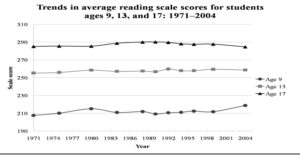
<p>Graphic #1A below displays national trends in reading since 1971.</p>
<div id="attachment_496322" class="wp-caption alignnone" style="width: 450px"><a title="Graphic #1A" href="http://educationnext.org/files/Guthrie1A.jpg"><img class="size-full wp-image-49632206 " src="http://educationnext.org/files/Guthrie1A.jpg" alt="Guthrie1A" width="440" height="227" /></a><p class="wp-caption-text">Graphic #1A</p></div>
<p style="padding-left: 30px;text-align: center">
<p>Graphic #1B displays mathematics achievement over the same time period.</p>
<div id="attachment_496322" class="wp-caption alignnone" style="width: 380px"><a href="http://educationnext.org/files/Guthrie1B.jpg"><img class="size-full wp-image-49632208 " src="http://educationnext.org/files/Guthrie1B.jpg" alt="Guthrie1B" width="370" height="269" /></a><p class="wp-caption-text">Graphic #2A</p></div>
<p>Graphic #2 below displays high school graduation data. Here one can see, with seventeen year olds for example, that the proportion of this age cohort graduating from high school has not changed since the early 1970s.</p>
<div id="attachment_496322" class="wp-caption alignnone" style="width: 387px"><a href="http://educationnext.org/files/Guthrie2.jpg"><img class="size-full wp-image-49632207 " src="http://educationnext.org/files/Guthrie2.jpg" alt="Guthrie2" width="377" height="277" /></a><p class="wp-caption-text">Graphic #2</p></div>
<p>Graphic #3 below makes clear that matters in higher education are little better, possibly worse.</p>
<div id="attachment_496322" class="wp-caption alignnone" style="width: 385px"><a href="http://educationnext.org/files/Guthrie3.jpg"><img class="size-full wp-image-49632209 " src="http://educationnext.org/files/Guthrie3.jpg" alt="Guthrie3" width="375" height="239" /></a><p class="wp-caption-text">Graphic #3</p></div>
<p>The next installment of my appraisal of education reform will demonstrate that the above-documented failure is not a consequence of failing to try.  The nation has, in fact, made a sustained and resource-filled effort to render schools more effective.</p>
<img src="http://educationnext.org/?ak_action=api_record_view&id=49632203&type=feed" alt="" />]]></content:encoded>
			<wfw:commentRss>http://educationnext.org/appraising-education-reform-part-1-a-failed-system/feed/</wfw:commentRss>
		<slash:comments>3</slash:comments>
		</item>
		<item>
		<title>Do Teachers Need Extrinsic Rewards like Performance Pay?</title>
		<link>http://educationnext.org/do-teachers-need-extrinsic-rewards-like-performance-pay/</link>
		<comments>http://educationnext.org/do-teachers-need-extrinsic-rewards-like-performance-pay/#comments</comments>
		<pubDate>Tue, 22 Dec 2009 17:09:36 +0000</pubDate>
		<dc:creator>James Guthrie</dc:creator>
				<category><![CDATA[Blog]]></category>
		<category><![CDATA[Editorial]]></category>
		<category><![CDATA[African-American]]></category>
		<category><![CDATA[Dan Reschly]]></category>
		<category><![CDATA[David Chard]]></category>
		<category><![CDATA[educator performance pay]]></category>
		<category><![CDATA[NAEP]]></category>
		<category><![CDATA[National Center on Performance Incentives]]></category>
		<category><![CDATA[NCPI]]></category>
		<category><![CDATA[Richard Rothstein]]></category>
		<category><![CDATA[Ted Hasselbring]]></category>

		<guid isPermaLink="false">http://educationnext.org/?p=49632142</guid>
		<description><![CDATA[Richard Rothstein recently posed an interesting question.  He asked, in effect, “why do performance pay advocates assume teachers need added motivation?  Is there not evidence already that they are motivated?” As support for his position that teachers, generally, are motivated, Richard referred to gains in the fourth grade mathematics scores on NAEP for African American youngsters. In thinking about Richard’s postulate, I consulted with a number of the nation’s experts regarding reading and mathematics instruction. The general consensus is that the rise in NAEP math scores for African American students provides virtually no support for this contention.]]></description>
			<content:encoded><![CDATA[<p>Richard Rothstein is among the most responsible skeptics when it comes to educator performance pay.  In a taping for a forthcoming PBS television show on performance pay, he posed an interesting question.  He asked, in effect, “why do performance pay advocates assume teachers need added motivation?  Is there not evidence already that they are motivated?”</p>
<p>As support for his position that teachers, generally, are motivated, Richard referred to gains in the fourth grade mathematics scores on NAEP for African American youngsters. He points out, quite correctly, that these scores have increased over time.  Even though the achievement gap has not narrowed—black youngsters now score on NAEP where white fourth graders did several decades ago— are not the black student achievement gains evidence that, when teachers know what to do, they do it?</p>
<p>In thinking about Richard’s postulate, I consulted with a number of the nation’s experts regarding reading and mathematics instruction (e.g., Ted Hasselbring, Dan Reschly, and David Chard).</p>
<p>The general consensus (and I will provide some of the details below) is that the rise in NAEP math scores for African American students provides virtually no support for the contention that teachers “do the right thing when they know what is right, and do not need extrinsic incentives to do it.”</p>
<p>If anything, it may be the other way around.  Teachers may badly need extrinsic incentives, in addition to information, to do the right thing, even when the right thing is well known.</p>
<p>Let me first address some possible explanations for the math gains demonstrated by African-American students.</p>
<p>The big point here is that presently, no one knows why these gains have occurred. We are all pleased that they have occurred, but no one has studied the effect sufficiently to offer an empirical analysis.</p>
<p>There are several prominent hypotheses.</p>
<p>Given the long-standing and wide gap between white and black student mathematics scores, the NAEP gain may represent nothing more than regression to the mean.</p>
<p>Recent improvements in mathematics standards may have contributed significantly to the ability of black students to score higher.  The mathematics curriculum, as expressed in state guidelines, textbooks, student workbooks, and teacher guides, has been modified to make more sense, and this alteration may place math instruction closer to what NAEP tests are measuring, irrespective of what teachers are doing.</p>
<p>If this latter hypothesis should ever be proven correct, it would testify to the efficacy of a standards-based strategy for raising student achievement.</p>
<p>Mathematics is less culturally dependent than is reading.  Both reading and mathematics require our brain to create new neural patterns. (We are not born with these pathways.) In reading, the 26 human-invented squiggles we label letters, and the 44 sounds associated with them, must be learned.  However, once the letters and sounds are learned, there is still an enormous world of meaning—culturally determined meaning—that a child must acquire in order to read.  Possibly one percent of children can acquire this comprehension on their own, but most need instruction to get there.  The less rich a child’s cultural milieu, the longer it may take to acquire reading comprehension skills, because there is such a great deal of culture to be learned also.</p>
<p>Mathematics, conversely, has a far greater internal logic that permits an individual to advance in skill without being completely stymied by deficits in cultural awareness.</p>
<p>Because low-income African-American youngsters often have less of an opportunity than middle-class children to acquire cultural awareness, when motivated they may learn math faster than they learn reading, absent any consideration of teacher effectiveness.</p>
<p>Here is a second point.  I am responsibly informed that there is a great deal more known about how to teach reading, to all kinds of students, than is known about how to teach mathematics.  If teachers will simply “do the right thing” in the absence of extrinsic inducement, why are NAEP reading scores stagnant?</p>
<p>Perhaps the answer to the foregoing question is that teachers do not have sufficient professional development activities on what is known about effective reading instruction. Possibly, but this path also seems fraught with complexity.  The most significant IES piece of research on this suggests that professional development presently has little or no effect on reading instruction and achievement.  (See <a href="http://ies.ed.gov/ncee/pubs/20084030/">The Impact of Two Professional Development Interventions on Early Reading Instruction and Achievement</a>.)</p>
<p>This is a controversial finding, and experts question the degree of implementation fidelity in the studies involved.  However, it just may be that professional development is more effective when operating in tandem with extrinsic incentives.  Here is a quote from one of the emails from experts I received when exploring Richard’s question:</p>
<p>Massive professional development without incentives (and these may or may not be financial) doesn&#8217;t seem to be sufficient. This question puts me in mind of the DESSI work done by Huberman and Miles in the 70s and 80s.  Particularly in the area of innovation.  I recall they talked about how we might have to take the &#8220;low road&#8221; to convince people to do things differently (this might involve sufficient motivation positive or negative) that, in turn, will lead to positive outcomes and will help teachers see why they were persuaded to do it in the first place.  Conversely, incentives without knowledge would also seem shortsighted.</p>
<p>Of course, I do not have evidence one way or another regarding the issue of extrinsic incentives, but that is one reason why the <a href="http://www.performanceincentives.org/research/mnps.asp">upcoming release</a> this spring of experimental results from the National Center on Performance Incentives (NCPI) is so important.  The NCPI is conducting a randomized field trial in which teachers in the treatment group (who are all middle school math teachers in Nashville) will receive bonuses based on student achievement gains. The extrinsic incentives involved in this experiment are big ones.  We may know more then than now.</p>
<p>Meanwhile, I want to thank Richard for elevating the issue because I never otherwise would have thought about it so much or learned so much from others.</p>
<img src="http://educationnext.org/?ak_action=api_record_view&id=49632142&type=feed" alt="" />]]></content:encoded>
			<wfw:commentRss>http://educationnext.org/do-teachers-need-extrinsic-rewards-like-performance-pay/feed/</wfw:commentRss>
		<slash:comments>3</slash:comments>
		</item>
		<item>
		<title>Think Education Spending Will Decline? Think Again</title>
		<link>http://educationnext.org/think-education-spending-will-decline-think-again/</link>
		<comments>http://educationnext.org/think-education-spending-will-decline-think-again/#comments</comments>
		<pubDate>Thu, 05 Nov 2009 15:01:49 +0000</pubDate>
		<dc:creator>James Guthrie</dc:creator>
				<category><![CDATA[Blog]]></category>
		<category><![CDATA[Editorial]]></category>
		<category><![CDATA[American Recovery and Reinvestment Act]]></category>
		<category><![CDATA[ARRA]]></category>
		<category><![CDATA[Arthur Peng]]></category>
		<category><![CDATA[NAEP]]></category>
		<category><![CDATA[National Assessment of Educational Progress]]></category>
		<category><![CDATA[per pupil spending]]></category>
		<category><![CDATA[school districts]]></category>
		<category><![CDATA[teacher salaries]]></category>
		<category><![CDATA[The Phony Funding Crisis]]></category>

		<guid isPermaLink="false">http://educationnext.org/?p=49631085</guid>
		<description><![CDATA[America’s schools have always been well funded, despite the claims of school funding advocates who persistently assert that the nation shortchanges its students. That’s the most basic point of “The Phony Funding Crisis,”an article by myself and Arthur Peng that Education Next published on its website today.]]></description>
			<content:encoded><![CDATA[<p>America’s schools have always been well funded, despite the claims of school funding advocates who persistently assert that the nation shortchanges its students. That’s the most basic point of “<a href="http://educationnext.org/the-phony-funding-crisis/">The Phony Funding Crisis</a>,”an article by myself and Arthur Peng that Education Next published on its website today.</p>
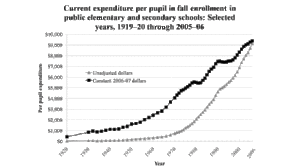
<p>As shown in the figure below, per pupil spending has increased in every year for the last century, even when controlled for inflation.  (There have been small exceptions, such as during the Great Depression and the early years of the Reagan Administration.)  Otherwise, the climb in adjusted per pupil spending has been steady, and even the above-noted plateaus did not involve decreased spending.</p>
<div id="attachment_496310" class="wp-caption alignnone" style="width: 444px"><a title="Figure 1" href="http://educationnext.org/files/GuthrieFig1.gif"><img class="size-full wp-image-49631086    " src="http://educationnext.org/files/GuthrieFig1.gif" alt="GuthrieFig1" width="434" height="243" /></a><p class="wp-caption-text">Figure 1</p></div>
<p>The ready availability of money has enabled school districts vastly to increase their supply of professional employees.</p>
<div id="attachment_496310" class="wp-caption alignnone" style="width: 443px"><a href="http://educationnext.org/files/GuthrieFig2.gif"><img class="size-full wp-image-49631087   " src="http://educationnext.org/files/GuthrieFig2.gif" alt="GuthrieFig2" width="433" height="243" /></a><p class="wp-caption-text">Figure 2</p></div>
<p>Even the salaries of teachers have benefited, though not as much recently as in the past.</p>
<div id="attachment_496310" class="wp-caption alignnone" style="width: 443px"><a href="http://educationnext.org/files/GuthrieFig3.gif"><img class="size-full wp-image-49631088   " src="http://educationnext.org/files/GuthrieFig3.gif" alt="GuthrieFig3" width="433" height="243" /></a><p class="wp-caption-text">Figure 3</p></div>
<p>These changes have taken place, more money, more teachers, and more purchasing power for teachers, and student achievement has remained stagnant.</p>
<p>Reading scores on the National Assessment of Educational Progress (NAEP) have been level for four decades. And, for a half century, nearly one-third of the nation’s high-school students have failed to graduate with their class each year, while graduation rates for black and Hispanic students are even lower.</p>
<p>As we highlighted in the <a href="http://educationnext.org/fueled-by-federal-stimulus-package-education-spending-will-likely-increase-over-next-decade-despite-lack-of-achievement-gains-for-students/">Education Next media advisory</a> released today:</p>
<p>Even in the current recession, it appears that schools will be protected.  The American Recovery and Reinvestment Act (ARRA) has increased the federal government’s contribution to public education from approximately 9 percent each year to approximately 15 percent.</p>
<p>As recent news reports have detailed, over half of the jobs created or saved by the federal stimulus package (325,000 out of 640,000 jobs) have been in public education.</p>
<p>All this federal support, however, could contribute to an even higher trajectory for future spending on public education than has been the case in the past, regardless of the diminishing returns in terms of student outcomes. Based on historic spending trends and estimating that the federal government’s stimulus contribution will grow to approximately $90 billion, we project that national per pupil revenues could increase at a rate of nearly 2.5 percent annually over the next ten years.</p>
<p>The $37 billion in the stimulus package that is intended to offset reduced state and local education revenues, which were down 4.6 percent for the first quarter of 2009, will cushion what would otherwise have been the first significant per-pupil spending reduction in 60 years.</p>
<p>Persistent claims that school districts are in fiscal jeopardy, often reported by the media, are misleading, driven by the fact that school-district budget cycles aren’t synchronized with state and federal legislative appropriations processes. Because it is increasingly rare for legislative bodies to enact spending bills before the beginning of the fiscal year on July 1, school districts, worried about their financial vulnerability and needing to comply with personnel notification deadlines (usually in April or May), issue layoff notices and hold mandatory public hearings, even if the probability of actual personnel layoffs is slender. Such public threats trigger a media frenzy, alarm employees and parent advocates, and fuel the public perception that schools are in financial risk.</p>
<p>Public education revenue has been insulated from the direct effects of economic ups and downs by a number of politically constructed conditions, including a privileged legal status in most state constitutions, multiple state and federal revenue sources, and stable tax support, such as property taxes, at the local level. In most states, too, education employee unions have locked in extended labor contracts, often bridging or outlasting economic recessions, which effectively counter any threat to revenue levels. Additionally, the misguided practice of using spending amounts as a measure of school quality has helped protect local school-funding levels from any effort to reasonably adjust them.</p>
<img src="http://educationnext.org/?ak_action=api_record_view&id=49631085&type=feed" alt="" />]]></content:encoded>
			<wfw:commentRss>http://educationnext.org/think-education-spending-will-decline-think-again/feed/</wfw:commentRss>
		<slash:comments>1</slash:comments>
		</item>
		<item>
		<title>The Phony Funding Crisis</title>
		<link>http://educationnext.org/the-phony-funding-crisis/</link>
		<comments>http://educationnext.org/the-phony-funding-crisis/#comments</comments>
		<pubDate>Thu, 05 Nov 2009 09:00:04 +0000</pubDate>
		<dc:creator>James Guthrie</dc:creator>
				<category><![CDATA[Features]]></category>
		<category><![CDATA[Homepage]]></category>
		<category><![CDATA[On Top of the News]]></category>
		<category><![CDATA[School Spending]]></category>
		<category><![CDATA[American Recovery and Reinvestment Act]]></category>
		<category><![CDATA[ARRA]]></category>
		<category><![CDATA[NAEP]]></category>
		<category><![CDATA[National Assessment of Educational Progress]]></category>
		<category><![CDATA[per pupil spending]]></category>
		<category><![CDATA[school districts]]></category>
		<category><![CDATA[teacher salaries]]></category>

		<guid isPermaLink="false">http://educationnext.org/?p=49631043</guid>
		<description><![CDATA[Even in the worst of times, schools have money to spend]]></description>
			<content:encoded><![CDATA[<p><a href="http://educationnext.org/files/20101_12_opener.gif"><img style="float: right;padding-top: 5px;padding-bottom: 5px;padding-left: 5px" src="http://educationnext.org/files/20101_12_open.gif" alt="20101_12_open" width="320" height="407" /></a>Chicken Little is alive and seemingly employed as a finance analyst or reporter for an education interest group. If one relies on newspaper headlines for education funding information, one might conclude that America’s schools suffer from a perpetual fiscal crisis, every year perched precariously on the brink of financial ruin, never knowing whether there will be sufficient funding to continue operating. Budgetary shortfalls, school district bankruptcies, teacher and administrator layoffs, hiring and salary freezes, pension system defaults, shorter school years, ever-larger classes, faculty furloughs, fewer course electives, reduced field trips, foregone or curtailed athletics, outdated textbooks, teachers having to make do with fewer supplies, cuts in school maintenance, and other tales of fiscal woe inevitably captivate the news media, particularly during the late-spring and summer budget and appropriations seasons.</p>
<p>Yet somehow, as the budget-planning cycle concludes and schools open their doors in the late summer and fall, virtually all classrooms have instructors, teachers receive their paychecks and use their health plans, athletic teams play, and textbooks are distributed. Regrettably, this story is seldom accorded the same media attention as are the prospects of budget reductions and teacher layoffs.</p>
<p>For a variety of reasons, from one year to the next, schools almost always have more real revenue for each of their enrolled students. For the past hundred years, with rare and short exceptions and after controlling for inflation, public schools have had both more money and more employees per student in each succeeding year. Teacher salaries have increased more than 42 percent in constant dollars over the past half century, while educators’ working conditions, health plans, and retirement arrangements have become ever more commodious. Moreover, school-related revenues and employment levels have increased even when the economy (as measured by Gross Domestic Product or GDP) turned down, unlike what typically happens in sectors such as manufacturing and retail sales, where recessions trigger cutbacks in personnel and profits.</p>
<p>Now, local school funding is apparently more secure than ever before. For the first time in history, the federal government has assumed a dramatic new school-funding role, that of banker of last resort, providing stopgap revenues to the nation’s schools during economic downturns. The Obama administration’s unprecedented injection of billions in federal funding for schools likely ensures that education’s resource cushion will continue for at least the current downturn and possibly for much longer. The notion that the federal government should serve as a fiscal flywheel for schools would have come as a major surprise to lawmakers even during the 1960s’ high point of federal funding for schools.</p>
<p><strong>A Bigger (and Brighter) Backdrop</strong></p>
<p>It is true that occasionally school districts become insolvent and states have to step in and take over. California had a string of costly and highly visible instances in the recent past, with the state having to elbow locally elected school boards aside and install all-powerful administrative overseers in large districts such as Oakland and Richmond. Detroit is the poster child for similar activity in the Midwest (see sidebar). School district insolvencies are rare and most often the result of administrative or school board mismanagement and malfeasance, rather than from the consequence of diminished revenues and systematic budget cuts.</p>
<div id="sidebar">
<p><strong>Another Detroit Deficit</strong></p>
<p>A century ago the Detroit Public Schools were among the nation’s leading educational institutions; they now teeter on the edge of oblivion. Enrollments have dwindled to 93,000, roughly half of their 2001 level, as parents have moved or enrolled their children in charter schools. Only 58 percent of enrollees graduate from high school; only</p>
<p>25 percent of 9th graders graduate four years later. Student standardized test scores are among the lowest in Michigan. A Council of Great City Schools report found deficiencies in instruction, data, accounting—the list goes on. The district has 100 vacant schools on its property rolls. The FBI has targeted a school district payroll manager for allegedly embezzling $400,000. When Detroit school employees were asked to pick up paychecks in person, 257 checks were never claimed, presumably made out to ghost employees. A recent audit found staggering waste, from unused vehicles and electronic equipment to health coverage costs for ineligible dependents. In 2002, the Detroit Public Schools had a $103.6 million surplus. Now the district faces a deficit of $259 million and is  contemplating filing for bankruptcy protection, a rare occurrence in the history of American public education. More than 2,000 layoffs and 29 school closures have done little to narrow the gap. The district is scheduled to receive $149 million in federal stimulus funds, but only $11 million of this can go toward reducing the deficit.</p>
</div>
<p><a href="http://educationnext.org/files/20101_12_fig11.gif"><img class="alignright size-full wp-image-49631065" style="float: right;padding-top: 15px;padding-bottom: 5px;padding-left: 5px" src="http://educationnext.org/files/20101_12_fig11.gif" alt="20101_12_fig1" width="336" height="424" /></a><br />
Nationally, America’s school-district revenues have long been on an upward trajectory (see Figure 1). Since 1929, per-pupil spending has declined only four times and significantly only twice, once during the Great Depression and once in the midst of World War II. There have been 11 periods during which GDP declined but mean total real per-pupil revenues still increased. The number of employees, teachers, administrators, and others has continually increased for four decades, except for the early 1980s period of declining enrollment and recession. And pupil-teacher ratios have fallen by almost 50 percent due to investments in class-size reduction and an increase in the number of teachers who are not assigned to full classrooms (see Figure 2).</p>
<p><a href="http://educationnext.org/files/20101_12_fig2.gif"><img class="alignright size-full wp-image-49631054" style="float: right;padding-top: 5px;padding-bottom: 5px;padding-left: 5px" src="http://educationnext.org/files/20101_12_fig2.gif" alt="20101_12_fig2" width="335" height="439" /></a></p>
<p><strong>How Is Education So Well Protected during Recessions?</strong></p>
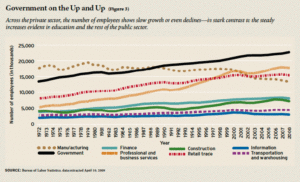
<p>Public schools have long been remarkably insulated from economic downturns. This becomes particularly clear when we compare employment trends in different economic sectors. Figure 3 displays historical (1972–2008) employment information in nine sectors: construction, finance, government, information, manufacturing, professional and business services, retail trade, transportation, and warehousing. Employment levels reflect economic conditions and, except for government (which includes elementary and secondary education), employment levels fluctuate with the economy and the historical trend is modestly upward. Contrast this picture with the much steeper upward slopes in education employment shown in Figure 2.</p>
<p>Unlike other employment sectors, education is protected from the direct effects of economic ups and downs by an interlocking and reciprocally reinforcing set of politically constructed conditions. Among these conditions are 1) education’s privileged legal status in most state constitutions; 2) schooling’s uniquely decentralized operation and diffuse revenue-generation structure; 3) local political dynamics and institutions that foster a favorable fiscal environment for public schools; 4) a multitiered structure for funding schools with complicated intergovernmental funding incentives and reliance on inelastic tax sources, such as property taxes at the local level. Almost no other economic endeavor enjoys such a spectrum of insulating conditions.</p>
<p><strong><em><a href="http://educationnext.org/files/20101_12_fig3.gif"><img class="alignright size-full wp-image-49631066" style="margin-left: 28px;margin-right: 28px;margin-bottom: 10px" src="http://educationnext.org/files/20101_12_fig3.gif" alt="20101_12_fig3" width="635" height="384" /></a></em></strong></p>
<p><strong><em>Constitutional Privilege.</em></strong> The United States Constitution is silent regarding education and schooling. This omission, taken in tandem with the Tenth Amendment’s reservation of unspecified powers to states and the people, and state-level constitutional provisions, renders education principally a state function. Moreover, state constitutions explicitly assume responsibility for provision of schooling.</p>
<p>State constitutional education clauses are generally of three kinds. They assign the legislature a responsibility for provision of an education system that is 1) “Thorough and Efficient,” 2) “General and Uniform,” or 3) the legislature’s “Paramount Duty.”</p>
<p>The precise language of the state constitution is not as important as the explicit specification of the state’s responsibility for providing education. Criminal justice, transportation, recreation, indigent care, economic development, commercial regulation, and even public safety are not privileged to the same degree. A state can decide to pursue or abolish numerous areas of government responsibility, such as support for prisons, highways, parks, and colleges, or welfare payments. It cannot decide to abandon its K–12 school system. Indeed, several states even have constitutional provisions that prevent less being spent on education in any one year than in a prior year.</p>
<p>Many state courts have made clear that education takes priority when it comes to appropriating funds. Adequacy cases decided in favor of plaintiffs in numerous states, such as Campbell County v. Wyoming, have emphasized that the state has a unique obligation to fund schools at high levels, even if other parts of the budget must suffer.</p>
<p><strong><em>Decentralized Operation.</em></strong> No modern nation has an education system that is more decentralized or multitiered than the United States. The consequence is that American school systems are buffered structurally and politically against resource competition with other state and local governmental services.</p>
<p>Conceived in the colonial period and evolving well into the 21st century, public education in the United States has relied on 50 distinct state systems that, in turn, delegate selected dimensions of operational authority to more than 13,000 local school districts. The majority of these local districts have property taxing authority; the rest rely on county or municipal governments to generate their share of local revenue.</p>
<p>Local school districts are overseen by boards of education. Most of these, 80 percent, are made up of elected members. The remainder of the boards are appointed by mayors, city councils, or other elected authorities. Regardless of membership selection procedures, these boards place education in a privileged position relative to those publicly provided services that depend on general governments for resources and must compete with other services for their share.</p>
<p><strong><em>Political Protection.</em></strong> General citizen apathy toward school spending and policy can be partially explained by the costs and effort required for active political participation. School policy and operational matters can be complicated. It takes a great deal of personal time to become informed regarding such issues as racial desegregation, charter schools, curriculum content, testing, graduation standards, geographic placement of a new school, and the configuration of attendance boundaries. These and other education-related issues affect parents and educators more than they do other citizens, particularly those citizens who do not have children enrolled in public school.</p>
<p>Hence, school district politics, including those surrounding funding issues and taxation, tend to be dominated by self-interested coalitions of parents and school district employees. For these constituents, the costs of becoming informed and actively participating in school district decisionmaking are low relative to the benefits to be gained. Employee-parent coalitions tend to dominate local school-board elections and ballot measures regarding school funding (see “<a href="http://educationnext.org/the-union-label-on-the-ballot-box/">The Union Label on the Ballot Box</a>,” research, Summer 2006). Their self-interest and favorable predisposition provide schools with political protection against budget cuts when the overall economy turns down.</p>
<p>Several other political elements favor school funding. District employees, those with the most direct interests in sustaining or elevating school spending, are frequently well organized politically. Employee groups can offer sympathetic candidates greater campaign resources than other school-related constituencies. Union members are probably the voters most predisposed to turn out at an election and to vote. These dynamics provide schools and school spending with local advocates who are politically sophisticated and well resourced for campaign purposes.</p>
<p>Opponents of increased school spending or higher taxes for schools can be mobilized and on occasion dominate an election. This was dramatized in the 1978 enactment of California’s famous tax-limitation provision, Proposition 13. Usually, however, incremental increases in proposed school budgets represent only a fractional addition to local property-tax rates. When property owners anticipate paying only a hundred or so additional dollars in the forthcoming year, they may be unwilling to make the effort needed to oppose the increase.</p>
<p>There is an additional political dynamic contributing to the preservation of local school-funding levels. A frequent metric, however misguided, for measuring school quality is the amount of money a district spends per pupil annually. Many posh suburbs actively compete on this dimension, proudly proclaiming their per-pupil-spending status ranking relative to competitor districts. Citizens, parents, and others who have purchased homes in such districts perceive the value of their property to be linked to high spending levels and accordingly acquiesce to advocates’ entreaties for more money.</p>
<p>Finally, in most states, education employee unions have the right to bargain with school boards and to embed collectively derived agreements regarding salaries and working conditions into legally enforceable multiyear contracts. These extended contracts, often bridging or outlasting economic recessions, act to buffer threatened revenue reductions.</p>
<p><a href="http://educationnext.org/files/20101_12_fig4.gif"><img class="alignright size-full wp-image-49631064" style="float: right;padding-top: 15px;padding-bottom: 5px;padding-left: 5px" src="http://educationnext.org/files/20101_12_fig4.gif" alt="20101_12_fig4" width="385" height="418" /></a></p>
<p><strong><em>Multiple Revenue Sources.</em></strong> Schools are highly resource dependent, but they are not dependent on a single source. The distribution of revenue-raising responsibility over federal, state, and local governments contributes to education revenue stability (see Figure 4).</p>
<p>Three trends of note can be discerned in this graphic. First, one can see that initially, local funds were the dominant source of district revenues, with states and the federal government being only minor partners. In most places, local district and municipal revenue has been generated through property taxation, and this arrangement has assisted in insulating schools from economic ups and downs. Property taxes are relatively inelastic when the economy swings up. It takes assessors two to three years to capture escalating property values and, thus, to give school districts the full measure of benefit from economic growth and housing inflation. However, this same inelasticity protects schools during economic downturns when property owners continue to pay those same taxes, even if their income is reduced, as assessors do not reduce property values in a timely manner.</p>
<p>The second trend began in the post–World War II era, as state funding supplanted and matched or slightly exceeded local revenues. This pattern resulted, at least partially, from the “equal protection” litigation movement launched in the 1970s, in which state courts determined that rectifying once-gaping spending inequalities between districts was the states’ responsibility. While remedies might have left local funding as the principal revenue source for schools, state legislatures chose instead to provide funding centrally from state coffers and to reduce the relative contribution of localities.</p>
<p>Even in the face of the current recession, state governments are raising taxes to cover deficits. This may actually reflect an additional explanation for how well schools have done in the past: States are required to have balanced budgets, so they raise taxes when times are tight and then keep the new rates when the money flows again. Local governments and school districts do not have the luxury of deficit spending.</p>
<p>Reliance on state funds is a double-edged sword, however. State revenues dampen interdistrict inequalities but, since they typically derive from sales and income taxes, these revenues are also more closely linked to economic fluctuation and more volatile than property tax receipts. Dependence on state funding also places education in a more competitive resource arena. Local school boards concern themselves, and focus their taxing authority, only on education issues. State legislatures, education’s privileged constitutional position notwithstanding, have to consider a far wider range of services and responsibilities in deciding who gets what.</p>
<p>The third trend pertains to the federal contribution. In 1965, the federal government launched its most significant education endeavor when the Johnson administration initiated the Elementary and Secondary Education Act (ESEA). Appropriations from this legislation pumped federal spending all the way up to 8 percent of total school revenues. The No Child Left Behind Act (NCLB) is the 2001 version of the ESEA. This statute did not dramatically increase federal funding for education, at least as a percentage of total revenue. It did, however, usher in a completely new era of accountability in education.</p>
<p>Prior to 2009, the highest historical rate of federal contribution to education had been 10 percent. The Obama administration’s economic stimulus plan ($44 billion for schools now flowing under the American Recovery and Reinvestment Act [ARRA] of 2009) dramatically alters this trajectory and contributes to a more evenly balanced revenue portfolio for schools. The federal government is becoming less and less a junior partner, and more and more an equal partner, in the tripartite American method of funding schools.</p>
<p><strong>Why the Ever-Present Fiscal Doom?</strong></p>
<p>If school revenues have enjoyed such remarkable stability, why the persistent appearance of fiscal calamity? One reason is that school-district budget cycles are imperfectly synchronized with state and federal legislative appropriations processes. The fiscal year for state and local governments routinely begins on July 1. It is increasingly rare for legislative bodies to enact spending bills much in advance of this date. School districts are legally obligated to have balanced budgets and cannot balance anticipated expenditures through deficit financing. As local school boards begin their winter and spring budget planning, they and their administrative officers perceive state and federal fiscal uncertainty and publicly discuss, as state “sunshine” statutes mandate, their contingencies for budget cutting.</p>
<p>Since some 80 percent of school-district budgets are absorbed in personnel costs, local school boards, when pressed fiscally, quite naturally give consideration to personnel cutbacks and salary freezes. State statutes make it necessary to inform school employees, usually in April or May, if there are to be layoffs. Sensing financial vulnerability and needing to comply with personnel notification deadlines, school districts issue layoff notices and hold mandatory public hearings, even if the probability of actual personnel layoffs is slender. Such public threats trigger a media frenzy, alarm employees and parent advocates, and exacerbate, yet again, the prevailing public perception that schools are headed for fiscally stringent times.</p>
<p>The likelihood of resource reductions is remote. However, it is a rare education reporter, teacher who receives a layoff notice (however unlikely to be acted upon), or parent who was expecting to have the highly regarded but layoff-vulnerable Ms. Jones for her 3rd-grade child in the fall, who sees the matter in historical perspective or with objectivity.</p>
<p><strong>What Has All This Money Produced? </strong></p>
<p>The ever-increasing cost of public education would engender less controversy if the product had improved apace. The United States expects much of its schools. Preparation for career, college, and citizenship; personal health and hygiene knowledge; racial and gender equity; leisure and aesthetic appreciation; social mobility; scientific sophistication; safe driving practice; and sex, alcohol, drug, reproductive, and environmental awareness are all part of the booming, buzzing, and sometimes antithetical public discourse that assigns purposes to the nation’s schools. Still, there are two fundamental dimensions on which schools must maximize performance in order to make progress toward all other desired education outcomes: 1) children learning to read and 2) students completing high school. Viewed longitudinally, America’s schools have not done well on these dimensions.</p>
<p>Reading scores on the National Assessment of Educational Progress (NAEP) have been level for four decades. Graduation rates, as recently calculated by economist and Nobel laureate James Heckman, display the same regrettable pattern as reading scores. For a half century, nearly one-third of the nation’s high-school students have failed to graduate with their class each year. That average masks much lower historical rates for black and Hispanic students than for white students. Many who do not graduate from high school subsequently obtain high-school equivalency credentials, such as the General Equivalency Diploma (GED). Still, more than 1 million adolescents each year have somehow not been retained by the nation’s schools.</p>
<p><strong>Will the Schools’ Fiscal Privilege Persist?</strong></p>
<p>If one were to place bets based on past evidence, the odds favor America’s public schools to operate next year with at least as much and probably with somewhat more money and a larger and (modestly) better-paid labor force than they had in 2009. The dramatic escalation of the federal government’s revenue contribution, to close to 15 percent of education’s national total, almost guarantees that mean per-pupil revenues will not decline in 2010.</p>
<p>There is no effort here to dispute the reality of the current recession. State and local tax receipts, heavily dependent on consumption and income, were down 4.6 percent for the first quarter of 2009 over the prior year. Still, per-pupil revenues will likely continue their historical upward trajectory. The unprecedented ARRA stimulus recovery allocation for education only strengthens this prediction.</p>
<p>Although the current economic crisis has several dimensions previously unseen—the pace at which employment and housing sectors crumbled, the speed at which credit disappeared, the intensified economic interdependence of global markets, and the stunning magnitude of plummeting personal and institutional wealth—the federal government’s monetary and fiscal recovery plans were enacted into policy with remarkable speed. Congressional willingness to subsidize the economy was never higher. And the international community coordinated stimulus spending as never before.</p>
<p>Also, during early April 2009, the U.S., European, and Asian stock markets seem to have bottomed out and turned up. Job losses, while continuing, are slowing. Nationwide unemployment, at 9.3 percent as of this writing, is still lower than at its post–World War II peak of 10 percent in the 1982 recession, and gives no indication of coming close to catastrophic Great Depression rates. In April 2009, prices of goods and services were down and consumer confidence unexpectedly climbed, modestly, upward.</p>
<p><a href="http://educationnext.org/files/20101_12_fig5.gif"><img class="alignright size-full wp-image-49631067" style="float: right;padding-top: 15px;padding-bottom: 5px;padding-left: 5px" src="http://educationnext.org/files/20101_12_fig5.gif" alt="20101_12_fig5" width="463" height="427" /></a></p>
<p>Balancing all these factors leads to the projections in Figure 5, which provide a bounded estimate of national total operating revenues per pupil through 2020. These high and low projections, based on 2006–07 dollar spending, are the result of calculating historical rates of least and greatest growth and applying those rates to create low and high projections until 2020. Specifically, the low projection, which would produce $9,519 in per-pupil spending in 2020, is based on an average growth rate of 0.1 percent, similar to the period from 1991 to 1996. The high projection, which would produce $13,208 in per-pupil spending in 2020, is based on an average growth rate of 2.45 percent, similar to the period from 1997 to 2004. (Readers should keep in mind that these figures are in 2006 dollars and the actual per-pupil dollar amounts in 2020 would be higher.)</p>
<p>The major assumption here is that the federal government’s stimulus contribution to K–12 schooling will approximate $90 billion. The $37 billion in the stimulus package that is intended to offset reduced state and local education revenue in 2009 will cushion what would otherwise likely have been the first significant per-pupil spending reduction in 60 years.</p>
<p><strong>A New Fiscal Stability</strong></p>
<p>Whether measured on a per-pupil basis or as a percentage of Gross Domestic Product, support for public schools is stronger in the United States than in most other nations. Moreover, this condition has persisted for many decades. A unique set of constitutional, structural, financial, and political arrangements ensures that school systems and professional educators are buffered from revenue losses when the economy declines. State rules surrounding local school-district budgeting procedures contribute to the opposite impression, making it appear that schools are in a perpetual financial crisis.</p>
<p>The 2009 ARRA stimulus package may portend an entirely new source of fiscal stability for America’s schools. When the economy turns down, the federal government may serve as the major fiscal backstop for public education.</p>
<p><em>James W. Guthrie is professor of public policy and education at Vanderbilt University and director of the Peabody Center for Education Policy, where Arthur Peng is research associate.</em></p>
<img src="http://educationnext.org/?ak_action=api_record_view&id=49631043&type=feed" alt="" />]]></content:encoded>
			<wfw:commentRss>http://educationnext.org/the-phony-funding-crisis/feed/</wfw:commentRss>
		<slash:comments>22</slash:comments>
		</item>
		<item>
		<title>The Decline of Ed Schools: Ten Questions and Answers</title>
		<link>http://educationnext.org/the-decline-of-ed-schools-ten-questions-and-answers/</link>
		<comments>http://educationnext.org/the-decline-of-ed-schools-ten-questions-and-answers/#comments</comments>
		<pubDate>Wed, 30 Sep 2009 15:08:07 +0000</pubDate>
		<dc:creator>James Guthrie</dc:creator>
				<category><![CDATA[Blog]]></category>
		<category><![CDATA[Editorial]]></category>
		<category><![CDATA[Teachers and Teaching]]></category>
		<category><![CDATA[Ed Schools]]></category>

		<guid isPermaLink="false">http://educationnext.org/?p=49629952</guid>
		<description><![CDATA[America does not now need education schools.  They add little and cost a great deal. They are unable to attract talented entrants and fail to add value to their graduates (either by boosting teacher performance or teacher’s lifetime incomes).]]></description>
			<content:encoded><![CDATA[<p><em>1. Does America need education schools?  Should steps be taken to defund or eliminate them?</em></p>
<p>America does not now need education schools.  They add little and cost a great deal. They are unable to attract talented entrants and fail to add value to their graduates (either by boosting teacher performance or teacher’s lifetime incomes).  Graduate students who attend them have to forego significant amounts of income. Today, ed schools face an increasing number of attractive, lower-priced, online competitors.<em> </em></p>
<p><em>2. </em><em>How many U.S. ed schools are currently operating? </em></p>
<p>U.S. News and World Reports estimates that in 2009 there are 278 education schools, 187 public and 91 private. (This may be a conservative number, as it omits those that failed to respond to questionnaires related to the rankings developed by U.S. News.)</p>
<p><em>3. </em><em>How many degrees do ed schools issue per year?</em></p>
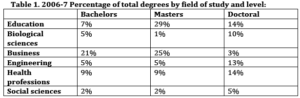
<p>A great many.  In 2007, almost 200,000 education degrees were awarded:105,641 bachelors degrees, 76,572 masters degrees, and 8, 261 doctoral degrees.  Masters and doctoral degrees in education meet or exceed all other categories of graduate degrees. (According to the National Center for Education Statistics, U.S. Department of Education)</p>
<p style="text-align: center"><a href="http://educationnext.org/files/Table11.gif"><img class="size-full wp-image-49629966 aligncenter" style="margin-right: 190px" src="http://educationnext.org/files/Table11.gif" alt="Table1" width="492" height="160" /></a></p>
<p><em>4. </em><em>How high are the academic skills of ed school students relative to those of other professionals?</em></p>
<p>Low.  The College Entrance Examination Board reports that students pursuing graduate degrees in education had a GRE Verbal score mean of 449 and a mean GRE Quantitative score of 533, for a combined total of 982. This puts ed school students at the 40th percentile of test takers, lower than students intending graduate study in all other professional fields (including business, engineering, and health).</p>
<p style="text-align: center"><a href="http://educationnext.org/files/Table2.gif"><img class="size-full wp-image-49629957 aligncenter" style="margin-right: 240px" src="http://educationnext.org/files/Table2.gif" alt="Table2" width="455" height="229" /></a></p>
<p style="text-align: center">
<p style="text-align: center"><a href="http://educationnext.org/files/Table3.gif"><img class="size-full wp-image-49629958 aligncenter" style="margin-right: 180px" src="http://educationnext.org/files/Table3.gif" alt="Table3" width="518" height="275" /></a></p>
<p><em>5. </em><em>What is the direct cost of ed school degrees to enrollees? What is the foregone income of enrollees? How much does it cost to operate education schools?</em></p>
<p>A conservative estimate of ed school tuition payments made annually is $1.283 billion. [This estimate assumes that three quarters of our nation’s 100,000 undergraduate ed school enrollees are paying in-state public college and university tuition and related fees of $10,260, and the other one quarter of undergraduates in ed schools are paying out-of-state or private school tuition and fees  ($18,303). It also assumes that similar proportions of graduate students in ed schools are paying in-state ($507) and out- of state/private ($703) tuition for 6 credit hours each.]</p>
<p>The income foregone by students attending ed schools amounts to approximately $1.2 billion.  [This assumes that only graduate students forego income to attend ed schools, that only half of ed school students at the graduate level attend full time, and that these students would otherwise earn an average salary of $30,000.]</p>
<p>If tuition is taken to be fifty percent of college operating costs, then ed schools can conservatively be estimated to spend $2.5 billion annually in direct operational expenditures. <em> </em></p>
<p><em>6. </em><em>What does it cost a student to obtain an education degree online?</em></p>
<p>Education degrees online range from $300 to $800 per credit.  Assuming thirty credits are required to obtain a degree, the cost would be $9,000 to $24,000 for a masters degree, and twice that for a doctoral degree.  The major cost advantage, however, for students pursuing education degrees online (when compared to students pursuing a conventional, on-campus education degree), comes because online students don’t have to give up their incomes and don’t have to absorb expenses like room and board and transportation. <em> </em></p>
<p><em>7. </em><em> Are online ed schools any good?</em></p>
<p>No one knows.  The performance of their graduates has not been systematically compared to those completing conventional ed school programs. <em> </em></p>
<p><em>8. </em><em>Don’t ed schools add value to graduates’ instructional capacity? Don’t ed schools contribute by undertaking valuable research?</em></p>
<p>No on both counts. Researchers (e.g., Hanushek and Rivkin) cannot discern a positive association between students’ academic achievement and their teachers’ post-BA course credits, degrees, or certificates.</p>
<p>Most education school faculty do not undertake research. Those who do are often ideologically, not scientifically, oriented. The few scholarly education schools, e.g., Pennsylvania, Vanderbilt, and Wisconsin, that do conduct serious and useful research do not train many teachers.  Other highly visible education schools such as Harvard, Stanford, and University of Washington have forfeited much of their research agenda to other parts of their universities, e.g., econ departments, public policy schools, or university-based think tanks.  Finally, worthwhile education research is increasingly undertaken outside of universities altogether, in think tanks and shops such as RAND, AIR, AEI, and Mathematica, and in regional educational laboratories. <em> </em></p>
<p><em>9. </em><em>What is the long-term future of ed schools? Have any education schools disappeared already? What forces currently prop up ed schools? What political constituencies will defend education schools? </em></p>
<p>A few major institutions (i.e., Yale and Duke) have dropped their ed schools. Several other visible institutions (e.g., the University of Chicago and UC Berkeley) have marginalized education through budget deprivation. However, these examples are idiosyncratic.</p>
<p>Newly emerging conditions will more likely shape the future.  It is likely that the inability of ed schools to boost the economic well-being of graduates, their ineffectiveness in engendering professional competence, public low regard, the prospect of accountability, and the growth of online programs will gradually begin to erode ed schools’ market share.</p>
<p>Ed schools presently benefit from a lack of public accountability, low political visibility, public policy inertia, and iron triangle protectionism provided by self-interested coalitions of executive branch credentialing managers, teacher union officials attempting to restrain labor market entry, and a few aligned legislators.  If ever subjected to performance accountability, intense high politics, or partisan scrutiny, this protective shield would likely fade quickly.  Ed school alumnae are notorious for their disaffection from and disregard for their training institutions.</p>
<p><em>10. </em><em>What possibly could change this scenario?</em></p>
<p>The development of a science of pedagogy would positively alter the above described scenario, and possibly preserve ed schools, but this development seems improbably.  Conversely, the demise of ed schools would be accelerated by any visible steps toward demanding public accountability of those schools, by evidence that online programs were equally or more effective, or by decreased state insistence upon formal credentials for entry into teaching.</p>
<img src="http://educationnext.org/?ak_action=api_record_view&id=49629952&type=feed" alt="" />]]></content:encoded>
			<wfw:commentRss>http://educationnext.org/the-decline-of-ed-schools-ten-questions-and-answers/feed/</wfw:commentRss>
		<slash:comments>6</slash:comments>
		</item>
		<item>
		<title>SAT Scores: A Distraction from the Urgent Need for Massive Reform</title>
		<link>http://educationnext.org/sat-scores-a-distraction-from-the-urgent-need-for-massive-reform/</link>
		<comments>http://educationnext.org/sat-scores-a-distraction-from-the-urgent-need-for-massive-reform/#comments</comments>
		<pubDate>Tue, 08 Sep 2009 05:15:01 +0000</pubDate>
		<dc:creator>James Guthrie</dc:creator>
				<category><![CDATA[Blog]]></category>
		<category><![CDATA[Editorial]]></category>
		<category><![CDATA[Standards, Testing, and Accountability]]></category>
		<category><![CDATA[Race to the Top]]></category>
		<category><![CDATA[SAT]]></category>

		<guid isPermaLink="false">http://educationnext.org/?p=49629157</guid>
		<description><![CDATA[The College Board has recently released its 2009 SAT results. These results increasingly are a distraction, a national narcotic that dulls the collective senses into believing that there are reform programs deserving of being evaluated.]]></description>
			<content:encoded><![CDATA[<p>The College Board has recently released its <a href="http://online.wsj.com/article/SB125121641858657345.html">2009 SAT results</a>. These results increasingly are a distraction, a national narcotic that dulls the collective senses into believing that there are reform programs deserving of being evaluated.</p>
<p>The U.S. education system is simply toying with reform.  For more than a quarter of a century, America’s schooling system has remained stagnant, and pupil performance indicators continually reflect this condition.</p>
<p><span style="text-decoration: underline">Background</span></p>
<p>Ever since 1966, the U.S. has systematically collected annual school performance information.  Each year, there are only modest perturbations in all these measures.  In any one year, scores in mathematics ascend a point or two and reading scores descend by a comparable amount.  Gaps between ethnic and income categories narrow and widen.  Dropouts, expulsions, and crime mildly fluctuate. On and on it goes.</p>
<p>Here is what the College Board said in its <a href="http://www.collegeboard.com/press/releases/206201.html">press release</a> regarding the 2009 SAT scores.</p>
<blockquote><p>On a long-term basis, students’ mathematics scores have experienced an upward trend and are now four points higher than a decade ago; conversely, critical reading scores have declined somewhat and are now four points below what they were 10 years ago.</p></blockquote>
<p>Regardless of the measures involved, student achievement results reflect four decades of abject stagnation.</p>
<p>Testing experts and policy wonks routinely opine regarding this flat line.  Scores are up because of (name your favorite fad: better texts, smaller classes, or teachers with MA degrees) or are down because of (name your favorite bogeyman: oppressive administrators, recalcitrant teacher unions, or inept ed schools).  Statisticians explain the changes, regardless of direction, by claiming “regression to the mean.”</p>
<p>School supporters proclaim that more money and smaller classes are what is needed.  Perhaps they are, but no nation now spends as much per pupil. Moreover, during the past four decades the U.S. has cut mean class size in half.</p>
<p>In the midst of this booming, buzzing cacophony of acclaim and criticism, it is useful to invoke a modicum of historical perspective.</p>
<p><span style="text-decoration: underline">A Need for A New Education System</span></p>
<p>Until the emergence of a global economy, it was possible for a student to perform poorly in school, drop out, obtain a reasonably well-paying manufacturing job, and pursue the material part of the America Dream.  That has all changed and changed rapidly.  Now, education counts as never before.</p>
<p>No other major nation has previously been faced with the daunting challenge of educating virtually all its people to a high standard.  A frequent, and inaccurate, statement is “We know how to achieve this objective but we lack the political will.”  Actually, our political system has made a sustained commitment to education reform.</p>
<p>What must be frankly acknowledged is that there are many unknowns regarding school improvement on a scale that America now needs. The route to higher performance is not via superficial fads and slogans, but through trying what is sensible and quickly abandoning that which proves unworkable.</p>
<p>Regrettably, to date our nation has responded to this new condition through tepid incrementalism. A tiny speck of teacher performance pay here, a dab of curriculum alignment there, a tiny piece of teacher professional development over there, block scheduling and a day or two of leadership training here, and a friendly nod to parent engagement somewhere.  However, these individual, ad hoc, and sometimes short-sighted and superficial school improvement components have had virtually no cumulative impact on student achievement.</p>
<p><span style="text-decoration: underline">Some Specifics</span></p>
<p>What the nation’s school systems need to try, and continually appraise, is coherent and comprehensive reform strategies consisting of operational components such as:</p>
<blockquote><p>- More rigorous and visible performance standards</p>
<p>- Promotion of institutional competition and innovation</p>
<p>- Recruitment and reward of talented leaders</p>
<p>- Fair and more comprehensive testing</p>
<p>- Rational links between K-12 and post-secondary systems</p>
<p>- Selected resource targeting</p>
<p>- Accurate accountability</p>
<p>- Appropriate performance incentives</p>
<p>- Celebrations of excellence and cloning of success</p>
<p>- Rapid mid- course corrections</p></blockquote>
<p>These are the logical steps to better schools that are worthy of sustained and coherent experimentation.</p>
<p>The Obama Administration’s “Race to the Top,” while undoubtedly well intended, is unlikely to be sufficient.  It is far too timid. States will not propose coherent reforms, and are even less likely to regard them as experiments.  The more likely outcome is that fads will be funded and, regardless of their success, will attract protective constituencies, thereby adding to encrusted and politicized school bureaucracies.</p>
<p>A more exciting national approach would be something on the scale of the Tennessee Valley Authority or the Manhattan Project.  These were massive and comprehensively structured efforts that undertook a coherent strategy of change with clear objectives: harness science and win a war, electrify a region and jumpstart its economy.</p>
<p>If press releases trumpeted experimental and comprehensive research of this nature and magnitude, one could be more excited.</p>
<img src="http://educationnext.org/?ak_action=api_record_view&id=49629157&type=feed" alt="" />]]></content:encoded>
			<wfw:commentRss>http://educationnext.org/sat-scores-a-distraction-from-the-urgent-need-for-massive-reform/feed/</wfw:commentRss>
		<slash:comments>2</slash:comments>
		</item>
		<item>
		<title>Courtroom Alchemy</title>
		<link>http://educationnext.org/courtroom-alchemy/</link>
		<comments>http://educationnext.org/courtroom-alchemy/#comments</comments>
		<pubDate>Fri, 10 Nov 2006 17:07:48 +0000</pubDate>
		<dc:creator>James Guthrie</dc:creator>
				<category><![CDATA[Features]]></category>

		<guid isPermaLink="false">http://content.hks.harvard.edu/educationnext/?p=4611792</guid>
		<description><![CDATA[Adequacy advocates turn guesstimates into gold]]></description>
			<content:encoded><![CDATA[<p>Beginning in the late     1960s, and accelerating unabated through to the present, plaintiffs have filed more than 125 court cases questioning     the constitutionality of school district and     school spending levels. In 2005 alone, high-court decisions were handed     down in eight states, including Kansas and Texas,     with a decision rendered in South Carolina that has national implications.</p>
<p>Cases in seven more states, including Kentucky,     Louisiana, Missouri, and Nebraska, are now pending decisions concerning     issues of adequacy in state funding mechanisms. And legal challenges to     state funding mechanisms are not one-off endeavors. Arizona, California,     Connecticut, Kansas, New Hampshire, New Jersey, New York, Ohio,     Pennsylvania, Texas, and Wyoming are states in which there have been not     one, not two, but as many as five or six legal challenges to legislatively     determined spending levels.</p>
<p>Much of the litigation, particularly early on,     centered on the issue of funding <span class="italic">equity</span>. As of 2005, funding mechanisms in 36 states had been     challenged on the grounds that interdistrict spending was inequitable.     Increasingly, however, cases have focused instead on the overall amount, or     <span class="italic">adequacy</span>, of     funding. Beginning in the 1990s, enactment in virtually every state of     learning objectives and curriculum standards provided a new reference point     for plaintiffs arguing that funding was inadequate overall. By 2006, the     constitutionality of funding mechanisms in 39 states had been challenged on     adequacy grounds (see “<a href="http://educationnext.org/judging-money/">Judging Money</a>”, <span class="italic">research</span>, p. 68). Indeed, through the     first half of 2006, funding mechanisms in only five states—Delaware,     Hawaii, Mississippi, Nevada, and Utah—have been spared constitutional     challenge.</p>
<p>Few would seek to deny American public school students     access to the courts when inadequate school funding threatens their chances     for achieving academic, and ultimately economic, success. But contemporary     school-finance adequacy litigation goes far beyond seeking equity for the     educationally disadvantaged. The movement is becoming a self-serving cause     whereby plaintiffs have gained relatively uncontested judicial access to     the policy process. Indeed, unsubstantiated claims and unreasonable     requests contained in costing-out studies commissioned by plaintiffs have     successfully circumvented democratic executive and legislative funding     dynamics. The trend threatens to erode public interest in and support for     K–12 education policy.</p>
<p class="tocheading"><span class="bold">Plaintiff Victories Pick Taxpayer Pockets </span></p>
<p>Amounts awarded by courts are often substantial.     Wyoming and New Jersey are fine examples. Wyoming plaintiffs have returned     to court six times and have so far doubled Wyoming’s per-pupil     spending, elevating it from $5,971 in 1996–97 to an estimated $12,422     for 2006–07 Beginning teacher salaries, for those with     master’s degrees, rose in constant dollars from $24,402 in 1997 to     $32,451 in 2004, a 33 percent increase. The average student-teacher ratio     declined from 15 to 1 in 1993 to 13 to 1 in 2003 In spite of dramatic     increases in spending, Wyoming student achievement levels in math as     measured by the National Assessment of Educational Progress (NAEP) have     either been stagnant or dropped relative to the United States as a whole.</p>
<p>While Wyoming is a poster child for litigant success,     it is not all that extreme. New Jersey per-pupil spending, in response to <span class="italic">Robinson v. Cahill </span>and <span class="italic">Abbott v. Burke</span>, has been     elevated in constant dollars from $4,688 in 1970, when the litigation     began, to $13,229 in 2003. So-called <span class="italic">Abbott</span> districts, those that receive the largest share of new     state funding, in select instances spend in excess of $19,000 per pupil, a     figure that rivals day-student tuition at many of the nation’s most     prestigious independent schools.</p>
<p class="tocheading"><span class="bold">How Much Is Adequate? </span></p>
<p>The underlying question seems reasonable enough: after     all, if Johnny’s school is underresourced, how can Johnny be expected     to meet the state’s expectations for learning? The problem is that no     one knows with any degree of certainty how much money it takes for Johnny     to meet state-derived learning standards.</p>
<p>Ensuring that sufficient resources are available for     all students to meet state-specified learning standards is a laudable     policy objective. Unfortunately, contemporary legal petitions for resource     adequacy go far beyond the analytic capacity of present-day social science.     The evolving concept of financial adequacy requires researchers to     ascertain far more elusive relationships between education inputs,     processes, throughputs, and outcomes. Researchers have simply not yet     discovered answers to many of the questions regarding these relationships.     For example, the amount of money or configuration of schooling resources     needed to compensate educationally for impoverishment, disability, or     language deficiency is simply not known.</p>
<p>Still, court cases proceed, and even proliferate, with     the primary evidence coming in the form of adequacy cost studies. According     to ACCESS, a project of the Campaign for Fiscal Equity, Inc., a total of 58     cost studies had been conducted in 39 states as of January 2006. Of these     cost studies, state courts initiated 7, state government agencies initiated 34, and independent     groups initiated 17 At least 20 cost studies in 14 different states were     undertaken between January 2004 and December 2005, with a potential for at     least 5 additional studies in 2006. Two adequacy cost-modeling methods are     employed most often: the econometric or cost function approach and the     professional judgment approach.</p>
<p class="tocheading"><span class="bold">Cost Function Approach </span></p>
<p>In the recently decided (2005) <span class="italic">West Orange Cove ISD v. Neeley </span>case in     Texas, plaintiff and intervening districts claimed revenues were     insufficient to provide an adequate opportunity for students to meet newly     elevated state learning standards. The evidence marshaled on behalf of the     parties involved illustrates the weaknesses in the cost function approach     to determining the cost of an adequate educational opportunity.</p>
<p>Generally speaking, researchers employing the cost     function strategy specify a desired student performance level. They then     seek school variables or student conditions such as household and community     characteristics and school service levels (for example, teacher     qualifications) that are statistically associated with that performance     level. Researchers employ a cost function model to approximate spending     associated with the desired outcome.</p>
<p>The heart of the evidence regarding adequacy in West     Orange Cove was provided by two cost function studies, one submitted by the     plaintiffs and one by the defense. The table in Figure 1 identifies     similarities and differences between the plaintiff and defense studies. The     studies relied on similar econometric models, data, and proficiency     standards. Differences existed in the treatment of value-added measures,     tests (SAT/ACT variables), and school-district efficiency controls.</p>
<p>While the plaintiff and defense cost function models     initially appear quite similar, the subtle differences resulted in     drastically different conclusions. The defense study estimated that $226     million to $408 million in additional state or local funding was needed for     the entire state’s student enrollment to reach a 55 percent passing     standard. The plaintiffs’ study estimated a need for $1.7 billion to     $5.4 billion more in public funding. Such radically different estimates     stem from the current state of cost function analysis. Varying assumptions,     model specifications, and data deficiencies inform analyses that     consequently lack objectivity, robustness, and precision.</p>
<p>This rendering is not intended as a criticism of the     defense or plaintiff research. To the contrary, they have addressed a     significant policy issue, and their studies advance cost-modeling     strategies. Nevertheless, one must realize that seemingly innocuous     assumptions made by each research team—none of which can be proven to     be technically “wrong”—yield radically different results.     In their current state, cost function analyses are simply inadequate for     guiding changes in state education-finance policy.</p>
<p class="tocheading"><span class="bold">Professional Judgment Approach </span></p>
<p>The modern introduction of the professional judgment     approach into education finance began in Wyoming as a consequence of <span class="italic">Campbell County School District v. State of Wyoming</span> in 1995. The challenge resulting from <span class="italic">Campbell</span> was to provide the     legislature, not the court, with an estimate of what it would cost to     achieve a “visionary” school system, mandated by the court to     be the best in the world. The absence of a statewide student achievement     test limited the means by which the cost to Wyoming of such a     high-performing school system could be determined. (It was not until the     1998–99 school year that the state began the annual administration of     the Wyoming Comprehensive Assessment System [WyCAS].) Finance experts     retained by the state modeled their practices after those of the Food and     Drug Administration, Air Traffic Control Administration, and Veterans     Administration, all of which have relied for years on professional judgment     panels when faced with information deficiencies.</p>
<p>Typically, a professional judgment approach to     costing-out adequacy relies on experienced professional educators to     identify the resources necessary to produce desired outcomes. This presumes     the ability of professional educators to exercise craft knowledge in design     of instructional programs and auxiliary services sufficient to ensure an     adequate opportunity for all students. Upon a panel’s completion of     instructional program design, economic and finance experts impute current     market prices (for salaries, fringe benefits, and supplies) to create a     final per-pupil cost figure. In the early days, circa 1995, researchers     employing the professional judgment approach were careful to make sure     everything was transparent and met as rigorous a standard as possible.     Selection of panel participants, for example, was carefully done so as to     be as representative and objective as possible. Solace accrued to those     engaged in what was openly acknowledged as a porous means for determining     costs from knowing that recommendations were being provided to an executive     branch agency or a legislature—a deliberative body whose participants     could take into account weaknesses in the evidence.</p>
<p>The professional judgment approach proliferated in     education-finance lawsuits following <span class="italic">Campbell</span>. Approximately 18 professional     judgment studies conducted by at least seven different research groups were     tendered as evidence in adequacy litigation from 1996 to 2003. Many are     devoid of methodological rigor and injected with self-serving biases,     rendering results unworthy of legislative, executive, or judicial     consideration. In the politically polarized domain of school-finance     litigation, the professional judgment approach has evolved into a den of     foxes guarding the henhouse.</p>
<p>Take, for example, a recent professional judgment     study prepared by Verstegen and Associates for <span class="italic">Young     et al. v. Williams et al.</span>, a pending     education-finance adequacy trial in Kentucky. The firm’s evidentiary     submission relied principally upon two organizations to select teachers,     curriculum specialists, and administrators to serve on professional     judgment panels that constructed the resource ingredients that would ultimately help determine     the cost of an adequate education in Kentucky. The first organization was     the Council for Better Education, Inc. (CBE), a coalition of school     districts that first brought an adequacy suit against the Commonwealth of     Kentucky in the late 1980s and then for a second time in 2003. The second     organization was the Kentucky Education Association (KEA), the     state’s National Education Association (NEA) affiliate, whose mission     targets “improved” education funding and which further     identifies “enhancing” compensation and benefits as a principal     reason for educators to join their association.</p>
<p>To the extent that panel participants knew their work     was likely to be used to advocate for additional funding for the     state’s public schools (or that panel participants’     predispositions reflect CBE’s and/or KEA’s mission and values),     there is an obvious bias injected into the Verstegen and Associates study     from its inception. For that reason, one might not be too surprised to     learn that the report concluded between $892 million and $1.162 billion in     additional funding was needed to achieve an adequate education.     Furthermore, raising teacher salaries was identified as one of three     “key resource requirements” for attaining educational adequacy.</p>
<p>We reviewed results from professional judgment studies     in eight states released from 2001 to 2003. All eight studies were     conducted by Augenblick &amp; Myers, Inc. (A&amp;M) or Augenblick Palaich     &amp; Associates, Inc. (APA). This review was limited to studies by these     two groups for three reasons. First, professional judgment exercises     organized by A&amp;M and APA impose similar constraints on panel     participants across studies and, in most instances, have relied on     similarly trained staff members to facilitate panel deliberations. This     makes cross-state and cross-study comparisons more reasonable. Second, they     report the number of instructional personnel required per 1,000     “regular” students in nearly every professional judgment study     conducted. This provides a common metric for comparison. Finally, A&amp;M     and APA have conducted the most professional judgment studies by any single     group of consultants, thus providing the largest possible sample with a     common metric for comparison purposes.</p>
<p>Figure 2 shows instructional personnel per 1,000     “regular” students recommended for elementary schools and high     schools in several states. Projected numbers for instructional personnel     vary significantly, even when the contexts are similar. For example,     professional judgment panels in Maryland estimated, on average, that     elementary schools need 116 instructional personnel per 1,000 regular     students to meet state standards. Nebraska elementary schools require 90     instructional personnel per 1,000 regular students, whereas Montana only     needs 75 instructors.</p>
<p>Unjustified variances such as those displayed in     Figure 2 suggest, at a minimum, that there is no science involved in such     estimations. The present state of education-finance adequacy cost modeling     is highly vulnerable to assumptions made by researchers. Even within     studies one can find great disparities. For example, the combined corporate     team providing advice to New York plaintiffs in the Campaign for Fiscal     Equity remedy phase, a joint venture of American Institutes for Research     (AIR) and Management Analysis &amp; Planning, Inc. (MAP), a Davis,     California–based consulting firm specializing in education finance     and litigation support (of which coauthor Guthrie is chairman of the board     of directors), had contrasting approaches for adjusting differences between     cost estimates generated by multiple professional judgment panels (see     “<a href="http://educationnext.org/pseudoscienceandasoundbasiceducation/">Pseudo-Science and a Sound Basic Education</a>,” <span class="italic">check the facts</span>, Fall 2005). The differences, distilled to their essence, were as     follows. AIR aggregated cost estimates across multiple panels, essentially     taking the highest amount recommended for each category. MAP contended that     averaging the cost estimates from different panel submissions was more     appropriate; taking the average yielded a lower recommended level of     spending for each category. The different approaches resulted in estimates     of additional funding needed that were billions of dollars apart.</p>
<p class="tocheading"><span class="bold">Adequacy Is Jeopardizing Public Accountability </span></p>
<p>In the equity-based litigation of the 1970s and 1980s,     researchers investigated and courts intervened in deep-seated     education-finance issues of public policy significance, such as school     funding schemes that exacerbated existing socio­economic disparities.     By contrast, contemporary adequacy research and lawsuits are increasingly     pursued by narrowly self-interested plaintiffs as a means to bypass the     conventional competitive political process and procure private gain at     public expense. These very same “we need more money” groups     ardently oppose operational innovations, such as competition and     incentives, that may increase efficiency and productivity and help ensure     that all children are provided the opportunity for an excellent education.     Adequacy advocates seldom open the door to alternative public-policy     solutions, such as income maintenance, housing subsidies, or health and     nutrition improvement, for addressing the education problems of the     disadvantaged.</p>
<p>Selfishness is not new to jurisprudence. Certainly,     other parties at interest have pursued the protected calm and rational     patois provided by the judicial process in place of subjecting themselves     to the bare-knuckle pummeling of political debate. If this alone were all     that was taking place, then there would be little or no news here. However,     there is a deeper and more sinister dynamic at play in modern     education-finance adequacy research and litigation. Self-interested     advocacy has become a primary driver for adequacy research and, as the     following example illustrates, now plagues the adequacy reform movement.</p>
<p>In August 2003, a 19-member task force commissioned by     Minnesota governor Tim Pawlenty convened to make recommendations for     revamping Minnesota’s K–12 education-finance system. In     addition to including prominent Minnesota school superintendents, a former     state finance director, a state board of     education president, and local community leaders, the School Funding Task     Force engaged MAP (with which coauthor Guthrie was engaged). The resulting     report’s principal recommendations included (1) linking education     funding to student learning; (2) elevating school accountability; (3)     fostering community engagement and encouraging educator creativity; (4)     continuing to value school choice; and (5) sustaining progress toward     funding equity.</p>
<p>In September 2005, approximately 18 months after the     School Funding Task Force report was released, the Association of     Metropolitan School Districts, the Minnesota Rural Education Association,     and Schools for Equity in Education contracted the services of APA to     “examine the Task Force results and, <span class="italic">using     widely accepted methodologies</span>, determine the     costs necessary to ensure that each public school student is educated to     meet the state’s academic standards.” APA’s     “continuation” of the School Funding Task Force’s report     estimated that $7.998 billion was required to realize educational adequacy     for the 2003–04 school year, which implied that Minnesota’s     public school system was underfunded by approximately $953 million during     that year.</p>
<p>It is worth noting that student outcomes measured by     the NAEP scores are quite favorable for Minnesota. Only Massachusetts had a     greater percentage of students at or above proficient in mathematics in 4th     grade in 2005, while no state had a greater percentage of students than     Minnesota at or above proficient in mathematics in 8th grade. When charting     the average mathematics scale score and percentage of students eligible for     free and reduced-price lunch in the 4th and 8th grades, we find that only     nine or fewer states had a smaller percentage of students than Minnesota     below “basic” proficiency. While areas in need of improvement     surely exist, it is also difficult to believe an “inadequate”     state is among the national leaders in student achievement by <span class="italic">a widely accepted measure</span>.</p>
<p class="tocheading"><span class="bold">Salvaging Adequacy as Legitimate Public Policy </span></p>
<p>Clearly, cost modeling deficiencies, pseudo-scientific     research practices, and advocacy testimony are tainting contemporary     education-finance adequacy litigation. Yet readers should not interpret     these criticisms as calling for an end to the adequacy reform movement. The     principled cause of adequacy is legitimate. America’s public schools     surely would be enhanced if assured the optimal mix of resources,     incentives, practices, and structures. Consequently, we set forth three     recommendations by which adequacy-driven reform and cost modeling     strategies can become more effective.</p>
<p><span class="bold">Invest in Research </span>The     policy system thirsts for more precise information regarding 1) the manner     by which education resources can be deployed to gain greater student     performance returns and 2) how much money is actually needed to ensure     students an opportunity to learn what is expected. With a new generation of     reform-minded philanthropists targeting high-profile efforts that will     influence educational politics and policy, the time is ripe for a project     that targets methodological advances and improvements for cost modeling     strategies. A modest outlay, in the range of $10 to $20 million, could have     dramatic potential if expended on convening the nation’s top-flight     statisticians, economists, and psychometricians to construct a research and     methodological task force to buttress cost modeling strategies.</p>
<p><span class="bold">Raise the Standards </span><span class="bold"> </span>If adequacy research and cost studies are to have a useful     role, then steps must be taken to construct higher evidentiary standards.     An independent organization such as the National Research Council, Council     of Chief State School Officers, or Education Commission of the States     should convene a panel of finance experts to construct adequacy research     and cost-study standards. A clear set of evidence standards and screening     criteria would be useful to legislative and executive bodies when     appraising the objectivity and scientific reliability of cost studies that     aim to determine the adequacy of state funding mechanisms.</p>
<p><span class="bold">Change the Venue </span>Finally,     the venue for adequacy deliberation should be the statehouse, not the     courthouse. Decisions regarding adequate funding levels and designing means     to provide all students with the opportunity to reach state standards of     proficiency should reside with state legislative and executive branch     officials. The judicial system is best suited to considering solutions for     issues brought before the court. Legislative and executive branch     deliberations are far better adapted for accommodating uncertainty,     deconstructing complexity, and considering the tradeoffs inherent in     education policymaking. Unlike the judiciary, legislative and executive     bodies might also have the capacity to consider, alongside resource     investments, innovations aimed at making sure those resources are used     effectively.</p>
<p><span class="italic">-James W. Guthrie is professor of public policy and     education, </span><span class="italic">Peabody College of Vanderbilt     University. Matthew G. Springer </span><span class="italic">is research     assistant professor of public policy and education, Peabody College of     Vanderbilt University. The unabridged version of this essay is available in     Martin R. West and </span><span class="italic">Paul E. Peterson, eds., </span>School Money Trials: The Legal Pursuit of Educational     Adequacy<span class="italic">, forthcoming from the Brookings     Institution Press. </span></p>
<img src="http://educationnext.org/?ak_action=api_record_view&id=4611792&type=feed" alt="" />]]></content:encoded>
			<wfw:commentRss>http://educationnext.org/courtroom-alchemy/feed/</wfw:commentRss>
		<slash:comments>0</slash:comments>
		</item>
	</channel>
</rss>