

<?xml version="1.0" encoding="UTF-8"?>
<rss version="2.0"
	xmlns:content="http://purl.org/rss/1.0/modules/content/"
	xmlns:wfw="http://wellformedweb.org/CommentAPI/"
	xmlns:dc="http://purl.org/dc/elements/1.1/"
	xmlns:atom="http://www.w3.org/2005/Atom"
	xmlns:sy="http://purl.org/rss/1.0/modules/syndication/"
	xmlns:slash="http://purl.org/rss/1.0/modules/slash/"
	xmlns:itunes="http://www.itunes.com/dtds/podcast-1.0.dtd"
xmlns:rawvoice="http://www.rawvoice.com/rawvoiceRssModule/"
>
<channel>
	<title>Education Next &#187; Robert M. Costrell</title>
	<atom:link href="http://educationnext.org/author/rcostrell/feed/" rel="self" type="application/rss+xml" />
	<link>http://educationnext.org</link>
	<description>Education Next is a journal of opinion and research about education policy.</description>
	<lastBuildDate>Thu, 24 May 2012 05:01:57 +0000</lastBuildDate>
	<language>en</language>
	<sy:updatePeriod>hourly</sy:updatePeriod>
	<sy:updateFrequency>1</sy:updateFrequency>
	<generator>http://wordpress.org/?v=3.0.1</generator>
<!-- podcast_generator="Blubrry PowerPress/2.0.4" -->
	<itunes:summary>Education Next is a journal of opinion and research about education policy. Our podcasts include stories, interviews, and discussions of the latest developments in education policy. 

The Education Next Book Club features in-depth interviews by Mike Petrilli with authors of new and classic books about education.

 For more information visit educationnext.org</itunes:summary>
	<itunes:author>Education Next</itunes:author>
	<itunes:explicit>clean</itunes:explicit>
	<itunes:image href="http://educationnext.org/images/itunes.jpg" />
	<itunes:owner>
		<itunes:name>Education Next</itunes:name>
		<itunes:email>education_next@hks.harvard.edu</itunes:email>
	</itunes:owner>
	<managingEditor>education_next@hks.harvard.edu (Education Next)</managingEditor>
	<itunes:subtitle>Education Next is a journal of opinion and research about education policy.</itunes:subtitle>
	<itunes:keywords>ednext, educationnext, education, school, reform, k-12, charter, voucher, teacher, NCLB, curriculum</itunes:keywords>
	<image>
		<title>Education Next &#187; Robert M. Costrell</title>
		<url>http://educationnext.org/images/rss.jpg</url>
		<link>http://educationnext.org</link>
	</image>
	<itunes:category text="Education">
		<itunes:category text="K-12" />
	</itunes:category>
		<item>
		<title>Fixing Teacher Pensions</title>
		<link>http://educationnext.org/fixing-teacher-pensions/</link>
		<comments>http://educationnext.org/fixing-teacher-pensions/#comments</comments>
		<pubDate>Sun, 14 Aug 2011 11:44:59 +0000</pubDate>
		<dc:creator>Robert M. Costrell</dc:creator>
				<category><![CDATA[Forum]]></category>
		<category><![CDATA[Homepage]]></category>
		<category><![CDATA[Journal]]></category>
		<category><![CDATA[School Spending]]></category>
		<category><![CDATA[Teachers and Teaching]]></category>
		<category><![CDATA[Christian Weller]]></category>
		<category><![CDATA[Michael Podgursky]]></category>
		<category><![CDATA[Robert Costrell]]></category>
		<category><![CDATA[teacher pensions]]></category>

		<guid isPermaLink="false">http://educationnext.org/?p=49643727</guid>
		<description><![CDATA[Is it enough to adjust existing plans?]]></description>
			<content:encoded><![CDATA[<p><strong>Education Next talks with Robert M. Costrell,  Michael Podgursky, and Christian E. Weller</strong></p>
<p><em><a href="http://educationnext.org/files/ednext_20114_forum_opener.gif"><img class="alignright size-full wp-image-49643737" style="float: right;padding-top: 5px;padding-bottom: 5px;padding-left: 5px" src="http://educationnext.org/files/ednext_20114_forum_opener.gif" alt="" width="314" height="375" /></a></em></p>
<p><em>Teacher benefits, once a sleepy question primarily of interest to actuaries, have become a flash point in the education debate. With individual states on the hook for tens or hundreds of millions in unfunded pension and health insurance obligations, state leaders are trying to determine the severity of the situation and the appropriate response. In this forum, Robert Costrell of the University of Arkansas and Mike Podgursky of the University of Missouri argue that the situation is critical, but offer an opportunity for overdue reform, while Christian Weller of the University of Massachusetts-Boston argues that measured steps will put teacher pensions on sound footing.</em></p>
<p><strong>Education Next:</strong> How bad is the teacher pension crisis?</p>
<p><strong>Christian Weller:</strong> The states’ fiscal crisis necessitates that they address pension underfunding. Underfunding means that pension assets are lower than liabilities, or those benefits promised to beneficiaries. The underfunding often seems staggering. The Center for Retirement Research at Boston College, for instance, estimated the gap at more than $700 billion in 2009. The aggregate underfunding reflects the money that states will need to come up with over several decades. But the CRR also estimates that an additional 2 percent of payroll would cover the expected shortfall, making the problem manageable without ruining governments.</p>
<div id="attachment_496437" class="wp-caption alignright" style="width: 168px"><a href="http://educationnext.org/files/ednext_20114_forum_weller.gif"><img class="size-full wp-image-49643740" src="http://educationnext.org/files/ednext_20114_forum_weller.gif" alt="" width="158" height="216" /></a><p class="wp-caption-text">Christian Weller</p></div>
<p>States can take a balanced approach to managing pension underfunding that fits their particular circumstances. Thirty-nine states reduced benefits, increased contributions, or both between 2001 and 2009, according to the Pew Center on the States. The exact combination of benefit and tax changes depends on several factors, including public employees’ Social Security coverage, current benefits and contributions, and states’ human resource needs. States still want to make sure that their benefits allow them to hire the most-effective employees.</p>
<p><strong>Robert Costrell and Michael Podgursky: </strong></p>
<p>Indeed, educator pension systems are becoming increasingly expensive and, in many states, are seriously underfunded (see “<a href="http://educationnext.org/teacher-retirement-benefits/">Teacher Retirement Benefits</a>,” <em>research</em>, Spring 2009). One major source of this problem is the massive increase in benefits from several decades of legislative enhancements. The key to understanding this is the concept of “pension wealth,” the current dollar value of the expected stream of future benefits, in other words, the cash value of a retiree’s annuity. Pension wealth encompasses both the annual pension payment and, importantly, the number of years it is collected.</p>
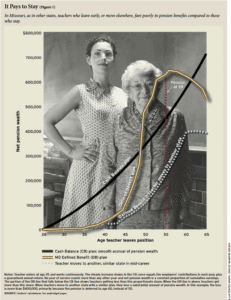
<p>The two solid curves in Figure 1 show pension wealth for a typical Missouri teacher in 1975 and today. Each curve is calculated under the current salary schedule for teachers in the state capital, so the growth represents only pension rule changes. The bottom curve shows that under 1975 rules a teacher entering at age 25 would have accrued just under $400,000 in pension wealth by age 55. Today, the same teacher would have accrued pension wealth of just under $900,000 by the same age. Not surprisingly, these enhancements have come at a substantial cost: Combined contributions for teachers and districts increased from 16 to 29 percent of salary over this period. However, even this is inadequate; the portion of salary required to pay for pension wealth accruals of current teachers and to pay off the unfunded liability is 31.3 percent.</p>
<p><a href="http://educationnext.org/files/ednext_20114_forum_fig1.gif"><img class="size-full wp-image-49643734 alignnone" src="http://educationnext.org/files/ednext_20114_forum_fig1.gif" alt="" width="690" height="437" /></a></p>
<p><strong>EN:</strong> What steps should states take to address the crisis?</p>
<p><strong>RC &amp; MP:</strong> Given concerns about cost and long-term sustainability, a number of states have cut benefits, usually for new teachers, and others are considering doing so. However, in making these changes, policymakers should carefully consider their labor market effects. Some of the proposed cuts reproduce, and even exacerbate, undesirable features of current systems. These shortcomings stem from a fundamental flaw: the failure to tie benefits to contributions. Thus the fix must expose and eliminate the gaps between the two. Below are three recommendations for reforming teacher pensions:</p>
<div id="attachment_496437" class="wp-caption alignright" style="width: 164px"><a href="http://educationnext.org/files/ednext_20114_forum_costrell.gif"><img class="size-full wp-image-49643733" src="http://educationnext.org/files/ednext_20114_forum_costrell.gif" alt="" width="154" height="216" /></a><p class="wp-caption-text">Robert Costrell</p></div>
<p>1. Report the gaps between contributions and pension wealth. In many respects, current defined benefit (DB) pension plans for teachers are opaque. Teachers rarely know what their plan is worth. By contrast, holders of 403(b) or 401(k) accounts typically know exactly what their account is worth at any point in time. To provide the same transparency for teachers, plans should not only disclose the projected annual pension payment, they should also report pension wealth. For comparison, the plan should disclose the cumulative value of contributions, both the employee’s and the employer’s, along with accumulated returns. In this way, each educator could see how the value of her accrued benefits compares with the value of the contributions. In the typical teacher pension plan, these are going to be very different numbers. Early in a teacher’s career, the value of the contributions will far exceed pension wealth, whereas for more senior teachers, the reverse is true. The dotted line in Figure 1 illustrates this point. It represents the cumulative value of contributions that is fiscally equivalent to the current pension plan, showing that the cumulative value of pension contributions exceeds pension wealth until age 50. However, between ages 50 and 62 pension wealth is typically well in excess of contributions. Not surprisingly, this is when the vast majority of full-career teachers choose to retire.</p>
<div id="attachment_496437" class="wp-caption alignright" style="width: 168px"><a href="http://educationnext.org/files/ednext_20114_forum_podgursky.gif"><img class="size-full wp-image-49643738" src="http://educationnext.org/files/ednext_20114_forum_podgursky.gif" alt="" width="158" height="216" /></a><p class="wp-caption-text">Michael Podgursky</p></div>
<p>2. Close the gaps between contributions and pension wealth. To make pensions more equitable and effective tools for staffing schools, we propose that retirement benefits paid to any teacher should be tied to the lifetime contributions made by or for that teacher. If $300,000 has been contributed on behalf of a teacher (including accumulated returns), then the cash value of an annuity provided to this teacher should also be $300,000.</p>
<p>Unfortunately, as we have seen, this fundamental principle is routinely violated in teacher plans. The gap (positive or negative) between the value of benefits and contributions is rarely considered in plan design. Instead, legislatures tinker with complex and arbitrary pension rules, such as the calculation of final average salary (how many years included, what counts as “salary”), the annual service “multiplier,” and the eligibility rules to receive the pension (“rule of 80,” “25-and-out,” etc.). Since these benefit rules are not tied to contributions, legislatures have, over the years, enhanced them, without regard to equity or efficiency, and often without adequate funding. These complex rules also encourage “gaming” by educators and districts in order to increase the gap between benefits and contributions.</p>
<p>Our analysis shows that current systems typically result in very large implicit transfers from young teachers working short spells to “long termers,” who work full careers in the same system (see “<a href="http://educationnext.org/golden-handcuffs/">Golden Handcuffs</a>,” <em>research</em>, Winter 2010). In our view, a teacher who works 10 years or 30 years should accrue pension wealth roughly equivalent to total pension contributions (with accumulated returns). Thus, in Figure 1, the pension wealth curve would coincide with the contributions curve depicted, for a fiscally equivalent plan, or with a lower curve if costs are to be reduced.</p>
<p><a href="http://educationnext.org/files/ednext_20114_forum_cartoon1_text.gif"><img class="alignright size-full wp-image-49643876" style="float: right;padding-top: 5px;padding-bottom: 5px;padding-left: 5px" src="http://educationnext.org/files/ednext_20114_forum_cartoon1_text.gif" alt="" width="300" height="350" /></a></p>
<p>In addition to improving equity, tying benefits to contributions would have important workforce benefits. First, it would provide rational incentives for retirement versus continued work. Each year, an educator would accrue pension wealth in a smooth and transparent way, providing a steady addition to the annual salary she is earning. This would generate neutral incentives to work or retire based on individual preferences and effectiveness. That is not the case with current systems. In our own work, we have shown sharp “peaks and valleys” in pension wealth accrual, which distort incentives for retirement (see “<a href="http://educationnext.org/peaks-cliffs-and-valleys/">Peaks, Cliffs, and Valleys</a>,” <em>features</em>, Winter 2008). Some years (e.g., at 25 or 30 years of service) yield increases in pension wealth that are several times the teacher’s salary. This provides a huge incentive to stay on the job until that pension “spike,” regardless of classroom effectiveness. There is no economic rationale for favoring one year of work over another in this way. Nor should an additional year of work reduce pension wealth (net of employee contributions), as is the case in current teacher plans after a certain point, often at relatively young ages. This penalizes good teachers who wish to stay.</p>
<p>Tying benefits to contributions would also eliminate the massive penalties for mobility in current systems. It is well understood in the private sector that in order to recruit and retain talented young employees it is necessary to provide portable retirement benefits. This is accomplished by defined contribution (DC) or cash balance (CB) plans that vest immediately or nearly so. Current teacher plans typically have 5- and even 10-year vesting. Our research finds that even for vested educators, the loss in pension wealth for those who split a teaching career between two traditional plans is massive. In a system where benefits are tied to the cumulative value of contributions, it does not matter whether contributions have all been made in one or many jobs: Penalties for mobility are eliminated.</p>
<p>3. There is more than one way to do it right—and to do it wrong. We favor CB plans. These are a form of defined benefit plans that generate individual retirement accounts in bookkeeping form within the pension fund. They are funded by contributions from employer and employee just like most current teacher plans and carry an investment return guaranteed by the employer. Such plans resemble a DC plan, but without transferring investment risk or asset management to the teacher. They are transparent, offer smooth wealth accrual, and are readily turned into annuities at retirement, like traditional teacher plans. However, no one year of retirement is favored over any other. Large private employers such as IBM have converted to such plans, as have a few public employers. The TIAA guaranteed-return plans that are common in higher education are similar in operation. They have provided retirement security for generations of college professors, who often spread careers over multiple institutions.</p>
<p><a href="http://educationnext.org/files/ednext_20114_forum_fig2.gif"><img class="alignnone size-full wp-image-49643735" src="http://educationnext.org/files/ednext_20114_forum_fig2.gif" alt="" width="690" height="425" /></a></p>
<p>By contrast, Illinois is a cautionary example of how not to reform teacher pensions. Illinois recently implemented a two-tiered plan, placing teachers hired after January 1, 2011, in the second tier. Tier 2 teachers make identical contributions (9.4 percent) as their Tier 1 colleagues, but take a drastic cut in pension wealth accrual over their work lives, as shown in Figure 2. The Tier 2 plan retains the same basic structure while raising the retirement age. This exacerbates the back-loading and mobility penalties, and widens the gaps between benefits and contributions. A new teacher entering the Illinois plan at age 25 will accrue no pension wealth, net of employee contributions, until age 51. This is not an attractive offer for young, mobile teachers. Indeed, the Tier 2 package is not actually a net “benefit” for entering teachers, since the teacher contributions are nearly double the cost of the average benefit they accrue; the rest is basically a tax to pay for benefits accrued but not funded, by previous cohorts of teachers.</p>
<p>As states grapple with the current pension crisis, a window of opportunity is open to implement more modern and strategic plans, or to make matters worse. Fundamental reforms are needed to fix these broken systems. Systems should first be required to report the gaps between benefits and contributions for all members. Then, as a matter of equity and efficiency, the plans should be restructured to close these gaps by tying benefits to contributions. This would give young teachers their fair share of the retirement benefit pie and rationalize the retirement incentives for all teachers.</p>
<p><a href="http://educationnext.org/files/ednext_20114_forum_cartoon2_text.gif"><img class="alignright size-full wp-image-49643882" style="float: right;padding-top: 5px;padding-bottom: 5px;padding-left: 5px" src="http://educationnext.org/files/ednext_20114_forum_cartoon2_text.gif" alt="" width="300" height="381" /></a></p>
<p><strong>CW:</strong> States can take a number of steps to alleviate the pension crisis:</p>
<p>1. Spread the pain of addressing underfunding, if adjustments are unavoidable. Changes to pension plans generally only apply to new hires. State constitutions and courts typically hold already-earned benefits and future not-yet-earned benefits for existing employees and beneficiaries inviolate. This protection is also occasionally applied to employee contributions. Governments cannot reduce benefits and raise contributions for current employees, even if they want to. Hence, adjustments fall disproportionately on new hires.</p>
<p>Private-sector pension benefits also enjoy substantial protections, but to a lesser degree than public-sector benefits. The Employee Retirement Income Security Act of 1974 protects from reductions benefits that have already been earned, but it does not protect future benefits not yet earned. Private-sector employers can thus lower future benefits when a crisis requires a drastic change.</p>
<p>States should change their public benefit protections to permit adjustments to be distributed across a broader range of employees, if such adjustments become necessary. States could guarantee already-earned benefits but not those not yet earned, as the private sector does. States could also ease older employees’ distress about potential benefit changes by allowing future benefit reductions only for employees under a certain age.</p>
<p>There are several advantages to this approach: Current beneficiaries would remain fully protected, already-earned benefits could not be taken away, and older employees would receive the retirement benefits that they had earned. Arbitrary divisions in younger employees’ compensation arising from whether they were hired before or after the benefit change went into effect would also be eliminated.</p>
<p>2. Prevent underfunding in the future. The current underfunding resulted from massive stock and real-estate market declines. Public pensions were prudently managed before the crisis, as Jeff Wenger and Christian Weller have demonstrated elsewhere.</p>
<p>But many governments did not contribute as much as necessary to their pension funds, making them vulnerable in a crisis. The problems of pensions are more a result of low employer contributions than poor pension management. Governments often avoided paying the full amount of what was necessary to cover benefits earned in a given year. Even in 2011, Governor Chris Christie (R-NJ) considers the state’s contributions to its pension plan an optional expense. Governments, as employers, have exacerbated, and continue to exacerbate, their pension plans’ financial challenges.</p>
<p>One solution is to make governments pay the necessary amount to their pension plans. States could set a floor under employer pension contributions. The employer contributions could never fall to zero, commonly known as “taking a contribution holiday,” and employer contributions could never fall below the “floor” rate. DB pensions would receive money more regularly than is currently the case and thus underfunding would become less likely, particularly during a crisis.</p>
<p>If they set a floor for employer pension contributions, states would simultaneously have to change the rules that govern pension funding. Strong financial market performance could easily translate into overfunded pensions, which is desirable, since it means that DB pensions are prepared for a rainy day, such as the recent crisis. But overfunded plans could feed appetites for benefit improvements or contribution cuts, unless the law states that better benefits and lower contributions could only be considered if a DB pension has a minimum buffer for emergencies. Weller and Baker (2005) suggest a buffer of 20 percent of liabilities, which could be even smaller for state DB pension plans, since states cannot go bankrupt.</p>
<p><a href="http://educationnext.org/files/ednext_20114_forum_cartoon3a_text.gif"><img class="alignright size-full wp-image-49643888" style="float: right;padding-top: 5px;padding-bottom: 5px;padding-left: 5px" src="http://educationnext.org/files/ednext_20114_forum_cartoon3a_text.gif" alt="" width="300" height="377" /></a></p>
<p>3. Beware of unintended consequences with alternative benefits. The wrong changes could have serious adverse effects. This would be the case if states also changed their retirement plans from DB pensions to an alternative design, particularly defined contribution (DC) savings accounts such as 403(b) plans, but also a cash balance plan. Cash balance plans look like DC plans to employees but operate like a DB pension for employers. Employers offer a guaranteed rate of return on current and past contributions to a cash balance plan and take the risk of higher contributions if the actual rate of return falls below the promised one.</p>
<p>Alternative benefits are less efficient than DB pensions. First, the average teacher effectiveness will likely decrease, as much higher employee turnover will easily offset any potential effectiveness gains. Second, alternative benefits come with substantial costs.</p>
<p>One unproven assertion about alternative benefits is that they would result in greater teacher effectiveness. Alternative retirement benefits are attractive to their proponents because these benefits would offer more compensation earlier in a teacher’s career and promote turnover later in a teacher’s career relative to a DB pension. Higher compensation earlier would attract to the profession people who could potentially become more-effective teachers, while fewer financial incentives to stay would supposedly lead ineffective teachers to leave earlier than they otherwise would.</p>
<p>The literature on teacher effectiveness and employee turnover associated with benefits shows that average teacher effectiveness will likely decline with alternative benefits. Higher early compensation will offer only a small incentive for promising though untested teachers to enter the profession. And the link between teacher pay and student achievement has been shown to be tentative at best. Since a benefit change would only marginally increase beginning teachers’ compensation, any initial bump in overall instructional effectiveness would be both fleeting and faint, if it exists at all. Any small initial improvement in teacher effectiveness will be quickly offset by higher turnover among more-experienced teachers. Experienced teachers who leave will be replaced by inexperienced teachers, who will need time to build their classroom skills. Small turnover increases can quickly offset small productivity gains to ultimately lower average teacher quality. The literature, in fact, shows that we can expect substantial increases in turnover with a switch to DC and cash balance plans from DB pensions so that higher turnover will eliminate any possible gains from higher initial compensation. We estimate, for instance, that the chance of worsening teacher effectiveness is about 60 percent with a cash balance plan and 70 percent with a DC plan under optimistic assumptions that favor alternative benefit designs based on the existing long-standing literature on pensions and turnover and the much smaller literature on initial compensation and teacher effectiveness.</p>
<p>Teacher turnover can be expected to increase with alternative benefits because employees will understand that their economic security is less well protected with a DC or cash balance plan than with a DB pension. National opinion polls routinely find very strong support for DB pensions, as individuals who do not like risk prefer to have some income guarantees for themselves and their families when they retire, become disabled, or pass away. Fewer income guarantees, or insurance, lead people to leave employment more quickly than they otherwise would. Thus, under these circumstances, teacher turnover would increase and average teacher effectiveness would fall.</p>
<p>Private-sector employers without DB pensions often use other tools to mirror the human resource effects, i.e., long tenure of skilled workers, of DB pensions, exactly because they are worried about turnover. Employers in the field of information technology, especially, offer, for instance, stock options and stock grants to recruit and retain skilled workers for long periods of time. States simply cannot offer these benefits and hence have no way to lower turnover among effective employees.</p>
<p>Alternative benefits also cost more. First, DB pensions would have to operate with a finite investment horizon, increasingly moving money to secure, low-return assets so that lower investment earnings would lend less of a helping hand to pay for benefits. Second, employers may have to cover any underfunding more quickly for closed plans than for ongoing ones, raising employer contributions. Third, higher turnover increases cost due to more recruitment and training of new hires. Fourth, there are substantial transition costs. Older employees will continue to earn DB pensions, they will earn more benefits as they stay longer on the job, and there will be more long-term employees under the DB pension, raising the cost per employee of the DB pension. New employees, in comparison, would be more prevalent in the new plan, earn initially higher benefits than with a DB pension, and thus raise costs relative to a DB pension. These transition costs would last for about four decades and could average 1 percent of payroll for many years, even if the costs of retirement benefits are the same before and after the transition. Fifth, DC plans offer fewer insurance benefits than DB pensions. The insurance exists largely because employees who happen to live through a prolonged period of prosperity share some of their gains with less fortunate employees. Researchers at the National Institute on Retirement Security estimated in 2008 that the loss of insurance features meant that each dollar invested in a DC plan generated 46 percent less in retirement benefits than a dollar invested in a DB pension. Finally, there are higher administrative costs due to a large number of small accounts, especially in DC plans, and increased movement of money between retirement plans.</p>
<p>The two states that have switched from DB pensions to DC plans, West Virginia and Alaska, had severe cases of buyers’ remorse. West Virginia eventually switched back to a DB plan for their teachers in 2008, and Alaska’s policymakers have been investigating the possibility of making a similar reversal.</p>
<p>The lessons from the evidence are clear: States can manage the financial challenges of their pension plans. The proposal to use the current crisis as an opportunity to switch retirement plans, though, will leave states with a much less efficient compensation system. The average effectiveness of teachers will likely drop, and costs will go up substantially. States will be better off managing the financial problems of their DB pensions by putting mechanisms in place that will prevent future underfunding instead of engaging in costly retirement-plan experiments that offer no benefits.</p>
<p><strong>EN:</strong> What, then, are the main areas of disagreement?</p>
<p><a href="http://educationnext.org/files/ednext_20114_forum_cartoon4a_text.gif"><img class="alignright size-full wp-image-49643889" style="float: right;padding-top: 5px;padding-bottom: 5px;padding-left: 5px" src="http://educationnext.org/files/ednext_20114_forum_cartoon4a_text.gif" alt="" width="300" height="379" /></a></p>
<p><strong>RC &amp; MP:</strong> We disagree on structure. We argue that benefits should be tied to contributions. Professor Weller believes this would have adverse consequences.</p>
<p>Weller assumes a shift to CB or DC would raise annual exits at all ages by a hefty rate, between 22 and 220 percent, according to his recent but as yet unpublished paper on which his efficiency claim is based. Thus, the share of novice teachers in the workforce would rise and average effectiveness would fall. However, the 22 percent estimate is drawn from a 1993 paper by Allen, Clark, and McDermed that compares private-sector workers “covered by a company retirement plan” to those who were not covered by any plan, so there are no implications for CB or DC. The 220 percent assumption is drawn from a 1996 paper by Even and MacPherson that actually shows no difference in quit rates between DB and DC.</p>
<p>Economic theory suggests mixed effects of CB on teacher quit rates, raising them for mid-career teachers who would otherwise hang on for early retirement and lowering them for late-career teachers, otherwise driven out by negative accrual. It might also lower quit rates for young teachers, since they accrue more pension wealth under CB than under current plans. This mixed pattern is supported by Costrell and McGee’s findings, in their 2010 peer-reviewed econometric study of teacher response to pension wealth accrual. Their simulation of a shift to CB, based on their behavioral estimates, found a slight rise in average teacher tenure, not a large fall.</p>
<p>Turning to transition costs, Weller claims that new plans raise costs on old plans by forcing changes in investment strategy or amortization schedules. However, pension plans often introduce new “tiers” without these effects, as new and old funds are commingled. Introducing CB as a new tier would be no different.</p>
<p>Weller’s simulation of transition costs, also from his unpublished paper, makes a different argument. He claims costs will rise for decades because entering cohorts have a different time pattern of pension wealth accrual than previous cohorts. But the time pattern is irrelevant here. Each cohort’s cost is the present value of its lifetime accruals, however they are distributed. Costs cannot rise unless some cohort enjoys higher benefits and, hence, higher lifetime accruals of pension wealth. Yet Weller assumes each cohort accrues the same pension wealth—10.25 percent of the cohort’s lifetime payroll. That is the cohort’s “normal cost,” the contributions required to fund the cohort’s lifetime benefits and accruals. The system’s required contributions are a blend of each cohort’s normal costs, but these are the same, 10.25 percent for each cohort. Thus, the system’s contributions are unchanged, and there are no transition costs.</p>
<p>Costs and contributions would fall if benefits were cut, as Weller recommends. Indeed, they would fall more quickly under his reasonable proposal to cut normal costs of current teachers, as a matter of equity between generations. However, we also favor equity for mobile young teachers, who will continue to receive benefits worth far less than contributions, absent fundamental reform.</p>
<p><a href="http://educationnext.org/files/ednext_20114_forum_cartoon5_text.gif"><img class="alignright size-full wp-image-49643885" style="float: right;padding-top: 5px;padding-bottom: 5px;padding-left: 5px" src="http://educationnext.org/files/ednext_20114_forum_cartoon5_text.gif" alt="" width="298" height="384" /></a></p>
<p><strong>CW:</strong> The evidence shows that defined benefit pensions work for education. Professors Costrell and Podgursky do not address the fact that both employers and employees prefer defined benefit pensions over other retirement benefits.</p>
<p>The vast majority of states underwent pension reforms in the past decade to address the financial challenges of pension underfunding and none abandoned their defined benefit pensions. And private-sector employers in key growth industries, such as information technology and banking, offer either defined benefit pensions or other forms of deferred compensation, such as stock options, to their employees to mimic the retention benefits of pensions when pensions are absent. A substantial literature both develops the theory and shows the supporting evidence for the efficacy of deferred compensation as a retention and recruitment tool for skilled employees. There is a clear economic rationale for deferred compensation, since it allows employers to recoup the investments made in hiring and training skilled employees, such as teachers.</p>
<p>Teachers equally prefer pensions. Opinion polls routinely show a preference for defined benefit pensions, even among younger employees. And when teachers (and other public employees) have been given a choice between defined benefit pensions and defined contribution plans, the vast majority typically chooses the defined benefit pension plan. The evidence contradicts Professors Costrell and Podgursky’s key assertion that alternative plans that offer more immediate compensation are more attractive to younger teachers.</p>
<p>Finally, transition costs from a defined benefit pension to a cash balance plan would quickly drain public coffers. There would be a growing concentration of more-experienced teachers under the defined benefit pension that favors more-experienced teachers and a high concentration of inexperienced teachers under a cash balance plan that favors inexperienced teachers. A long-standing literature has regularly shown that DB pensions substantially reduce turnover compared to other retirement benefits, suggesting that a benefit switch will increase turnover.</p>
<p>The increase in turnover will raise costs and pose the threat of lower average effectiveness, as my own simulations for a switch from DB pensions to cash balance plans show. The costs are predictable and substantial, while any benefits are highly uncertain and likely nonexistent.</p>
<img src="http://educationnext.org/?ak_action=api_record_view&id=49643727&type=feed" alt="" />]]></content:encoded>
			<wfw:commentRss>http://educationnext.org/fixing-teacher-pensions/feed/</wfw:commentRss>
		<slash:comments>2</slash:comments>
		</item>
		<item>
		<title>A Modest Proposal for Pension Reform</title>
		<link>http://educationnext.org/a-modest-proposal-for-pension-reform/</link>
		<comments>http://educationnext.org/a-modest-proposal-for-pension-reform/#comments</comments>
		<pubDate>Mon, 21 Mar 2011 13:13:01 +0000</pubDate>
		<dc:creator>Robert M. Costrell</dc:creator>
				<category><![CDATA[Blog]]></category>
		<category><![CDATA[Editorial]]></category>
		<category><![CDATA[Teachers and Teaching]]></category>
		<category><![CDATA[teacher pensions]]></category>

		<guid isPermaLink="false">http://educationnext.org/?p=49639764</guid>
		<description><![CDATA[Fundamental reform—based on tying benefits to contributions—is needed to fix these broken systems.]]></description>
			<content:encoded><![CDATA[<p>Educator pension systems are becoming increasingly expensive and, in a  number of states, plagued by severe problems of underfunding. Given  concerns about cost and long-term sustainability, several states have  cut benefits, usually for new teachers, and many more are considering  doing so. However, in making these changes, policymakers should  carefully consider their labor-market effects. Some of the proposed cuts  reproduce—and even exacerbate—undesirable features of current systems.</p>
<p>That’s because they violate the paramount principle upon which  pension systems should be built: Benefits should be tied to  contributions. In other words, benefits paid to any teacher should be  tied to the lifetime contributions made by or for that teacher. If  $300,000 has been contributed on behalf of a teacher (including  accumulated returns) then the cash value of an annuity provided to this  teacher should also be $300,000.</p>
<p>This principle is routinely violated in current defined-benefit pension systems. Our analysis, <em><a href="http://www.tiaa-crefinstitute.org/articles/pb_reformingpension0211.html">Reforming K-12 Educator Pensions: A Labor Market Perspective</a>,</em> shows that the current systems result in very large implicit transfers  from young teachers working short teaching spells to “long termers” who  spend entire careers in the same system. In our view, a teacher who  works ten years or thirty years should accrue pension wealth roughly  equivalent to total pension contributions (with accumulated returns).</p>
<p>Illinois is a cautionary example of how <em>not</em> to reform  teacher pensions. The Land of Lincoln recently implemented a two-tiered  plan, with teachers hired after January 1, 2011 in the second tier. Tier  2 teachers will make identical contributions (9.4 percent) as their  Tier 1 colleagues, but will have a massive cut in pension wealth accrual  over their work lives. Moreover, by our calculations, a new teacher  entering the Illinois plan at age twenty-five will accrue no net pension  wealth until age fifty-one. If the teacher leaves the classroom in her  thirties or forties, she will walk away with nothing but her own  cumulative contributions.</p>
<p>Tying benefits to contributions would have positive workforce  consequences. First, it would provide rational incentives for retirement  versus continued work. Each year, an educator would accrue pension  wealth in a smooth and transparent way, providing an appropriate  addition to the annual salary she is earning. This would generate  neutral incentives to work or retire based on individual preferences and  effectiveness.</p>
<p>That is not the case with current systems, where pension-wealth  accrual is highly back loaded and concentrated at certain arbitrary  points in teachers’ careers. Some years (e.g. at twenty-five or thirty  years of service) yield increases in pension wealth that are several  times the teacher’s salary. This provides a huge incentive to stay on  the job until that pension “spike,” regardless of classroom  effectiveness. There is no economic rationale for favoring one year of  work over another in this way. Nor should an additional year of work  reduce pension wealth, as is the case in current pension plans after a  certain point in time, often at relatively young ages. This penalizes  good teachers who wish to stay but are encouraged to retire early.</p>
<p>Tying benefits to contributions would also eliminate the massive  penalties for mobility in current systems. It is well understood in the  private sector that in order to recruit and retain talented young  employees it is necessary to provide portable retirement benefits. This  is accomplished by defined-contribution (DC) or cash-balance (CB) plans  that vest immediately or nearly so. Current teacher plans typically have  five or even ten year vesting. But even for vested educators, <a href="http://www.mitpressjournals.org/doi/pdf/10.1162/EDFP_a_00015">our research finds</a> that the loss in pension wealth for those who split a teaching career  between two states is massive. In a system where benefits are tied to  the cumulative value of contributions it does not matter whether  contributions have all been made in one or many jobs: Penalties for  mobility are eliminated.</p>
<p>We favor cash-balance plans that generate notional individual  retirement accounts, with contributions from employer and employee, and  an investment return guaranteed by the employer. Such plans resemble the  DC design, but without transferring investment risk or asset management  to the teacher. They are transparent, offer smooth wealth accrual, and  are readily annuitized at retirement. Large private employers such as  IBM have converted to such plans, as have a few public employers. The  TIAA plans that are common in higher education are similar in operation.  They have provided retirement security for generations of college  professors who often spread careers over multiple institutions.</p>
<p>As states grapple with the current pension crisis, a window of  opportunity is open to implement more modern and strategic plans, or to  make matters worse. Fundamental reform—based on tying benefits to  contributions—is needed to fix these broken systems.</p>
<p><em><a href="http://www.uark.edu/ua/der/People/costrell.html">Robert M. Costrell</a> is the endowed chair in education accountability at the University of Arkansas’s College of Education and Health Professions. <a href="http://economics.missouri.edu/people/podgursky.shtml">Michael Podgursky</a> is a professor in the Department of Economics at the University of  Missouri, Columbia, as well as a fellow at the George W. Bush Institute  at Southern Methodist University. An expanded discussion of these  points, with references to the research literature, may be found in the  authors’ </em><a href="http://www.tiaa-crefinstitute.org/articles/pb_reformingpension0211.html"><em>new study published by the TIAA-CREF Institute</em></a><em>.</em></p>
<p><em>This article originally appeared in the <a href="http://www.edexcellence.net/publications-issues/gadfly/national/2011nationalgadfly0317.html">March 17</a> edition of <a href="http://www.edexcellence.net/news-commentary/education-gadfly.html">The Education Gadfly</a>.</em></p>
<img src="http://educationnext.org/?ak_action=api_record_view&id=49639764&type=feed" alt="" />]]></content:encoded>
			<wfw:commentRss>http://educationnext.org/a-modest-proposal-for-pension-reform/feed/</wfw:commentRss>
		<slash:comments>0</slash:comments>
		</item>
		<item>
		<title>Pension Reform Would Be Good for Teachers</title>
		<link>http://educationnext.org/pension-reform-would-be-good-for-teachers/</link>
		<comments>http://educationnext.org/pension-reform-would-be-good-for-teachers/#comments</comments>
		<pubDate>Thu, 23 Dec 2010 10:00:50 +0000</pubDate>
		<dc:creator>Robert M. Costrell</dc:creator>
				<category><![CDATA[Podcast]]></category>

		<guid isPermaLink="false">http://educationnext.org/?p=49631240</guid>
		<description><![CDATA[<img src="http://educationnext.org/wp-content/themes/ednxt/img/podcast_icon.jpg" height="9" width="7" border="0" style="width: 7px;height: 9px" /> Podcast: Robert Costrell and Michael Podgursky talk with Education Next about ways to eliminate the peculiar incentives built into current teacher pension systems.]]></description>
			<content:encoded><![CDATA[<p>Robert Costrell and Michael Podgursky talk with Education Next about ways to eliminate the peculiar incentives built into current teacher pension systems.</p>
<p><span id="more-49631240"></span></p>
<p><a href="http://educationnext.org/files/CostrellPodgurskyW2010.mp3"><strong>Listen to the Podcast</strong></a></p>
<hr />
<p>Economists Bob Costrell of the University of Arkansas and Mike Podgursky of the University of Missouri are the authors of “<a href="http://educationnext.org/golden-handcuffs/">Golden Handcuffs</a>,” an article in the Winter 2010 issue of Education Next that looks at the high price paid in pension wealth by teachers who change jobs.</p>
<p>As Bob and Mike note in their article, many states are being forced to reevaluate their teacher pension plans. The unfunded liabilities of these plans are in the billions. But while most analysts are focused on the enormous cost of teacher pensions and their long-term sustainability, Bob and Mike have been looking at another aspect of teacher pensions: the perverse incentives embedded in these plans that interfere with the goal of attracting and retaining outstanding teachers. In this podcast, they talk about the findings of their most recent study, which examines the way that teacher pension systems concentrate benefits on those teachers who spend their entire careers in a single state, and punish teachers who are more mobile.</p>
<p><a href="http://itunes.apple.com/us/podcast/education-next/id350855673">Click here for a free subscription to the Education Next podcasts on iTunes</a>.</p>
<img src="http://educationnext.org/?ak_action=api_record_view&id=49631240&type=feed" alt="" />]]></content:encoded>
			<wfw:commentRss>http://educationnext.org/pension-reform-would-be-good-for-teachers/feed/</wfw:commentRss>
		<slash:comments>0</slash:comments>
<enclosure url="http://educationnext.org/files/CostrellPodgurskyW2010.mp3" length="13513705" type="audio/mpeg" />
			<itunes:subtitle>Podcast: Robert Costrell and Michael Podgursky talk with Education Next about ways to eliminate the peculiar incentives built into current teacher pension systems.</itunes:subtitle>
		<itunes:summary>Podcast: Robert Costrell and Michael Podgursky talk with Education Next about ways to eliminate the peculiar incentives built into current teacher pension systems.</itunes:summary>
		<itunes:author>Education Next</itunes:author>
		<itunes:explicit>clean</itunes:explicit>
	</item>
		<item>
		<title>Yes, We Have No Bananas</title>
		<link>http://educationnext.org/yes-we-have-no-bananas/</link>
		<comments>http://educationnext.org/yes-we-have-no-bananas/#comments</comments>
		<pubDate>Mon, 08 Feb 2010 17:50:29 +0000</pubDate>
		<dc:creator>Robert M. Costrell</dc:creator>
				<category><![CDATA[Blog]]></category>
		<category><![CDATA[Editorial]]></category>
		<category><![CDATA[Beth Almeida]]></category>
		<category><![CDATA[Golden Handcuffs]]></category>
		<category><![CDATA[National Institute on Retirement Security]]></category>
		<category><![CDATA[Professor Alfred Kahn]]></category>
		<category><![CDATA[teacher pension systems]]></category>

		<guid isPermaLink="false">http://educationnext.org/?p=49632960</guid>
		<description><![CDATA[In a recent Education Next article we talked about winners and losers in teacher pension systems, and about the huge costs these systems impose on mobile teachers due to the back-loading of benefits.   In a letter to the editor written in response to our article, Beth Almeida of the National Institute on Retirement Security takes us to task for describing this phenomenon as “redistribution,” noting that such a practice is illegal.   Since we don’t want to get pension and teacher union officials in trouble, we have a modest proposal.]]></description>
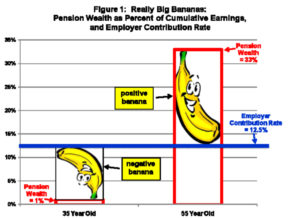
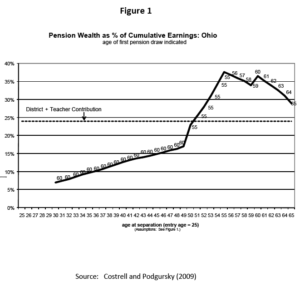
			<content:encoded><![CDATA[<p>In a recent Education Next article, “<a href="http://educationnext.org/golden-handcuffs/">Golden Handcuffs</a>,” we talked about winners and losers in teacher pension systems, and about the huge costs these systems impose on mobile teachers due to the back-loading of benefits.  Consider one example.  In Missouri, a 25-year old entrant into the teaching profession receives net pension wealth equal to 33% of her cumulative earnings if she teaches until age 55, but her net pension wealth will be equal to only one percent of her earnings if she leaves at age 35. Yet in both cases, her employer contributed 12.5 percent of earnings into the pension fund each year.</p>
<p><a href="http://educationnext.org/golden-handcuffs/comment-page-1/#comment-1671">In a letter to the editor written in response to our article</a>, Beth Almeida of the National Institute on Retirement Security takes us to task for describing this phenomenon as “redistribution,” noting that such a practice is illegal.   We are not lawyers, so we’ll take her word on that.   And since we don’t want to get pension and teacher union officials in trouble, we have a modest proposal, inspired by Professor Alfred Kahn, President Carter’s anti-inflation czar.   In the late 1970’s Professor Kahn was taken to task by his boss and his political advisors for talking about a “recession.”  So in public discussions Kahn started talking about a “banana” instead, at one point warning:  &#8220;We&#8217;re in danger of having the worst banana in 45 years.&#8221;</p>
<p>It is in the spirit of Professor Kahn that we offer Figure 1, which illustrates the bananas for our two Missouri teachers.  The teacher who stays on the job for 30 years, until age 55, receives far more in net pension benefits than has been contributed on her behalf &#8212; a positive banana.   By contrast, a teacher who puts in ten years, leaving at age 35, receives far less than has been contributed &#8212; a negative banana.</p>
<p>For the Ed Next article, we summed up the positive and negative bananas across all teachers entering at age 25 in Missouri. We estimate that 46 percent of their pension wealth gets banana-ed from those leaving teaching early (average age 37) to those leaving later (average age 54). In the article we note that the size of the average banana ranges from a high of 61 percent of an entering cohort&#8217;s pension wealth in Massachusetts to a low of 36 percent in California.</p>
<p>In our writings about teacher pensions over the last few years, we’ve identified a lot of bananas.   It has also become clear that bananas are an important issue in reforming these systems.   We think it’s important to start this policy discussion.  Just make sure you avoid the “r” word and choose a popular fruit or vegetable instead.</p>
<p>NB: <a href="http://educationnext.org/golden-handcuffs/comment-page-1/#comment-1672">We respond to some of Almeida’s other arguments here</a>.</p>
<p><a href="http://educationnext.org/files/CosPod_Banana.jpg"><img class="alignright size-full wp-image-49632961" src="http://educationnext.org/files/CosPod_Banana.jpg" alt="CosPod_Banana" width="444" height="322" /></a></p>
<img src="http://educationnext.org/?ak_action=api_record_view&id=49632960&type=feed" alt="" />]]></content:encoded>
			<wfw:commentRss>http://educationnext.org/yes-we-have-no-bananas/feed/</wfw:commentRss>
		<slash:comments>0</slash:comments>
		</item>
		<item>
		<title>Teacher Retirement Benefits</title>
		<link>http://educationnext.org/teacher-retirement-benefits/</link>
		<comments>http://educationnext.org/teacher-retirement-benefits/#comments</comments>
		<pubDate>Thu, 03 Dec 2009 15:00:46 +0000</pubDate>
		<dc:creator>Robert M. Costrell</dc:creator>
				<category><![CDATA[On Top of the News]]></category>
		<category><![CDATA[Research]]></category>
		<category><![CDATA[School Spending]]></category>
		<category><![CDATA[Teachers and Teaching]]></category>
		<category><![CDATA[Unions and Collective Bargaining]]></category>

		<guid isPermaLink="false">http://content.hks.harvard.edu/educationnext/?p=39204382</guid>
		<description><![CDATA[Even in economically tough times, costs are higher than ever.]]></description>
			<content:encoded><![CDATA[<p>An unabridged version of this article is available <a href="http://educationnext.org/files/ednext_20092_58_unabridged.pdf">here</a>.</p>
<hr />
<p>The ongoing global financial crisis is forcing many employers, from General Motors to local general stores, to take a hard look at the costs of the compensation packages they offer employees. For public school systems, this will entail a consideration of fringe benefit costs, which in recent years have become an increasingly important component of teacher compensation. During the 2005–06 school year, the most recent year for which <a href="http://www.ed.gov/index.jhtml" target="_blank">U.S. Department of Education</a> data are available, the nation’s public schools spent $187 billion in salaries and $59 billion in benefits for instructional personnel. Total benefits added about 32 percent to salaries, up from 25 percent in 1999–2000. The increase reflects the well-known rise in health insurance costs, but it also appears to include growing costs of retirement benefits, which have received much less attention.</p>
<p>Conventional wisdom holds that teacher pensions (along with other public pensions) are more costly than private retirement benefits, for reasons dating to an earlier era of low teacher salaries over lifelong careers. In spite of dissent from this view by some researchers (see sidebar), in this case we find that conventional wisdom is right: the cost of retirement benefits for teachers is higher than for private-sector professionals.</p>
<table border="0" cellspacing="0" cellpadding="5" bgcolor="#f7e4da">
<tbody>
<tr>
<td><strong>Wrong Data, Wrong Conclusion </strong></p>
<p>Our findings are at odds with the claim made by Lawrence Mishel and Richard Rothstein of the <a href="http://www.epi.org/" target="_blank">Economic Policy Institute</a> in the June 2007 <em>Phi Delta Kappan </em>that employer contributions for retiree benefits for teachers are no higher than for professionals in the private sector. Their claim was also based on <a href="http://www.bls.gov/NCS/" target="_blank">National Compensation Survey</a> (NCS) data. The <a href="http://media.hoover.org/documents/ednext_20092_58_unabridged.pdf">unabridged version of this paper</a> provides a detailed critique of their methodology. The three main problems with their calculations are summarized below.</p>
<p><strong>Inappropriate Occupational Categories </strong></p>
<p><strong> </strong>The policy debate is about public school teachers, yet Mishel and Rothstein combine public and private school teachers in their analysis. In addition, the “professionals” to whom these teachers are compared also include all teachers; indeed, they are one of the largest components of this group. The authors mislabel the group in their article as “all other professionals,” but the Bureau of Labor Statistics (BLS) table from which their data are drawn clearly shows it to be an occupational grouping that includes teachers. Finally, while Mishel and Rothstein state that the appropriate comparison is with private-sector professionals, this group includes all state and local government professionals, too. The same BLS report provides separate tables with data for the two appropriate occupational groups: public school K–12 teachers and private-sector “management, professional, and related” workers. These are the tables we use in our analysis.</p>
<p><strong>Confounding Social Security Contributions</strong></p>
<p>Mishel and Rothstein are unable to isolate Social Security contributions with the table they use. In that table, Social Security contributions are subsumed into a larger category that also includes Medicare, worker’s compensation, and federal and state unemployment insurance. This problem does not exist when using the proper table for private-sector professionals, as Social Security contributions are separated out. The table with data for public school teachers does not separate out Social Security, but those contributions can be estimated using the NCS estimate for Social Security coverage, as explained in the text.</p>
<p><strong>Share of Total Compensation vs. Percentage of Earnings </strong></p>
<p>Mishel and Rothstein measure employer contributions as a share of total compensation instead of as a percentage of earnings. Shares of total compensation are not informative about how remunerative one occupation is compared to another. To take a simple example, suppose two occupations, one of them teachers, have identical earnings and retirement benefits, but differ in health insurance benefits. Since employer contributions to health insurance are markedly higher for teachers, the share of compensation for that component will be higher and the share for retirement will be lower, since all shares must sum to 100 percent. This fact alone mathematically reduces the share of total compensation that goes to retirement for public teachers, relative to private professionals.</p>
<p><strong>Summing Up </strong></p>
<p><strong> </strong>Mishel and Rothstein find that employer costs for retirement constituted 11.5 percent of total compensation for “teachers” and for “other professionals” in June 2006. Correcting the three problems identified above, we find that employer contributions for retirement were 12.8 percent of earnings for public school teachers and 10.5 percent for private professionals in June 2006, a gap of about one-fifth. Since that time, as shown in Figure 1, contributions for private professionals have remained flat, while contributions for teachers have risen, doubling the gap between the two by September 2008.</td>
</tr>
</tbody>
</table>
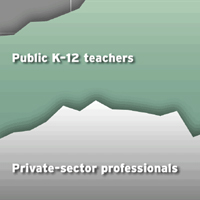
<p>To track changes in retirement costs and compare employer contributions to retirement for public school teachers with those for private-sector professionals, we draw on recent data from a major employer survey conducted by the <a href="http://www.dol.gov/" target="_blank">U.S. Department of Labor</a>. These data show that the rate of employer contributions to retirement benefits for public school teachers in 2008 is substantially higher than for private professionals: 14.6 percent of earnings for teachers vs. 10.4 percent for private professionals. Moreover, the gap has widened over the four years the data have been available. Between March 2004 and September 2008, the difference more than doubled, rising from 1.9 to 4.2 percentage points (see Figure 1).</p>
<div><img src="http://educationnext.org/files/ednext_20092_58_fig1.gif" border="0" alt="Article Figure 1: Employer contributions to public school teacher pensions and Social Security are higher than contributions for privatesector professionals, the gapmore than doubling between 2004 and 2008." align="middle" /></div>
<p>There are several reasons one might expect employer contributions to retirement to be higher for teachers. First, nearly all teachers are covered by traditional defined benefit (DB) pension plans, in which employees receive a regular retirement check based on a legislatively determined formula. These plans have, over the years, come to offer retirement at relatively young ages, at a rate that replaces a substantial portion of final salary. U.S. Department of Education data show a median retirement age for public school teachers of 58 years, compared to about 62 for the labor force as a whole. A teacher in her mid-50s who has worked for 30 years under a typical teacher pension plan will be entitled to an annuity at retirement of between 60 and 75 percent of her final salary. In nearly all plans this annuity has some sort of cost-of-living adjustment. One does not generally observe comparable retirement plans for professionals and lower-tier managers in the private sector, since most employers have replaced traditional DB plans with defined contribution (DC) or similar 401(k)-type plans, in which the employer and employee contribute to a retirement account that belongs to the employee. Nor do those traditional DB plans that remain typically reward retirement at such early ages; they more nearly resemble Social Security, where eligibility is age 62 for early retirement, and 66 and rising for normal retirement.</p>
<p><strong>The Survey Data </strong></p>
<p>Our analysis draws on data from the National Compensation Survey (NCS), an employer survey developed by the Bureau of Labor Statistics (BLS). The NCS survey is designed to measure employer costs for wages and salaries and fringe benefits across a wide range of occupations and industries in the public and private sectors. Although the BLS has been reporting quarterly fringe-benefit cost data for various public and private employee groups for more than a decade, only since March 2004 has the bureau broken out these fringe-benefit cost data for public school K–12 teachers. In this article we use those data to compare retirement benefit costs for public K–12 teachers with costs for private-sector professionals. We use the most detailed available private-sector comparison group, “management, professional, and related,” a category that includes business and financial managers, operations specialists, accountants and auditors, computer programmers and analysts, engineers, lawyers, physicians, and nurses.</p>
<p>We measure the cost of retirement benefits as a percentage of earnings. Virtually all states specify in law that the employer will contribute a certain percentage of teacher salaries to a DB pension fund (employee contributions are similarly specified), and it is commonplace to compare such contribution rates among the states. Similarly, private-sector employers offering DC plans will typically specify their contribution as a percentage of salary (often as a match to employee contributions). Unlike some other benefits (e.g., health insurance), if salaries change, the dollar costs for retirement benefits move proportionally. On the benefit side, the DB formula ties one’s starting annuity to final average salary, while the adequacy of a DC plan is commonly thought of in terms of the salary replacement rate. Thus it is natural to specify retirement costs as a percentage of salary, both for teachers and for private-sector professionals.</p>
<p>In making this comparison, we must account for the fact that, while all of the private-sector professionals are covered by Social Security, a number of public school teachers are not. Some of the higher cost of employer retirement plans for teachers is offset by lower employer contributions for Social Security benefits. Thus, we should compare the contribution rates for employer-provided retirement benefits <em>and </em>Social Security for both groups of workers. While the BLS reports the Social Security contribution rate for private professionals, it does not report a similar rate for teachers. However, we are able to make such an adjustment by multiplying the share of teachers covered by Social Security, which the BLS estimates to be 73 percent, times the employer contribution rate (6.2 percent). This assumes that the vast majority of teachers are below the Social Security earnings cap (currently $102,000) and that the share of teachers in Social Security has been steady over the four years for which we make the comparison.</p>
<p>A time series with quarterly data for these benefit percentages is reported in Figure 1. Two patterns are visible. First, the contribution rate is considerably higher for public school teachers than for private professionals. In the most recent quarter for which data are reported, ending September 2008, the employer contribution rate for public K–12 teachers (14.6 percent) was 4.2 points higher than that for private-sector professionals (10.4 percent). Second, the gap is widening. While the private sector contribution rate has been relatively flat over the four years, the rate for public school teachers has markedly increased, doubling the gap between them from one-fifth to two-fifths.</p>
<p>In one important respect, it is likely that the BLS data underestimate the cost of retirement benefits for public school teachers. Many public school districts (and some states) provide health insurance benefits for retired public school teachers. In the course of this research we were surprised to learn that retiree health insurance benefits are <em>not </em>included in the BLS employment cost estimates. Since private employers have largely eliminated this benefit, this means that our estimate of the gap in retirement benefits favoring public school teachers is low, although we cannot be sure of the extent of the underestimate.</p>
<p><strong>Social Security and Teachers </strong></p>
<p>While the overall employer contribution rate for public school teachers is higher than for private-sector professionals, the group average may mask differences between teachers who are and are not covered by Social Security. In order to assess this point empirically, we examined directly the data on employer contributions for teacher pension funds. We find that total employer contributions for both groups of public school teachers are higher than for private-sector professionals.</p>
<p>Most teachers are in statewide pension funds, with a relatively small number in district funds (e.g., New York City, Denver, St. Louis). Data on employer contributions for these plans are available in annual financial reports for each fund, which are surveyed by the <a href="http://www.nasra.org/" target="_blank">National Association of State Retirement Administrators</a> (NASRA).</p>
<p>Using data on contributions from NASRA and pension fund annual reports where necessary, and using weights based on the number of teachers employed in each state or district as reported in the <a href="http://nces.ed.gov/ccd/" target="_blank">NCES Common Core of Data</a>, it is possible to compute average employer contribution rates for teachers. First we consider teachers who are in states and districts covered by Social Security. For these teachers, we calculate the weighted average employer contribution to be 9 percent of earnings. This can be compared to the estimate of employer contributions to retirement for private-sector professionals and managers, calculated from the BLS data as 4.7 percent for the comparable period (FY07). This is a 4.3 percent difference favoring public school teachers, almost double, in those states and districts where teachers are enrolled in Social Security, so the comparison is on an equal footing.</p>
<p><img src="http://educationnext.org/files/ednext_20092_58_fig2.gif" border="0" alt="Article Figure 2: Total retirement contributions in 2007 were highest where teachers are covered by Social Security." align="right" /></p>
<p>For states and districts where teachers are <em>not </em>in Social Security, we calculate the average employer contribution at 11.1 percent of earnings. Of course, this is considerably higher than the 4.7 percent retirement contributions for private-sector professionals, but, perhaps surprisingly, it even exceeds their employers’ <em>combined </em>contributions to retirement and Social Security, which averaged 10.3 percent for FY07. Thus, as Figure 2 shows, comparing teachers with professionals in private-sector employment, total employer contributions are higher for teachers whether or not they are also covered by Social Security.</p>
<p>Our analysis of evidence from the BLS National Compensation Survey and the NASRA Public Fund Survey shows that the employer contribution rates for public school teachers are a larger percentage of earnings than for private-sector professionals and managers, whether or not we take account of teacher coverage under Social Security. In addition, the BLS data show that the contribution rate for teachers is clearly trending upward.</p>
<p><strong>Looking Ahead </strong></p>
<p>What are the likely trends going forward for the cost of teacher retirement benefits? No one knows for sure, but we can identify the two key factors that will drive these costs: future developments in the benefits themselves and in their funding. The trend through much of the postwar period was to enhance the retirement formulas in various ways, including reducing the age or service requirement for full benefits. For example, just last year New York City agreed to enhance its pension formula for younger teachers. But there is evidence that benefit enhancement has generally abated in recent years. There are even a few states, including Texas, that have moved to reduce benefits for newly hired teachers. However, this is unlikely to reduce costs in the near future, since benefits for incumbent teachers are protected by law in most states.</p>
<p>The other factor to consider is the funding status of teacher pension plans. The vast majority of teacher pension plans are not fully funded. This means that contributions include both the “normal cost” of pension liabilities accruing to current employees and the legacy costs of amortizing unfunded liabilities accrued previously (due to a variety of reasons, including the original pay-as-you go nature of most plans, as well as unfunded benefit enhancements over the years). In theory, if the actuarial assumptions hold true going forward and no new benefits are enacted, the amortization costs will eventually disappear (after 30 years, under a typical funding schedule), in much the same way that a homeowner’s monthly expenses decline when the mortgage gets paid off.</p>
<p>However, the near-term prospects may be very different. For one thing, public pension funds face the possibility of important accounting changes. Unlike private pension funds, public fund actuaries have been allowed to discount future liabilities at a rate of about 8 percent, the assumed long-run market return on fund assets. Finance economists have argued that such a high discount rate is imprudent, however, and there have been signs that public accounting standards might move toward the private-sector rules, based on corporate bond and Treasury rates, which could reduce the discount rate to about 5 percent. This would dramatically raise the required amortization payments.</p>
<p>Finally, it bears noting that the market value of pension funds has fallen precipitously as of this writing (December 2008). Barring a major market recovery, pension funds across the country will have new, large unfunded liabilities. Under actuarial smoothing methods, these losses will be phased in, raising required amortization payments over the next few years. If the accounting rules for public funds also change, reducing the discount rate on liabilities, the employers of public school teachers, along with other public employers, will face a double hit, requiring sharp increases in contributions. By contrast, those private employers who have switched over to defined contribution plans in recent decades will be unaffected. In short, there are good reasons to believe that the contribution gap we have documented will continue to widen in coming years.</p>
<p><em><a href="http://www.uark.edu/ua/der/People/costrell.html" target="_blank">Robert M. Costrell</a> is professor of education reform and economics at the University of Arkansas. <a href="http://economics.missouri.edu/people/podgursky.shtml" target="_blank">Michael Podgursky</a> is professor of economics at the University of Missouri–Columbia.</em></p>
<img src="http://educationnext.org/?ak_action=api_record_view&id=39204382&type=feed" alt="" />]]></content:encoded>
			<wfw:commentRss>http://educationnext.org/teacher-retirement-benefits/feed/</wfw:commentRss>
		<slash:comments>6</slash:comments>
		</item>
		<item>
		<title>Teacher Pension Reform:  A Way Out of the Impasse</title>
		<link>http://educationnext.org/teacher-pension-reform-a-way-out-of-the-impasse/</link>
		<comments>http://educationnext.org/teacher-pension-reform-a-way-out-of-the-impasse/#comments</comments>
		<pubDate>Thu, 12 Nov 2009 10:10:25 +0000</pubDate>
		<dc:creator>Robert M. Costrell</dc:creator>
				<category><![CDATA[Blog]]></category>
		<category><![CDATA[Editorial]]></category>
		<category><![CDATA["25-and-out" rules]]></category>
		<category><![CDATA[cash balance plan]]></category>
		<category><![CDATA[defined benefit]]></category>
		<category><![CDATA[defined contribution]]></category>
		<category><![CDATA[Golden Handcuffs]]></category>
		<category><![CDATA[Peaks Cliffs and Valleys]]></category>
		<category><![CDATA[reform of public pensions]]></category>

		<guid isPermaLink="false">http://educationnext.org/?p=49631294</guid>
		<description><![CDATA[For more than a decade, debate over reform of public pensions has been in a rut. On one side, some reformers have favored scrapping traditional teacher pension plans in favor of the IRA-type plans received by most  private-sector professionals. On the other side, teacher unions, retiree groups, and defined-benefit pension plan professionals fight hard to protect existing plans. Each side has legitimate points.]]></description>
			<content:encoded><![CDATA[<p><em>Robert M. Costrell is professor of education reform and economics at the University of Arkansas. Michael Podgursky is professor of economics at the University of Missouri–Columbia.</em></p>
<p>For more than a decade, debate over reform of public pensions &#8212; including teachers &#8212; has been in a rut.   On one side, some reformers have favored scrapping traditional teacher pension plans (defined benefit, or DB, of the &#8220;final average salary&#8221; type) in favor of the IRA-type plans received by most  private-sector professionals (defined contribution, DC).    On the other side, teacher unions, retiree groups, and DB pension plan professionals fight hard to protect existing plans.</p>
<p>Each side has legitimate points.</p>
<p>The critics of DB are correct that current plans are seriously underfunded in part because benefits are not tied to contributions.   This makes plans vulnerable to gaming and juicing up of benefits formulae when stock market returns are good, which, of course, leaves the taxpayers and employers holding the bag when stock market returns turn south.</p>
<p>DB advocates are correct in that a movement from DB to DC can shift investment risks from employers to teachers.   Last year&#8217;s stock market meltdown, which left many private sector professionals near retirement with inadequate savings, illustrates the problems associated with shifting these risks to employees.   Moreover, DB advocates argue, many educators lack the expertise or interest to make efficient retirement portfolio planning decisions, and will make poor choices, while running up large fees in the process.</p>
<p>In two articles in Education Next, we have highlighted a different set of problems with most teacher pension plans.  (The most recent article, “<a href="http://educationnext.org/golden-handcuffs/">Golden Handcuffs</a>,” was published today on the Ed Next website.) As currently configured, these plans<span style="text-decoration: underline"> </span>create peculiar backloaded incentives that <a href="http://educationnext.org/golden-handcuffs/">punish mobile teachers</a> and <a href="http://educationnext.org/peaks-cliffs-and-valleys/">push career teachers into retirement at relatively young ages</a>. One of the key features that create these peculiarities is retirement eligibility rules that disproportionately reward the attainment of certain service benchmarks, such as &#8220;25-and-out&#8221; rules that encourage teachers to remain in the classroom for 25 years and then retire immediately thereafter.  Another feature is the loss of employer contributions for teachers who leave before vesting.  Removing the perverse incentives embedded in teacher pension plans could help to boost teacher quality by making the field more attractive to teachers with more varied career paths.</p>
<p>What those who are butting heads over DB vs. DC pensions may not realize is that there are other pension reform options besides the traditional DB and DC plans that can go some way toward addressing the concerns of both groups, and also alleviate the  problems we identify with regard to mobility and retirement rules.   For example, in our new article &#8220;<a href="http://educationnext.org/golden-handcuffs/">Golden Handcuffs</a>,&#8221; we illustrate how pension wealth would smoothly accrue under a “cash balance” (CB) plan of the type that has commonly been adopted in the private sector, and also a few places in the public sector.   As with most current plans, educators and employers would make regular contributions.   The pension fund would guarantee a fixed return on these contributions (which makes it a DB plan, both logically and legally).  Each educator would get a notional account in the fund.  This would grow each year based on the fixed return and new contributions (which makes it look similar to DC plans, except without the investment risk).   When the educator chooses to retire, these returns could be converted into an annuity, just as in current DB plans, to make sure no one risks outliving their retirement savings.</p>
<p>There are two key points to note.   First, and most important, investment risk and money management costs stay with the employer, which should please the advocates of DB plans.   The pension fund would invest these funds and guarantee the return to the educator.  Second, there would no longer be “peaks” and “valleys” in pension wealth accrual – one year would be the same as any other as far as pension wealth accrual is concerned.   Unlike a DB plan, however, when teachers quit, the employer contributions would remain in the plan, and would continue to earn the fixed return until the educator chooses to retire.</p>
<p>Such a plan would help address many of the concerns of DB critics as well.   Since the final annuity is directly tied to the history of employee and employer contributions and not the just the last few years of earnings, as in current plans, it is harder to game.  Indeed, it is quite transparent for all to see how much has been contributed on the educator’s behalf.   In addition, the mobility costs described in &#8220;<a href="http://educationnext.org/golden-handcuffs/">Golden Handcuffs</a>&#8221; would disappear or be greatly reduced.   Teaching professionals who move from one state to another in the course of a teaching career would not suffer devastating losses in pension wealth as they do in the current system.</p>
<p>There would, of course, be issues to debate.   The degree of generosity can vary, depending both on the employer contribution rate and the guaranteed rate of return.  And the fund managers may still make overly risky investments that can leave the plan underfunded, although one suspects there will be less temptation to do so if the guaranteed return approximates the rate on risk-free investments, as is typically the case.</p>
<p>But the key point to understand is that there is nothing inherent in DB plans that require they have the peculiar incentives and penalties that we currently observe.   It is possible to design DB plans that keep the investment risk with the employer, but allow smoother and fairer accrual of pension wealth for educators.</p>
<p>The costs of current teacher pension plans are rising rapidly and their sustainability is in question.   This is forcing policymakers to consider changes and reforms.   In thinking about reform, it is important for policymakers to understand that the DB versus DC – either/or &#8212; dichotomy is not helpful.   As we have seen, CB plans have features of both.  In addition, there is a continuum of options available that includes hybrids of various sorts, with components of CB, DC, and traditional final average salary plans .  Indeed, why require that one size fits all?   Some teachers may want the freedom to invest at least some of their own funds, and hybrid plans such as TIAA-CREF, which include DC options, as well as CB-type of guaranteed-return funds with annuitization, offer such flexibility.</p>
<p>Actuaries are quite well aware of our main point here: that DB plans, which keep investment risk with the employer, need not generate peculiar incentives and uneven distribution of pension wealth.   Concerning the accrual of pension wealth, one actuary noted – “you can make the lines look however you want.”     And “how the lines look” should be a central focus of reform discussions.   What type of deferred compensation plan (and associated pension wealth accrual) is the best way to recruit, retain, and motivate a high quality teaching workforce?</p>
<p>NB: You can listen to a new Ed Next podcast in which we discuss teacher pension reform <a href="http://educationnext.org/pension-reform-would-be-good-for-teachers/"><strong>here</strong></a> and you can watch an interview about the ways that teacher pension plans punish short-term and mobile teachers and reward teachers who spend their entire career teaching in one state <a href="http://educationnext.org/teacher-pension-reform/"><strong>here</strong></a>.</p>
<img src="http://educationnext.org/?ak_action=api_record_view&id=49631294&type=feed" alt="" />]]></content:encoded>
			<wfw:commentRss>http://educationnext.org/teacher-pension-reform-a-way-out-of-the-impasse/feed/</wfw:commentRss>
		<slash:comments>4</slash:comments>
		</item>
		<item>
		<title>Teacher Pension Reform</title>
		<link>http://educationnext.org/teacher-pension-reform/</link>
		<comments>http://educationnext.org/teacher-pension-reform/#comments</comments>
		<pubDate>Thu, 12 Nov 2009 10:00:01 +0000</pubDate>
		<dc:creator>Robert M. Costrell</dc:creator>
				<category><![CDATA[Teachers and Teaching]]></category>
		<category><![CDATA[Video]]></category>

		<guid isPermaLink="false">http://educationnext.org/?p=49631214</guid>
		<description><![CDATA[<img src="http://educationnext.org/wp-content/themes/ednxt/img/video_icon.jpg" height="9" width="7" border="0">  Video: Robert Costrell talks with Education Next about the ways that teacher pension plans punish short-term and mobile teachers and reward teachers who spend their entire career teaching in one state.]]></description>
			<content:encoded><![CDATA[<p>Robert Costrell talks with Education Next about the ways that teacher pension plans punish short-term and mobile teachers and reward teachers who spend their entire career teaching in one state.</p>
<p><span id="more-49631214"></span>For more on this topic by Robert Costrell (and Michael Podgursky), please see <a href="http://educationnext.org/golden-handcuffs/"><strong>Golden Handcuffs</strong></a>.</p>
<img src="http://educationnext.org/?ak_action=api_record_view&id=49631214&type=feed" alt="" />]]></content:encoded>
			<wfw:commentRss>http://educationnext.org/teacher-pension-reform/feed/</wfw:commentRss>
		<slash:comments>1</slash:comments>
		</item>
		<item>
		<title>Golden Handcuffs</title>
		<link>http://educationnext.org/golden-handcuffs/</link>
		<comments>http://educationnext.org/golden-handcuffs/#comments</comments>
		<pubDate>Thu, 05 Nov 2009 10:00:00 +0000</pubDate>
		<dc:creator>Robert M. Costrell</dc:creator>
				<category><![CDATA[Homepage]]></category>
		<category><![CDATA[On Top of the News]]></category>
		<category><![CDATA[Research]]></category>
		<category><![CDATA[School Spending]]></category>
		<category><![CDATA[Teachers and Teaching]]></category>
		<category><![CDATA[Unions and Collective Bargaining]]></category>
		<category><![CDATA[defined benefit]]></category>
		<category><![CDATA[distribution of pension benefits]]></category>
		<category><![CDATA[mobile teachers]]></category>
		<category><![CDATA[Peaks Cliffs and Valleys]]></category>
		<category><![CDATA[public pension plans]]></category>
		<category><![CDATA[teacher pensions]]></category>
		<category><![CDATA[Teacher Retirement Benefits]]></category>

		<guid isPermaLink="false">http://educationnext.org/?p=49631215</guid>
		<description><![CDATA[Teachers who change jobs or move pay a high price]]></description>
			<content:encoded><![CDATA[<p><img style="width: 7px; height: 9px;" src="http://educationnext.org/wp-content/themes/ednxt/img/video_icon.jpg" border="0" alt="" width="7" height="9" /> Video: <a href="http://educationnext.org/teacher-pension-reform/">Robert Costrell talks with Education Next.</a></p>
<p><img style="width: 7px; height: 9px;" src="http://educationnext.org/wp-content/themes/ednxt/img/podcast_icon.jpg" border="0" alt="" width="7" height="9" /> Podcast: <a href="http://educationnext.org/pension-reform-would-be-good-for-teachers/">Robert Costrell and Michael Podgursky talk with Education Next.</a></p>
<p>An unabridged version of this article is available <a href="http://educationnext.org/files/Costrell_Podgursky_mobility.pdf">here</a>.</p>
<hr />
<p>Teacher pensions consume a substantial portion of school budgets. If relatively generous pensions help attract effective teachers, the expense might be justified. But new evidence suggests that current pension systems, by concentrating benefits on teachers who spend their entire careers in a single state and penalizing mobile teachers, may exacerbate the challenge of attracting to teaching young workers, who change jobs and move more often than did previous generations.</p>
<p>The design of teacher pension plans is a timely concern: like other public pension plans, those for teachers are becoming more costly. Employer contributions to pension funds tack on a larger percentage of earnings for public school teachers than for private-sector managers and professionals, and this gap is widening (see “<a href="http://educationnext.org/teacher-retirement-benefits/">Teacher Retirement Benefits</a>,” <em>research</em>, Spring 2009, Figure 1). Those data do not yet reflect the impact of the stock market decline since 2007: the drop in the value of pension funds means further increases in employer contributions will be required to fund promised benefits. As fiscal concerns force states to reevaluate the costs of teacher pension plans, officials might also consider the plans’ consequences for teacher quality.</p>
<p><a href="http://educationnext.org/files/20101_60_fig1.gif"><img class="alignright size-full wp-image-49631220" style="border: 15px solid white;" src="http://educationnext.org/files/20101_60_fig1.gif" alt="20101_60_fig1" width="646" height="838" /></a></p>
<p>In earlier work we highlighted the peculiar incentives for retirement built into these plans (see “<a href="http://educationnext.org/peaks-cliffs-and-valleys/">Peaks, Cliffs, and Valleys</a>,” <em>features</em>, Winter 2008). Most plans create large spikes in pension wealth accumulation for teachers in their 50s. These spikes act as an incentive for teachers to stay in the classroom until their pension wealth reaches its peak and then push them into retirement shortly thereafter, as pension wealth accumulation turns negative.</p>
<p>We now extend this line of research by focusing on the distribution of pension benefits among teachers of varying career lengths and the penalties for those who switch systems. We examine pension formulas in six state plans and develop measures of the redistribution of pension wealth from teachers who separate early to those who separate later. We compare existing defined benefit (DB) teacher pension systems to fiscally equivalent systems that treat all teachers equally and find that the former often redistribute about half the pension wealth of an entering cohort of teachers to those who separate in their mid-50s from those who leave the system earlier. We then show that this back loading produces very large losses in pension wealth for mobile teachers. Compared to a teacher who has worked 30 years in a single state system, a teacher who has put in the same years but split them between two systems will often lose well over one-half of her pension wealth. It is difficult to justify such a system of rewards and penalties on grounds related to fairness or teacher quality.</p>
<p><strong>Teacher Pensions 101</strong></p>
<p>Public school teachers are almost universally covered by traditional defined benefit pension systems. In such a system, the employer has an obligation to provide a regular retirement check to employees upon their retirement. Typically, a DB teacher pension plan requires that both teachers and employers make a contribution each year to a pension trust fund. The salient characteristic of a traditional DB system is that for any individual, benefits are not tied to contributions.</p>
<p>More specifically, once a teacher is “vested” (usually after 5 or 10 years), she becomes eligible to receive a pension upon reaching a certain age or length of service. These eligibility rules vary across states, but they typically allow a teacher to draw a pension well before age 65, especially if she has been working since her mid-20s. Benefits at retirement are usually determined by a formula that takes into account years of service and the final average salary (FAS), which is an average of the last few years of salary (typically three). In Missouri, for example, teachers eligible for normal retirement earn 2.5 percent (the “multiplier”) for each year of teaching service. Thus, a teacher with 30 years of service would earn 75 percent of the final average salary. So if the FAS were $60,000, she would receive $45,000 every year for the rest of her life. If the teacher were to separate from service prior to being eligible to receive the pension, the first payment would be deferred and the amount of the pension would be frozen until that time. Once the pension payments begin, there is typically some form of inflation adjustment, although the specifics again vary from state to state.</p>
<p>We examined teacher pension plans in six states. While the states were not randomly chosen (we inhabit two of them), their plans are indicative of many teacher pension plans. Because the composite effect of each system is hard to discern by simply looking at the benefit formula, we examine patterns of pension wealth accumulation by age of separation.</p>
<p><strong>Calculating Pension Wealth</strong></p>
<p>We use the benefit formulas of pension plans to estimate the pension wealth of individual teachers. When an individual retires under a DB plan, she is entitled to a stream of payments that has a lump-sum value that we calculate using standard actuarial methods (which take into account expected mortality patterns and adjust the sum of payments to reflect the fact that they are received over many years rather than at a single point in time).</p>
<p>The heavy S-shaped curve in Figure 1 depicts pension wealth (net of employee contributions) for 25-year-old entrants to the Missouri teaching force who work continuously until they leave teaching at various ages. The salary schedule assumed is that of the state capital (Jefferson City), under which teachers receive experience-based salary increases and are also paid more if they have a master’s degree. The accumulation of pension wealth is not smooth and steady, but rises with fits and starts, due to rules of eligibility for early retirement and the like. In Missouri, after vesting at five years, a teacher is eligible for a pension at age 60. Her pension wealth—the current value of those deferred benefits—grows fairly steadily until age 45. The curve becomes steeper at age 46 because of a provision that allows teachers to begin collecting a pension when their age and years of service sum to 80, which brings her pension forward to age 59 and earlier. Then there is a big jump at age 50, because the 25th year of service makes a teacher eligible for an immediate pension (albeit with a reduced multiplier). Growth in pension wealth continues to be rapid in subsequent years as the multiplier is increased to its “normal” rate of 2.5 percent. Then, following a final bump in the benefit formula’s generosity at 31 years of service (age 56), net pension wealth starts shrinking. As is evident, complex pension rules lead to pension wealth curves that are irregularly shaped and bear no resemblance to the smoothly growing cumulative value of contributions.</p>
<p><strong>(Pension) Wealth Redistribution</strong></p>
<p>The result of these complex pension rules is that teachers who leave the profession in their 50s receive more pension wealth (as a percentage of cumulative earnings) than those who separate earlier. To develop a measure of the resulting redistribution, we compare existing DB systems to a fiscally equivalent plan where pension wealth is neutrally distributed: a cash balance (CB) system. CB systems calculate employee retirement benefits based on the cumulative contributions, with a guaranteed rate of return. Thus, pension wealth is a fixed percentage of cumulative earnings, regardless of retirement age.</p>
<p>In dollar terms, pension wealth grows smoothly under a CB system. Figure 1 compares the accrual of pension wealth under Missouri’s DB plan (the S-shaped curve) with the smooth accrual under a hypothetical CB plan. This diagram readily illustrates the redistribution of pension wealth toward those who retire in their 50s from those who leave teaching earlier. Teachers who retire before age 49 in Missouri receive less pension wealth than they would under a CB plan, while teachers who retire later receive considerably more.</p>
<p>We have developed a numerical measurement of this redistribution. Specifically, to compare net pension wealth across different ages of separation, we measure it at a fixed point in time, and we also estimate the frequency of separations at different ages. In this fashion, we can calculate weighted averages of net pension wealth for winners, losers, and the whole cohort of 25-year-old entrants. When we compare the Missouri plan to the fiscally equivalent CB plan, we find that 46 percent of pension wealth is redistributed from those leaving teaching at an average age of 36.6 to those separating at an average age of 54.2.</p>
<p>We made the same calculations of the distributional impact of the DB plans in the other states. In all states, the degree of redistribution is substantial. In Massachusetts, for example, average pension wealth is low, but 61 percent of it is redistributed. The degree of redistribution is also relatively high in Ohio (49 percent) and Texas (47 percent, for new hires), while it is somewhat lower in Arkansas (39 percent) and California (36 percent). As in Missouri, the redistributive gains are concentrated among those who retire in their 50s, while the losses are dispersed among all early leavers. This pattern holds particularly true for Massachusetts, where the gains are concentrated among just one-fifth of the cohort.</p>
<p>To summarize, there is significant variation among states in the magnitude of the gains and losses compared to a simple CB system, but all states redistribute net pension wealth to a substantial degree to those who retire in their 50s (after about 30 years of service) from those who leave a teaching position after shorter periods. In addition to the issue of equity, this has serious implications for teacher mobility, to which we now turn.</p>
<p><strong>Moving Costs</strong></p>
<p>It is well understood that DB pension plans penalize mobility, yet the sources of these costs are rarely delineated or quantified in a systematic way. There are several factors that reduce pension wealth when a teacher moves. First, teachers who leave a system before they are vested have no claim on a pension. Upon termination, or shortly thereafter, any teacher contributions are returned with interest (the rate varies, and can be well below market), but the teacher does not receive employer contributions. This is a major source of loss for many young teachers, since most teacher pension systems have a vesting period of five years or longer and the vast majority of early-career teacher turnover occurs in the first five years on the job. In fact, nine states have a 10-year vesting period for teachers. With such long vesting windows, many teachers will receive no employer contributions toward retirement as a result of their work in the classroom.</p>
<p>Although the effects of these vesting windows are large, they are at least fairly transparent for young teachers. This information is routinely provided to those newly hired. Even for teachers who are vested, however, there remain potentially large costs from mobility, and these are less obvious. One cost comes from the fact that teacher DB pensions are all based on final average salary. When a teacher leaves the profession before normal retirement age, the value of her annuity is tied to her salary at the time of her separation. No adjustment is made for ensuing salary growth or inflation.</p>
<p>Other costs to mobility arise from the service eligibility rules for normal and early retirement. Teachers who separate from a plan with, say, fewer than 20 years of service will often not be able to begin collecting their pensions until much later than teachers who remain in the plan until they meet eligibility requirements. At any given age, pension wealth is therefore lower for the mobile teacher—who has left one system early and entered another system late—simply because she can expect to collect fewer pension checks. Alternatively, she may be able to draw her pension at the same time as the teacher who stays in one system, but with a penalty. Either way, the costs are substantial.</p>
<p><strong>Switching Systems</strong></p>
<p>Pension wealth calculations similar to those above provide a comprehensive method for evaluating the costs of mobility. Specifically, let us continue to examine the pension wealth of a hypothetical teacher who enters at age 25 and works continuously. However, now, rather than working continuously in the same system, at age 40, after 15 years in state A, she moves to state B, which has the same pension formula and same pay grid, and ultimately retires. We assume that she collects two pensions, one in each of the states in which she worked. The pure mobility cost can be thought of as the loss from moving at age 40 to an identical state, but with zero creditable service.</p>
<p>The hypothetical wealth trajectory described above is depicted as the dotted curve in Figure 1 for Missouri. As discussed above, the heavy solid curve illustrates net pension wealth for continuous service under the DB plan, evaluated at date of separation. The dotted segment represents the wealth trajectory for a teacher who moves after 15 years, at age 40, diverging at that point from the solid curve for the teacher who stays. For the first five years, the dotted curve is flat since the teacher must get vested in the new system. After vesting, the teacher is entitled to two pensions, one from the old job and one from the new one. However, the loss from mobility continues to widen in the following years, as the teacher who stays becomes eligible for earlier and earlier retirement, while the teacher who moves does not earn enough service credit to advance the pension from age 60.</p>
<p>Under a continuous career, our hypothetical teacher would obtain 30 years of service by age 55, qualifying her for “normal” retirement benefits immediately at 75 percent of final average salary. This is worth $626,088 at age 55. The split career of the mobile teacher means that she receives two annuities, each of which is for 37.5 percent of final average salary, but the FAS for the first pension is of course much lower. In addition, neither the first nor the second pension would be drawn until “normal” retirement at age 60. This means that five years of pension payments are lost. These two factors together reduce the net pension wealth to $219,163, a loss from mobility of $406,925. This is the gap between the dotted and solid curves in Figure 1 at age 55. The cost of mobility is 65 percent of pension wealth.</p>
<p>By contrast, under the hypothetical cash balance system, also depicted in Figure 1, there is no loss from mobility. Net pension wealth, the cumulative value of employer contributions, is a constant percentage of cumulative earnings, regardless of whether they accrue in one job or two.</p>
<p><a href="http://educationnext.org/files/20101_60_tbl1.gif"><img class="alignright size-full wp-image-49631226" style="float: right; padding-top: 5px; padding-bottom: 5px; padding-left: 5px;" src="http://educationnext.org/files/20101_60_tbl1.gif" alt="20101_60_tbl1" width="394" height="349" /></a>Table 1 provides summary calculations of these mobility losses for all six states. A glance down the first column shows substantial mobility costs in all six states, ranging from approximately $200,000 to more than $500,000. As the table also shows, these losses are large in relative terms as well, ranging from 41 percent to 74 percent of net pension wealth for teachers who stay.</p>
<p>Figure 2 depicts the sources of these losses, as well as the variation across states. For each state, the full bar gives the net pension wealth of a teacher who stays in the system to age 55, and the bottom portion, in black, is that of the mobile teacher. The middle portion gives the loss from mobility due to freezing FAS on her first job. The top portion gives the mobility cost imposed by service eligibility rules. Specifically, splitting 30 years of service credit between two jobs delays the first pension draw and can also affect the replacement rate (the annual pension as a percentage of FAS).</p>
<p><a href="http://educationnext.org/files/20101_60_fig2.gif"><img class="alignright size-full wp-image-49631225" style="border: 15px solid white;" src="http://educationnext.org/files/20101_60_fig2.gif" alt="20101_60_fig2" width="636" height="525" /></a></p>
<p>The costs from the split in service credit are generally large and vary across states. In Missouri, Arkansas, and Ohio, these rules lead to a delay of first pension draw from age 55 to 60, while in California, the first draw is delayed to age 57. In Texas, the mobile teacher delays first draw to 63, but she gains a higher replacement rate as a result. In Massachusetts, there is no delay for first draw, but the mobile teacher sacrifices a large increase in the replacement rate that is awarded to 30-year veterans. All in all, the service eligibility rules for early retirement, pension bumps, and the like—little known to the general public (and, we suspect, to many young teachers)—can impose large costs on teachers who move.</p>
<p><strong>Final Considerations</strong></p>
<p>Our work offers the first detailed analysis of the distribution of net pension benefits among teachers of varying ages of separation and the corresponding costs that teacher pension systems impose on mobile teachers. We find that in a typical DB system, compared to a neutral system, half an entering cohort’s pension wealth is redistributed to teachers who separate in their 50s, from those who separate earlier. One of the main reasons is that teachers who teach into their 50s can start collecting a pension immediately, while teachers who leave earlier often must defer their pension until age 60 or later, so they collect fewer payments over their retirement.</p>
<p>This inequality in benefits produces very large losses in pension wealth for mobile teachers. We estimate that teachers who split a 30-year career between two pension plans often retire with less than half the pension wealth accrued by teachers who complete a similar career in a single system. Again, one of the main reasons is that teachers who split their career often cannot begin collecting pension payments as early as those who stay in one system.</p>
<p>Our discussion has focused on teachers. However, the problems we have identified extend to other professional staff in public schools. School administrators are always included in teacher retirement systems. The market for administrators in urban school districts is increasingly becoming national in scope, yet for mobile administrators retirement benefit systems with 5- to 10-year vesting systems can have a devastating effect on retirement savings.</p>
<p>The impediments to mobility—for both teachers and administrators—may be particularly problematic for charter schools. Many charter schools are part of organizations (e.g., Knowledge Is Power Program [KIPP], Edison Learning, Imagine Schools) that operate in more than one state. Edison Learning, for example, operates schools in 16 states. As these schools attempt to replicate their school models, it is valuable to them to move staff from one location to another, particularly when they start new schools, in much the same way business firms relocate managers. As we have shown, current educator retirement benefit systems make such mobility very costly in those states where charter school employees are required to participate in the state’s teacher pension plan.</p>
<p>Such a system of rewards and penalties is hard to justify. To appreciate the importance of mobility, consider the large differences in the growth of public school enrollment between states. The National Center for Education Statistics projects that states such as Nevada and Arizona will see enrollment growth in excess of 40 percent between 2005 and 2017. Louisiana, Vermont, and Rhode Island can expect enrollment declines of 10 percent or more over this same period. Heavily populated states such as Michigan and New York can anticipate declines of between 5 and 6 percent. In a well-functioning labor market, one would see considerable movement of workers from areas of contracting demand to areas in which demand is increasing. In the case of teaching, however, the pension systems impose large costs on those who move.</p>
<p>The barriers to reform are primarily political. First, states have a coordination problem. It is in no state’s individual interest to facilitate mobility out of the state; to the contrary, states are inclined to keep average pension costs down by skimping on benefits for those who depart. In addition, the distribution of benefits within states between short-term and career teachers will be governed by the relative influence of junior versus senior educators in educator groups and state politics. Influence generally increases with seniority for a variety of reasons, and these are enhanced in the case of pension politics, because the benefits of pensions are far more immediate and tangible for senior educators than for junior ones. The opaque nature of final-average-salary DB systems, with their complicated eligibility rules, only reinforces this imbalance.</p>
<p>All that said, these barriers are not insurmountable. Similar issues arise in higher education, and yet the benefits of academic mobility have led many state and private universities to offer more portable retirement plans. As states grapple with the pension difficulties they now face, they should consider systems with smooth wealth accrual, such as the CB plan described in this article. Another alternative to consider might be a hybrid such as TIAA-CREF, which has features of both CB and defined-contribution plans and has proven popular in higher education. Such systems are more transparent, tie benefits more closely to contributions, and do not penalize mobility or job shopping among young teachers. At a minimum, education policymakers should consider experiments that provide actuarially fair alternatives to traditional DB plans for new teaching recruits, and evaluate their utility for recruiting and retaining high-quality teachers.</p>
<p><em>Robert M. Costrell is professor of education reform and economics at the University of Arkansas. Michael Podgursky is professor of economics at the University of Missouri–Columbia.</em></p>
<img src="http://educationnext.org/?ak_action=api_record_view&id=49631215&type=feed" alt="" />]]></content:encoded>
			<wfw:commentRss>http://educationnext.org/golden-handcuffs/feed/</wfw:commentRss>
		<slash:comments>4</slash:comments>
		</item>
		<item>
		<title>Peaks, Cliffs, and Valleys</title>
		<link>http://educationnext.org/peaks-cliffs-and-valleys/</link>
		<comments>http://educationnext.org/peaks-cliffs-and-valleys/#comments</comments>
		<pubDate>Fri, 09 Nov 2007 00:28:58 +0000</pubDate>
		<dc:creator>Robert M. Costrell</dc:creator>
				<category><![CDATA[Features]]></category>
		<category><![CDATA[On Top of the News]]></category>
		<category><![CDATA[Teachers and Teaching]]></category>

		<guid isPermaLink="false">http://content.hks.harvard.edu/educationnext/?p=11130171</guid>
		<description><![CDATA[The peculiar incentives of teacher pensions]]></description>
			<content:encoded><![CDATA[<p>Ms. Baker is a hypothetical Ohio school teacher, age     49 with 24 years of service. She’s had a good run, but is     ready for a change; her heart’s not in it anymore, and she wants to     go out on a high note. But she has a dilemma regarding her pension. She and     her school district have contributed $422,000 to Ohio’s pension trust     fund (with interest), yet her pension is worth only $315,000. If she hangs     on for another six years, the pension picture changes dramatically: her     pension will be worth close to $1 million,     hundreds of thousands of dollars <span class="italic">more</span> than the contributions.</p>
<p>Ms. Brooks has the opposite dilemma. She’s been     teaching in Arkansas since age 25, and at age 53, in light of her exemplary     career and continuing enthusiasm, she’s just been chosen to be a     mentor teacher. The problem is her pension. Every year of additional     service <span class="italic">reduces</span> her pension wealth, despite the fact that she and her     district continue to contribute 20 percent of her pay into the fund.</p>
<p>Welcome to the world of teacher pensions.</p>
<p>Pensions have long been an important part of     compensation for teachers in public schools. However, the incentive     structures of teacher pension systems are not widely understood, even     though they can have powerful effects on the composition of our teaching     force and on public finance.</p>
<p>In our research, we have found that teacher pension     systems have two strong incentives—a pull and a push. Teachers     typically earn relatively little in the way of pension benefits until they     reach their early fifties, when much larger benefits start to accrue. The     system therefore pulls teachers to “put in their time” until     then, whether or not they are well suited to the profession. Beyond that     point, the pension system quickly begins to punish teachers for staying on     the job too long, pushing them out the door at a relatively young age,     often in their mid-fifties, even if they are still effective teachers.     These “pull-push” incentives are     embedded in the patterns of pension wealth accumulation over     teachers’ careers, patterns that feature dramatic peaks, cliffs, and     valleys that can greatly distort work decisions for no compelling     public-policy purpose.</p>
<p>Teacher pension systems can also have important     implications for recruitment. Pension benefits may seem distant and     uncertain for prospective young teachers, who often change jobs. The costs,     however, are incurred from the start in contributions from employer and     employee that can exceed 20 percent of the teacher’s pay. Many young     teachers, who are paying off student loans, starting families, and buying     homes, might prefer more of their compensation paid up front rather than     diverted into a system from which they may well never benefit.</p>
<p>Finally, the teacher retirement benefit system has     major effects on K–12 school finance. Teachers who retire in their     mid-fifties are likely to draw pension benefits for at least as many years     as they taught. This can be expensive. A teacher retiring at age 55 with a     $50,000 inflation-indexed annual pension has received an annuity valued at     over $1 million. Retiree health insurance can add much more to the bill. To     fund these benefits requires large contributions from employees and     employers. In Ohio, for example, contributions currently stand at 24     percent of salary (10 percent from the teacher and 14 percent from the     district). But even this falls well short of what is needed and pension     officials are recommending an increase to 29 percent, to shore up funding     for pensions and retiree health benefits.</p>
<p>There is a surprising disconnect between discussions     of state teacher pension systems and the larger discussion of retiree     benefits in an era of longer life spans and the impending bulge of     baby-boom retirees. The retirement age for Social Security is being raised,     but there is little discussion of the incentives to retire early from     teaching. Just as the benefit overhang of GM, Chrysler, and Ford finally     forced changes in their plans, the growing share of K–12 spending     consumed by these retirement benefit systems may force similar changes.</p>
<p>As teacher retiree benefit costs spiral upward, it is     important to begin asking what effect these systems have on recruitment and     retention. In this article, we analyze the incentives embedded in teacher     pension systems by examining the pattern of pension wealth accumulation over a teacher’s career.</p>
<p><span class="bold"><strong>PENSION PLAN BASICS </strong></span></p>
<p>Public school teachers are almost universally covered     by traditional defined benefit (DB) pension systems. The employer has an     obligation to provide a regular retirement check to employees upon their     retirement, based on a legislatively determined formula (see sidebar). The     key characteristic of DB systems is that the benefit is not tied to the     contributions that individual teachers and employers make to the pension     fund. That is what distinguishes DB from defined contribution (DC) plans,     known more popularly as 401(k)-type systems.</p>
<p>DB plans were once the norm in both the public and     private sectors. In recent decades, private sector employers have shifted     in large numbers to DC systems (or closely related systems known as cash     balance, discussed below). In DC systems, the employer contributes annually     to a retirement account for an employee, and the employee contributes as     well. For example, a common arrangement in the private sector is for the     employer to match employee contributions up to a certain percentage of the     employee’s salary. If the employee quits, he takes the retirement     funds with him. The employer is under no obligation to provide a given     payment to the employee at the time of retirement. The employee, however,     can always choose at retirement to convert the accumulated funds into a     stream of payments for life by buying an annuity.</p>
<p>Conversely, when a teacher retires under a DB plan,     she is entitled to a stream of payments that has a lump-sum value (or     present value) that can be readily determined using standard actuarial     methods. In principle, this pension wealth represents the market value of     the associated annuity: it is the size of the 401(k) that would be required to generate the same stream of payments.</p>
<table border="0" cellspacing="0" cellpadding="5" bgcolor="#f7e4da">
<tbody>
<tr>
<td><span class="bold"><strong>HOW TEACHER PENSIONS WORK </strong></span></p>
<p>Once a teacher is vested in a defined benefit system     (has worked and contributed for usually five or ten years), she becomes     eligible to receive a full pension upon reaching a certain age and/or     length of service. Eligibility rules typically allow a teacher to draw a     full pension well before age 65, especially if she has been teaching since     her midtwenties. Benefits at retirement are usually determined by a   formula such as the following:</p>
<p>Annual Benefit = (years of service) x (<span class="italic">r</span>) x (final average     salary).</p>
<p>Typically, the final average salary is calculated over     the last three years, and <span class="italic">r</span> is a percentage that we will call the “replacement     factor.” In Missouri, teachers earn 2.5 percent for each of the     first 30 years of teaching service. For example, Ms. Howard, a Missouri     teacher with 30 years’ service, would earn 75 percent of the final     average salary. So if the final average salary were $60,000, she would     receive:</p>
<p>Annual Benefit = 30 x .025 x $60,000 = $45,000,     payable for life.</p>
<p>For teachers who separate from service prior to being     eligible to receive the pension, the first draw is deferred and the amount     of the pension is frozen until that time. Once     the pension draw begins, there is typically some form of inflation     adjustment.</td>
</tr>
</tbody>
</table>
<p>Typically, a DB teacher pension plan requires that     both teachers and employers make a contribution each year to a pension     trust fund, much as in DC plans, but the funding characteristics are very     different. Under DC plans, the pension benefits are always fully funded,     since the benefit is generated directly by the contributions. Under DB     plans, individual benefits are not tied to contributions, so the pension     fund as a whole is supposed to accumulate enough money to pay for the     accrued liabilities. But this is rarely the case. Many teacher pension     systems have large unfunded liabilities (e.g., California $19.6 billion,     Missouri $5.2b, Ohio $19.4b, Oklahoma $7.7b, New Jersey $10.0b, all in     2006). Matters are made worse by legislatures that juice up the benefit     formula when the stock market is up and the value of pension funds is high,     only to find the systems saddled with even larger unfunded liabilities when     the market turns sour. And as large as these liabilities are, they do not     include future costs for retiree health insurance, an issue that is now beginning to appear on education-finance radar screens.<img src="http://educationnext.org/files/ednext_20081_22_fig1.gif" border="0" alt="" align="right" /></p>
<p><span class="bold"><strong>INCENTIVES TO TEACH OR RETIRE </strong></span></p>
<p>The decision to teach or to retire at any given age     can have profound financial consequences for the individual teacher. Small,     and arbitrary, differences in the timing of retirement can be worth     hundreds of thousands of dollars. Teachers cannot afford to be indifferent     to these consequences, and many of them surely respond to the incentives     embedded in the system. To appreciate these incentives, it is necessary to     understand the pattern of a teacher’s pension wealth accumulation     over the course of her career.</p>
<p>Figure 1 depicts the pension wealth, in     inflation-adjusted dollars, at various ages of separation for a 25-year-old     entrant to the Ohio teaching force, the profile of our hypothetical Ms.     Baker. Clearly, the accumulation of pension wealth is not smooth and     steady, but rises with fits and starts after age 50, due to rules of     eligibility for early retirement and the like. During her first 24 years in     the classroom, she accumulates $315,000 in     pension wealth. However, over the next six years she accumulates more than     $100,000 <span class="italic">per year </span>and     crosses the million-dollar mark at age 56. Pension wealth reaches a peak by     her early sixties and then starts to decline.</p>
<p>In this system, those teachers who retire after 25     years or more (age 50 in our example) receive more in benefits than has     been contributed to the system on their behalf, while those who leave     teaching earlier do not. The inequities here can be quite substantial. If     Ms. Baker retires at age 56, her million dollars of pension wealth exceeds     the cumulative contributions (with interest) of herself and of her employer     by over $370,000; if she leaves at age 49, she will receive benefits worth     $100,000 <span class="italic">less</span> than     the contributions.</p>
<p>The next set of figures answers the question that is     critical for understanding the system’s incentives: how much does a     teacher’s pension wealth change if she works an additional year? This     is a measure of <span class="italic">deferred</span> income received from employment. If, for example, a     year of work raises a teacher’s pension wealth by $50,000 (net of     interest on the prior year’s pension wealth), it is as if she had a     401(k) account that received $50,000 in contributions that year. Figures 2a     through 2e illustrate graphically the peaks, cliffs, and valleys in pension     wealth accrual from each additional year of work over the course of a     teacher’s career in five state systems.</p>
<p>Consider Ohio, depicted in Figure 2a (which is derived     from Figure 1). A teacher who enters service at age 25 (such as Ms. Baker)     accrues pension wealth during her early years on the job starting at     roughly 10 percent of annual earnings and gradually rising to 34 percent in     her 24th year (age 49). Her 25th year of experience yields quite a bonanza:     her pension wealth jumps by about 176 percent of her annual earnings. Each     of the next five years also yields deferred income that equals or exceeds     her current income. Pension wealth accrual drops off dramatically over the     years following, with another sharp spike at age 60 (35 years’     experience). Beyond age 60, while both she and her employer are continuing     to make large contributions to the retirement fund, Ms. Baker’s     pension wealth actually shrinks, and at an accelerating rate.</p>
<p>All five states display sharp pension spikes. In     Arkansas, a particularly sharp spike occurs at age 50 (see Figure 2b). In     that year, a teacher’s pension wealth increases by almost five times     her salary. For a teacher with a $50,000 salary, it is as if she received a     $250,000 contribution to her 401(k) account. Her pension wealth accrual     drops off precipitously the next year, and turns negative by age 54,     creating the dilemma of our would-be mentor teacher Ms. Brooks. Similarly,     teachers in Missouri, California, and Massachusetts experience pension     spikes in their early to mid-fifties, followed by much slower growth and     ultimately shrinking pension wealth at various ages (see Figures     2c–2e).</p>
<p>The dotted lines on Figures 2d and 2e indicate the     pattern of accrual prior to benefit enhancements enacted by the     legislatures in California and Massachusetts. These legislated changes     created spikes where none existed. In Arkansas, benefit enhancements over     the years have shifted the spike to the left, to earlier retirement.     Ohio’s multiple-spiked system also reflects its history of benefit enhancements; it used to have a single spike at age 60.</p>
<p><img src="http://educationnext.org/files/ednext_20081_22_figs2.gif" border="0" alt="" align="center" /></p>
<p><strong>WHAT CAUSES PENSION PEAKS, CLIFFS, AND VALLEYS?</strong></p>
<p>What features of the benefit formula give rise to such     sharp spikes in pension wealth accrual? One might expect that the growth in     pension wealth would be fairly steady, as it is in a DC plan. After all,     both the teacher and employer are making the same contributions year after     year. But in a DB plan, pension wealth is not tied to contributions. The     primary drivers of pension wealth accrual are changes in the annual annuity     payment (determined by the benefit formula) and the number of years the     teacher can expect to collect. It is the latter that is often the wild card     in these systems.</p>
<p>Spikes in several of these states occur because     teachers can start collecting their pension at an earlier age once they     have worked a certain number of years. For example, during the first 24     years of teaching (to age 49), Ohio’s Ms. Baker had to wait until age     60 to collect her pension. However, her 25th year of teaching (at age 50)     allows her to begin collecting pension checks five years earlier, producing     a sharp spike in wealth accrual.</p>
<p>Another example is Missouri’s “rule of     eighty,” under which a teacher is eligible to receive a full pension     once the sum of age and service equals eighty, rather than the normal     retirement age of 60. When our 25-year-old entrant passes age 45, each     successive year of service allows her to start receiving her pension one     year earlier, resulting in rapid growth in pension wealth for several years     (see Figure 2c).</p>
<p>Once a teacher gets past the spike (or spikes),     pension wealth accrual turns negative. This is not because her monthly     pension check shrinks. In fact, it is growing. Rather, pension wealth falls     because once she is at an age to begin collecting without deferral, each     year of work requires her to forgo a year of pension, which is never     recouped. The monthly payment is not enhanced sufficiently to offset this     loss.</p>
<p>At this point in her career, the pension system serves     as a twofold tax on earnings, first by the required employee contribution     and second by the negative deferred income. Together, these can easily     offset much or even all of her salary, in which case her total compensation     is little or nothing. If the reduction in pension wealth from working an     additional year exceeds the teacher’s take-home pay, her total compensation is negative and she is paying for the privilege of teaching.</p>
<p><strong>DO TEACHERS RESPOND TO PENSION INCENTIVES?</strong></p>
<p>The peaks and valleys of pension wealth accrual create     large pull-push incentives. Teachers are pulled to stay on the job until     they reap the benefit of the spikes: a few more years of “putting in     time” can mean a difference of several hundred thousand dollars. Once     a teacher is beyond the spike and pension wealth starts shrinking, the     system is effectively pushing her into retirement.</p>
<p>There is ample evidence that such incentives affect     behavior. Anecdotal evidence is commonplace of teachers (and others) timing     their retirement decisions to the parameters of the benefit formula;     pension systems routinely provide online pension calculators to help their     members do so.  Labor economists have developed more systematic     statistical evidence on the incentive effects of retirement benefit     systems, particularly those in the Social Security system.  There has     been much less research specifically on teacher pensions, but that which is     available indicates strong incentive effects. In Missouri, for example,     teacher labor-force data show that retirement rates spike when the sum of     age and experience is around 80—consistent with the incentives     embedded in that state’s “rule of eighty” eligibility formula.</p>
<p><strong>UNINTENDED CONSEQUENCES: EMPLOYMENT AFTER &#8220;RETIREMENT&#8221;</strong><span class="bold"> </span></p>
<p>Teacher pension systems typically have strong     incentives for early retirement built in. Given concerns about teacher     shortages and pressures from the No Child Left Behind Act to staff     classrooms with qualified teachers, it makes little sense for districts to     nudge experienced, credentialed, and effective teachers out the door at     such early ages. Not surprisingly, all of these teacher pension systems     have provisions that allow educators to continue to teach and collect their     pension in certain circumstances (a practice called “double     dipping”). These provisions seem to be expanding. Here are examples.</p>
<p>1. Part-time     employment. All of the pension systems considered here allow retired     teachers who are receiving pension payments to continue to work in covered     employment on a part-time basis (without accruing additional benefits).</p>
<p>2. Employment in     shortage areas. Many states permit retired educators to teach full time for     a specified period of time in “shortage” fields.</p>
<p>3. Break in     employment. Some states allow teachers to return to full-time employment     and collect their pension after a specified break in service. In California     the required break is 12 months. In Ohio, a retired teacher can return to     work the next day, but must wait two months before receiving pension     benefits.</p>
<p>4. DROP plans. Many     states have implemented Deferred Retirement Option Plans (DROPs). These     permit teachers to continue working full time for a specified period of     time (up to ten years in Arkansas), during which all or most of their     pension check goes into what amounts to an individual retirement account.</p>
<p>Of course, retired educators can resume teaching by     crossing a state line or a district boundary to work in a different pension     system. For example, Missouri teachers in the state pension system can     retire and work full time in the St. Louis or Kansas City systems, or they     can cross the border and work in Kansas.</p>
<p>The result of all of these postretirement options is     that the decision to “retire” (i.e., collect a retirement     check) is not necessarily the same as a decision to quit teaching.     Unfortunately, we are aware of no comprehensive national data on this     topic. Limited data from a national survey conducted by the U.S. Department     of Education suggest that at least 5 percent of the public school teaching     workforce is also collecting a teacher pension. A longitudinal study of     Missouri teachers found that 12 percent of teachers worked at least one     year part time or full time following retirement.</p>
<p>Reemployment provisions such as these are not found in     the private sector, where early retirement incentives are usually part of a     downsizing effort. In teaching, by contrast, early retirement incentives     have a completely different origin, namely legislatively enacted benefit     enhancements, typically under heavy union lobbying. Reemployment provisions     are often a delayed response to the unintended (if often predictable)     problems created by these incentives. In other words, these provisions are     ad hoc fixes to enhanced pension spikes.</p>
<p>Postretirement employment blurs the distinction     between current and deferred compensation. At the very least, this calls     into question the meaning of published data on teacher compensation. In     addition, as reemployment becomes easier, the incentive to     “retire” at or near a pension spike becomes more pronounced, as     there is no downside if employment can continue. It might also be in the     district’s interest, if the pension costs are borne by the state. One     might expect, therefore, that “retirements” would become even further concentrated at the spikes.</p>
<p><strong>MORE UNINTENDED CONSEQUENCES: HEALTH INSURANCE</strong></p>
<p>Another consequence of early teacher retirement is a     linked demand for retiree health insurance coverage. Since regular Medicare     eligibility does not begin until age 65, teachers who retire in their     fifties have a gap of many years in coverage. In light of this, many school     districts and states have extended health insurance coverage to retirees.     Unlike the teacher pension system, payments for retiree health insurance     are typically pay-as-you-go (i.e., no employer fund is created to pay for     these future liabilities). Under new government accounting rules (GASB 43     and 45), benefit plans and employers will need to begin providing annual     estimates of these liabilities in their financial statements. First hints     at the figures are staggering. Los Angeles Unified, which provides complete     health insurance coverage for all retirees, has an estimated $5 billion     unfunded liability. A recent report by the Cato Institute estimates that     the unfunded liabilities of state and local governments under GASB 45 could     total $1.5 trillion. These unfunded liabilities create pressures for higher contribution rates, local tax increases, and spending cuts in other areas.</p>
<p><strong>OPTIONS FOR REFORM</strong></p>
<p>The underlying problem with DB systems is their     distortion of retirement incentives, stemming from the broken link between     benefits and contributions. DC systems and cash balance (CB) plans restore     that link. Many large corporations have switched to DC and CB plans over     the last 20 years. Some public entities, including a few teacher pension     systems (Ohio’s is one), have also started to offer DC or CB-type     options in their plans.</p>
<p>CB plans are similar to DC plans in that both systems     tie benefits closely to contributions. The main difference is that in a CB     plan, the return is guaranteed by the employer (typically at a rate     comparable to risk-free Treasury bonds), so the market risk is not borne by     the employee. Often the debate over DB vs. DC plans focuses on the issue of     risk, rather than the retirement incentives. Since our subject here is     retirement incentives, we focus on CB plans, where the issue of market risk     does not arise.</p>
<p>The neutrality of CB plans with regard to age of     separation can be simply depicted. In the pension wealth accrual graphs,     the lines would be horizontal at a percentage given by the sum of employee     and employer contributions (see Figure 2a). The system does not drive     teachers to stay to their mid-fifties and then leave. Pension wealth never     declines: if a teacher wants to work another year, the account grows by the     contributions, plus the investment return. This can then be converted to an     annuity. If a teacher works another year, the starting annuity is increased     in an actuarially fair manner, since there is one less year of retirement     to cover.</p>
<p>Such a retirement-neutral plan leaves the employee     much more latitude to decide when to retire or switch careers based on     individual preferences (such as Ms. Baker). It also makes it easier for     schools to retain effective teachers (such as Ms. Brooks), who might     otherwise be driven by the pull-push incentives of pension spikes. This is     preferable to the heavy-handed DB formulas, supplemented by makeshift DROP     formulas or other reemployment provisions. Finally, it is fiscally more     stable when benefits are tied closely to contributions. Unfunded     liabilities do not arise so readily, and legislatures have less opportunity     to enhance benefits by shifting costs to future generations of taxpayers and teachers.</p>
<p><strong>PRINCIPLES FOR REFORM</strong></p>
<p>The time is ripe to consider teacher pension reform,     with an eye both to teacher quality and fiscal stability. A new or reworked     retirement system should embody several key features:</p>
<p><span class="bold">Neutrality. </span>Each     additional year of work should increase pension wealth in a fairly uniform     way. There should be no spikes or cliffs at any particular years of     service. Longevity decisions by individuals and their employers should be     based on personal priorities and education needs.</p>
<p><span class="bold">Transparency. </span> The     accrual of benefits should be simple and clear. There should be no     opportunities for “gaming” the system.</p>
<p><span class="bold">Portability. </span>The     private sector has moved toward systems that do not penalize young     professionals for changing jobs. Portability may also help attract to     teaching an energetic, talented portion of the labor pool, as well as     midcareer switchers, such as engineers and other technical workers, who     could make valuable math and science teachers.</p>
<p><span class="bold">Sustainability. </span>The     pension system should be self-funding. Individual benefits should be tied     to contributions made by and for the individual teacher.</p>
<p>DC and CB systems satisfy all these conditions far     better than the traditional and outdated DB systems. To build and maintain     a qualified teacher workforce in today’s labor market, states should fundamentally reform their retirement benefit systems.</p>
<p><span class="italic"><em>Robert M. Costrell is professor of education reform     and economics at the University of Arkansas. Michael Podgursky is professor   of economics at University of Missouri–Columbia. </em></span></p>
<img src="http://educationnext.org/?ak_action=api_record_view&id=11130171&type=feed" alt="" />]]></content:encoded>
			<wfw:commentRss>http://educationnext.org/peaks-cliffs-and-valleys/feed/</wfw:commentRss>
		<slash:comments>1</slash:comments>
		</item>
		<item>
		<title>Exploring the Costs of Accountability</title>
		<link>http://educationnext.org/exploringthecostsofaccountability/</link>
		<comments>http://educationnext.org/exploringthecostsofaccountability/#comments</comments>
		<pubDate>Thu, 06 Jul 2006 18:47:52 +0000</pubDate>
		<dc:creator>James A. Peyser</dc:creator>
				<category><![CDATA[Features]]></category>
		<category><![CDATA[No Child Left Behind]]></category>

		<guid isPermaLink="false">http://content.hks.harvard.edu/educationnext/?p=3287576</guid>
		<description><![CDATA[No Child Left Behind is no unfunded mandate ]]></description>
			<content:encoded><![CDATA[<table border="0" cellspacing="0" cellpadding="5" width="330" align="right">
<tbody>
<tr>
<td><img src="http://educationnext.org/files/ednext20042_peyser2.jpg" border="0" alt="" width="330" height="261" /></td>
</tr>
</tbody>
</table>
<p>How much will the federal No Child Left Behind Act (NCLB) cost? Critics argue that NCLB&#8217;s requirement that states bring all students up to academic proficiency by the year 2014 represents a massive unfunded mandate. William J. Mathis, for example, claims in a recent <em>Phi Delta Kappan</em> article that public K-12 spending needs to rise by at least 20 to 35 percent to meet the goals of NCLB-an increase of $85 to $150 billion a year. These critics reason that unless the feds put a lot more money on the table, financially strapped state and local governments will be forced to raise taxes sharply. Otherwise, the entire reform effort could collapse of its own weight.</p>
<p>The funding issue has three components. First is the cost of designing and implementing a statewide testing system. Second is the cost of establishing a state-level system for evaluating schools and districts and for intervening in those schools that continuously underperform. Third, and most controversial, is the cost of ensuring that schools have enough resources to provide the high-quality educational opportunities that students need to meet the academic standards required by NCLB.</p>
<p>We have examined these three components in light of our own experiences in Massachusetts. Since Massachusetts embarked on a path similar to that mandated by NCLB well before the law&#8217;s adoption and has proceeded further than most other states, its experience may be useful in evaluating what is required nationally.</p>
<p>Our analysis suggests that many critics greatly exaggerate the shortfall of federal resources. Specifically,</p>
<p>• Federal spending to develop and administer mandated assessments is adequate for now, but will need to increase over time. The needed dollar amounts are relatively small and could be met easily by reallocating funds from lower-priority programs.</p>
<p>• Federal support of school evaluation and technical assistance, required under NCLB, is underfunded. This gap is likely to grow significantly as more schools are found to be &#8220;in need of improvement.&#8221; Much of the gap can be filled, however, by allowing states to allocate more of their federal dollars to supporting turnaround efforts in low-performing districts.</p>
<p>• No one-neither critics nor supporters of NCLB-really has any idea what it would cost to bring all students to proficiency by 2014 (or even 95 percent of all students, given the exceptions already built into the law), or if it can be done at all. The only question we can reasonably answer is whether there is enough money in the system to allow well-run schools to meet their goals for improvement.</p>
<p>From this perspective, school spending may, in some states or districts, be below what is required to steadily improve student achievement in line with federal requirements for &#8220;adequate yearly progress.&#8221; However, the extent of the shortfall appears to be a small fraction of the figures put forth by NCLB&#8217;s critics. Our calculations using a school improvement approach based on data from Massachusetts suggest a national gap of perhaps $8 billion a year, concentrated in a few states. This is only 5 to 10 percent of the critics&#8217; estimates, which are based on far more speculative and problematic models.</p>
<p class="tocheading"><strong>One of Several Mandates</strong></p>
<p>In approaching these questions, it is crucial to remember that the federal government has a long-established interest in the operation of public schools and the academic achievement of students, dating back at least to the National Defense Education Act of 1958. Even before NCLB, most states had already committed themselves to a standards-based reform strategy. In some states, such as Texas and North Carolina, this was the result of internal pressures for reform. Other states were responding to the mandates of the 1994 reauthorization of the Elementary and Secondary Education Act, the predecessor to NCLB. Under the reauthorization, each state was supposed to develop comprehensive academic standards with curriculum-based tests that would be administered annually at three grade levels, in both reading and math. The problem was that these federal requirements lacked teeth. By the time the 1994 reauthorization was superseded by NCLB in 2002, only 21 states were in compliance with its accountability provisions. At its most basic level, NCLB attempts to fulfill the promise of earlier efforts by putting in place specific implementation timelines for those states that wish to continue to receive federal aid.</p>
<p>In addition, a wave of school finance lawsuits has placed half the states under court orders that effectively mandate comprehensive reforms and increased spending. The central claim in the latest, and most successful, of these lawsuits is that schools need a minimum amount of per-pupil funding in order to provide an &#8220;adequate&#8221; education. The plaintiffs in these lawsuits often draw on the same or similar reports that critics of NCLB use to make their case that a large funding shortfall exists related to NCLB&#8217;s mandates.</p>
<p>Later in this essay we will demonstrate that these methods of determining the spending necessary for an adequate education suffer from severe shortcomings, and we will present an alternative approach that generates more credible numbers. For now the point is simply that much of what is alleged to be an NCLB mandate is either not new or actually results from states&#8217; actions. Most states have already dramatically increased their spending on education and have poured considerable resources into testing programs-changes driven by earlier federal initiatives, state-level policy, and court decisions, not NCLB. That NCLB raises the bar (and the stakes) is not in question. In assessing the burden of implementing the law, however, analysts must take care to focus on the fiscal impact of changes at the margin, instead of the total cost of education reform.</p>
<p><img src="http://educationnext.org/files/ednext20042_peyser1.gif" border="0" alt="" hspace="3" vspace="3" width="300" height="630" align="right" /></p>
<p class="tocheading"><strong>Student Assessment</strong></p>
<p>Under the 1994 reauthorization, each state was supposed to put in place criterion-referenced tests to be administered annually at three grade levels, in both reading and math. By the 2005-06 school year, NCLB requires states to implement annual standards-based math and reading assessments in grades 3 through 8, plus at least one more round in grades 10 through 12. In addition,beginning in the 2007-08 school year, states must administer annual science tests at three grade levels (once each in grades 3-5, 6-9, and 10-12). In total, NCLB will require 17 tests per year, while the previous federal law required only six.</p>
<p>A number of states, however, had already committed themselves as a matter of law or policy to roll out many of these tests, with or without a federal mandate. Massachusetts, for example, has a statutory requirement to develop student assessments at three grade levels in five subject areas (English, math, history, science, and foreign languages). In addition, the commonwealth&#8217;s board of education determined as a matter of policy to implement a somewhat broader assessment program, adding an extra year of testing in both English and math in 2001. Other states, such as California, Colorado, Florida, Iowa, North Carolina, and Texas, adopted assessment systems that exceeded the old federal requirement. Five states met the full NCLB testing mandate before it even went into effect.</p>
<p>A survey by the Government Accounting Office (GAO) reports that, on average, states will have to add eight or nine tests to their existing programs as a result of NCLB. This number probably overstates the added burden, however, since it includes tests that were required under the previous reauthorization but not implemented by the states. It is reasonable to assume that NCLB itself will actually account for fewer than half of the 17 tests it eventually requires.</p>
<p>When fully implemented, the law&#8217;s reading and math testing provisions will require states to administer approximately 45 to 50 million tests a year. The GAO&#8217;s report estimates that the total cost to states of developing, administering, scoring, and reporting tests of the type currently administered would have been $442 million in fiscal year 2003, or roughly $9 per student tested.</p>
<p>Based on cost data from Massachusetts, we believe that the actual costs for tests of the quality necessary for an effective accountability program may run as much as twice the GAO&#8217;s estimate. However, many states do not have all these tests in place for this school year. Moreover, many states have laws and policies requiring administration of such tests-with or without NCLB. All in all, it looks as if the incremental cost for implementing the new English and math tests soon to be required is about $400 million.</p>
<p>In short, the Department of Education&#8217;s current level of appropriation for state assessments-$391 million-appears to be enough to cover the full marginal cost of federally mandated tests that states actually administered. This level of funding may not be sufficient going forward, however, as more states roll out the full complement of required tests and enrich the tests with more open-response questions.</p>
<p class="tocheading"><strong>School Evaluation and Intervention</strong></p>
<p>Besides measuring and tracking student achievement, NCLB requires districts and states to respond when schools repeatedly fail to meet improvement expectations. Such intervention was also required under the previous federal law, but without the explicit requirements and timetables of NCLB. As a result, little outside intervention in underperforming schools has occurred.</p>
<p>Last year, under the NCLB rules, more than 8,600 schools around the country were listed as &#8220;in need of improvement&#8221; by state departments of education-less than 10 percent of all public schools in the country. As the &#8220;adequate yearly progress&#8221; aspect of the law results in increasingly heightened performance expectations, this number will probably rise, too, even though many schools will &#8220;graduate&#8221; off the list due to improving (or at least fluctuating) test scores.</p>
<p>Under NCLB rules, schools that fail to meet their adequate yearly progress targets are subject to an escalating series of interventions. The mandated roles for state departments of education in this process are scorekeeper-determining which schools and districts are missing their targets-and provider of technical assistance. Many states have enacted legislation that provides considerably greater authority for intervention, up to and including takeover powers in cases of persistent underperformance.</p>
<p>NCLB requires states to set aside about $230 million of their federal funds for grants to schools in need of improvement. Individual grants are supposed to be at least $50,000, with a ceiling of $500,000. Given 8,600 underachieving schools nationwide, however, the $230 million set-aside can support an average grant amount of only about $25,000, assuming each qualifying school receives a grant. As a practical matter, grants of this size will likely be focused on planning and professional development for staff.</p>
<p>The number of schools needing improvement under NCLB may increase substantially. In fact, this seems likely to occur once the requirement that all subgroups of students within a school make adequate yearly progress comes into effect. In this case, much more money will have to be appropriated or reallocated to school improvement grants in order to fund the minimum mandated interventions. If, for example, one-third of all schools found themselves &#8220;in need of improvement,&#8221; then the minimum amount of federal support required to fund grants of $50,000 per school would be $1.6 billion.</p>
<p>Although the specific allocation for school improvement grants appears to fall well short of the minimum amount required by federal regulations, other sources of federal funds could more than close the gap, if they were directed to low-performing schools. For example, grants to states for &#8220;innovative programs&#8221; total more than $380 million. These resources, however, are allocated to districts on the basis of an enrollment-driven formula. Grants for improving teacher quality are much larger, exceeding $2.9 billion in 2003. Once again, these funds are allocated to districts by formula. Both of these grant programs provide relatively more money to districts with higher proportions of low-income students, which also tend to be lower-performing districts. Nevertheless, a more flexible allocation method would free up considerable resources to support the specific school improvement activities mandated under NCLB.</p>
<p>Rarely mentioned in the discussion of intervention programs is the cost of developing and sustaining a state evaluation infrastructure capable of conducting in-depth analysis and diagnosis of struggling schools and districts. Even with just 8,600 schools in need of improvement, it is not possible for state education agencies to develop and implement effective turnaround strategies, no matter how much money is available. Some form of triage must be used to identify those schools and districts most in need of help and least able to help themselves. Scanning the test results is not enough to determine which schools and districts require acute care and to prescribe the appropriate treatment. States must conduct in-depth evaluations of the facts on the ground, using a reliable protocol and experienced educators.</p>
<p>Massachusetts has been pioneering such a process for the past several years. To date, 18 schools have been declared underperforming, and each one has been required to develop an improvement plan, in collaboration with the state department of education, based on the findings of a diagnostic evaluation. A similar district-level procedure recently resulted in two districts&#8217; being identified as underperforming. The annual budget for this in-depth evaluation work is $2.4 million, and it is still in its launch phase. When fully implemented, the budget could easily double. Virtually none of these costs is covered by federal grants. If a similar evaluation infrastructure were put in place in every state, the total cost might reach $250 million a year.</p>
<p class="tocheading"><strong>The Cost of an &#8220;Adequate&#8221; Education</strong></p>
<p>These discrete funding issues are important, but they pale in comparison with the claim that schools need to spend at least 20 to 35 percent more ($85 to $150 billion) to meet NCLB&#8217;s performance goals. The source of this claim is a series of recent consultant reports commissioned by teacher unions, school board associations, legislative bodies, and others, often for use in school finance cases.</p>
<p>A fundamental problem with these reports is their tendency to rely on the outdated notion that education can be reduced to a simple production function between input and output. Of course, the amount of spending can matter a great deal if it is raised from very low levels. But over the range of spending commonly observed among school systems in the United States, the effect on student achievement is often swamped by how wisely the money is spent, by bureaucratic and contract rigidities, and by a host of important policies and decisions that have nothing at all to do with money. The fact is that most research finds, after controlling for demographic factors, no consistent causal relationship between expenditures and achievement over the current range of spending levels.</p>
<p>Consider, for example, data from the school finance case currently being litigated in Massachusetts. The plaintiffs point out that high-performing districts often spend considerably in excess of the foundation budget, the state&#8217;s measure of what is necessary to provide an adequate education. But the association between performance on state tests and spending as a percentage of the foundation budget-the plaintiffs&#8217; preferred measure of spending-vanishes after applying even the most rudimentary demographic controls (see Figure 1).</p>
<p><img src="http://educationnext.org/files/ednext20042_peyserfig1.gif" border="0" alt="" width="700" height="372" /></p>
<p>Nonetheless, the claims that schools are underfunded rest on models that purport to quantify the level of expenditure necessary to meet higher performance standards. Two approaches are used most frequently: the &#8220;professional judgment&#8221; and &#8220;successful schools&#8221; models. The professional judgment approach asks educators to build their ideal school budget from the bottom up, by answering questions such as: What is the optimal class size? How many teacher aides, computers, and professional development days should there be? Their instructions typically encourage them to &#8220;be creative and innovative,&#8221; to create new programs or services, and to assume there are no revenue constraints. By contrast, the successful schools approach uses observed spending levels in the highest-performing schools as models from which to calculate necessary spending in other, lower-performing schools.</p>
<p>There are several methodological problems with the typical implementation of both of these approaches. The principal problem with the professional judgment model-the model drawn on most heavily by Mathis-is that there is no attempt to tie observed spending levels to actual student outcomes. It assumes that educators already know, instinctively or by dint of personal experience, what resources are necessary to meet higher standards, so the analysis of data is considered superfluous. This raises questions of possible subjectivity.</p>
<p>Take the Massachusetts case, for example. The plaintiffs&#8217; professional judgment study, performed by University of Virginia professor Deborah Verstegen, relied on employees of the school systems where the plaintiff students are enrolled to determine the ideal level of school spending. Verstegen&#8217;s panelists included the superintendents of seven plaintiff districts. As the judge pointed out, one of the panelists was the mother of the named plaintiff in the original 1993<em> </em>case. The study&#8217;s findings implied that almost every district in the state-even the wealthiest-was underfunded, with an average shortfall of 66 percent. Ironically, the only sizable district judged to be spending enough was Cambridge, where student performance has been persistently low.</p>
<p>While in the past there may have been few alternatives to the professional judgment model&#8217;s input-based approach, today it seems out of step with the spirit of standards-based reform. The successful schools approach, to its credit, does focus on measured performance in a standards-based system. However, in practice, the approach is typically flawed by its method for selecting high-performing schools. As has been long established, family background is the strongest predictor of academic success. Children from wealthier, better-educated families also tend to live in communities where property-tax revenues and school budgets are high. The successful schools model typically assumes that a school&#8217;s high test scores are primarily a function of its budget, rather than a student&#8217;s family background. As a result, high-spending schools may be identified as &#8220;successful,&#8221; not because they add more educational value, but because they enroll children from high-income families. The red bubbles in Figure 1, which indicate the districts identified as successful by the plaintiffs in the Massachusetts litigation, illustrate a concrete example.</p>
<p>As typically applied, the successful schools approach also has a number of technical flaws. Most important is its use of <em>average</em> spending among high-performing schools as the <em>minimum</em> level necessary for fiscal adequacy. By using this method, half or more of the successful schools themselves are inevitably found to have insufficient funding to be successful. While it may be true in Lake Wobegon that all districts can be at or above average, the laws of mathematics rule that out for the rest of us.</p>
<p>In Massachusetts, the plaintiffs commissioned a successful schools study by John Myers. Myers selected the top 75 districts and estimated their average level of per-pupil expenditures for regular education students. Because the selection criterion was the level of state test scores (with no attempt to gauge value added), the 75 districts were disproportionately high income-with incomes 50 percent above the state average-and the share of their students who were eligible for free or reduced-price lunches was only 4 percent, compared with 24 percent statewide. Myers&#8217; practice of using the average spending from this high-spending group (as well as some other flawed procedures) implied that 90 percent of Massachusetts students are in under-funded districts, including 70 percent of those in the &#8220;successful&#8221; districts. On average, Massachusetts spending was judged to be 20 percent too low.</p>
<p>The studies used to claim that NCLB requires a 20 to 35 percent increase in school funding are similar to those brought to court in Massachusetts. Many are by the same author. Lacking scientific grounding, they are too flawed and too sensitive to changes in assumptions to sustain a compelling critique.</p>
<p class="tocheading"><strong>Improvement Model</strong></p>
<p>Although any approach to calculating fiscal adequacy is bound to have limitations and flaws, state laws and courts increasingly require that some rational method be developed to approximate the price of an adequate education. Given that mandate, we suggest an &#8220;improvement&#8221; version of the successful schools approach, based at least in part on the rate of growth in measured academic achievement rather than a simple snapshot of average performance. This is not a full-blown value-added model, which would track gains in individual student performance from one year to the next. But it at least roughly controls for a district&#8217;s previous performance, rather than effectively selecting districts with favorable demographics.</p>
<p>The improvement approach would first identify a set of K-12 districts that have realized the greatest gains in measured student achievement over a multi-year period. The next step is to identify a spending level somewhat lower than the group average to capture the minimum necessary expenditure as demonstrated by successful districts. In identifying that level, one should keep in mind that some of the lowest spending districts may be outliers whose success would be difficult to replicate. In general, one to two standard deviations below the average among improving districts might be a reasonable benchmark.</p>
<p>Let&#8217;s again use Massachusetts as an example to see how this might work in practice. With the state&#8217;s index for determining overall progress across grades and subjects as the criterion, 183 of the state&#8217;s 207 K-12 districts met their adequate yearly progress targets in 2001-02. Among these districts, 114 also achieved a performance rating of at least &#8220;moderate&#8221; in both English and math. Of these districts, 46 had improvement rates that were above average. These two sets of improving districts (114 and 46) are still above average in terms of income, but less so than the set of K-12 districts selected by Myers solely on the basis of their performance levels. Incomes in the groups of 114 and 46 districts are 26 percent and 8 percent, respectively, above the state average, while Myers&#8217; districts were 50 percent above the average.</p>
<p>The average per-pupil spending figures for these two sets of improving districts were $7,499 and $7,105, respectively, in 2001-02 (compared with $7,840 for all K-12 districts). One standard deviation below the mean of the improving districts was $6,320 and $6,354. This would imply that the necessary spending level for adequate progress is approximately 80 percent of the K-12 average spending level in Massachusetts. By contrast, the necessary spending levels implied by the plaintiff models discussed above, which are similar to the models used by NCLB&#8217;s critics, were well above the average spending level.</p>
<p>Whether districts can continue to meet their adequate yearly progress targets with the current level of spending, right on through NCLB&#8217;s ambitious goals for 2014, remains to be seen. It will demand close monitoring at both the state and federal levels. But for now, it would appear that spending in Massachusetts is adequate to achieve the NCLB student achievement mandate.</p>
<p><img src="http://educationnext.org/files/ednext20042_peyserfig2.gif" border="0" alt="" width="450" height="357" align="right" /></p>
<p class="tocheading"><strong>The National Picture</strong></p>
<p>To illustrate what this analysis might mean nationally, consider <em>Education Week</em>&#8216;s calculation of spending per student, adjusted (albeit imperfectly) for regional cost differences. By <em>Education Week</em>&#8216;s measure, only 11 states have average spending levels below our benchmark for adequacy (in other words, 80 percent of Massachusetts&#8217; per-pupil average). For each of these states, a total fiscal gap can be estimated by multiplying the per-pupil gap by enrollment. Adding these up for the 11 states results in an estimated national fiscal gap of approximately $8 billion (almost half of which is in California). While this $8 billion estimate is not trivial, it is only 5 to 10 percent of the projections claimed by the law&#8217;s critics.</p>
<p>To be sure, this estimate carries with it certain caveats. For example, if a state&#8217;s average per pupil spending exceeds the adequacy measure, but some of its districts do not, the estimated fiscal gap of zero for that state assumes it will redistribute some of its spending. Progress in Massachusetts is also no doubt attributable in part to the state&#8217;s strong system of student accountability, including a universal graduation requirement pegged to the 10th grade statewide test-a provision missing from the NCLB mandate. Other states that spend at levels similar to those in Massachusetts, but without student accountability, may fall short of NCLB goals.</p>
<p>Although NCLB&#8217;s critics charge that Washington has not been doing its fair share, especially when compared with the original spending plan authorized by the act, total federal Department of Education appropriations for K-12 education grew by more than 25 percent-almost $8 billion-from 2001 to 2003, despite a sharp drop in federal revenues (see Figure 2). Title I appropriations alone grew by more than $2.9 billion over the same period-a 33 percent increase-and as of this writing are set to grow another $0.7 billion in fiscal year 2004, for a total of a 41 percent increase since NCLB&#8217;s enactment.</p>
<p>If this spending increase does not fully cover the fiscal gap, it would appear to come pretty close-especially when combined with state-level spending increases already required under various state laws and court decisions. Given that many states have been slow to implement the statewide assessment and accountability systems required by NCLB, one might even argue that in some instances federal spending growth has overshot the target.</p>
<p><em>-James Peyser is chairman of the Massachusetts Board of Education. Robert Costrell is a professor of economics at the University of Massachusetts at Amherst (on leave) and currently serves as chief economist in the Massachusetts Executive Office for Administration and Finance. Peyser is a named defendant in the Massachusetts school finance case, and both Peyser and Costrell testified for the defense. An unabridged version of this article is available at www.educationnext.org.</em></p>
<img src="http://educationnext.org/?ak_action=api_record_view&id=3287576&type=feed" alt="" />]]></content:encoded>
			<wfw:commentRss>http://educationnext.org/exploringthecostsofaccountability/feed/</wfw:commentRss>
		<slash:comments>0</slash:comments>
		</item>
	</channel>
</rss>