


When It Comes to Student Achievement, States are Changing Big Time
In a study of “achievement growth” around the world, Eric Hanushek, Ludger Woessmann and I found the United States 25th among 40 countries in the rate of annual growth in student test score performance since the 1990s.
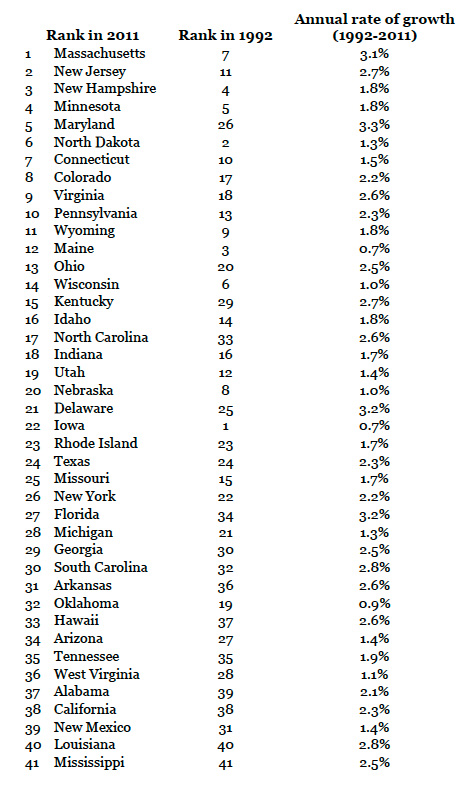
We also found that, among states within the United States, there was also wide variation in the annual rate of growth between 1992 and 2011. When data from all the 4th and 8th grade math, reading and science tests administered by the National Assessment of Educational Progress (NAEP) are combined, we found that the annual growth in some states (Maryland, Florida, Delaware and Massachusetts) was more than three times as great as in other states, including Iowa, Maine, Oklahoma and Wisconsin. (Nine states did not participate in NAEP testing in 1992, so these results are for the remaining 41 participating states.)
I used to think that any state close to the Canadian border had a top quality educational system. It was never clear exactly why. Perhaps because it was cold outside and there was nothing to do but read, write and calculate. Or perhaps it was simply because the Puritans, who had a passion for learning, were blown off course and settled in Massachusetts instead of Virginia. When their descendants moved west, they stayed in the same latitude.
Whatever the reason, the Canadian border theory explained inter-state variation quite well back in 1992. The seven states with the highest scores on NAEP were Iowa, North Dakota, Maine, New Hampshire, Minnesota, Wisconsin, and Massachusetts, in that order.
But, by 2011, three of the seven states had fallen out of the top tier. Iowa fell from first place to 22nd place, Wisconsin dropped from 6th place to 14th place, and Maine dropped from 3rd place to 12th. Meanwhile, Massachusetts rose to first place, proving that decline was not inevitable.
So who has taken over the top slots? It’s New Jersey, Maryland, and Connecticut—all of them in the northeast corridor in areas adjacent to the great metropolises of New York and Washington, D. C.
I am not sure what explains why some states are improving so much more rapidly than others, but if you look below you will see how differently the states rank today, as compared to how they ranked in 1992.
-Paul Peterson
Comment on this article
Comment on this Article
Sponsored Results
Sponsors
Sign Up To Receive Notification
when the latest issue of Education Next is posted
In the meantime check the site regularly for new articles, blog postings, and reader comments


Isn’t Jeb Bush chair of the PEPG? Would it be possible to insert the 2009 NAEP scores for Seniors in any way? I know Florida was one of three states where the Seniors scored below the national average in BOTH reading and Math out of the participating eleven. What were the prior results for Seniors on the NAEP? What were the retention policies in effect at the time of the study years? I know Florida’s changed.
Dear Diane: Your information cannot possibly be corrrect. There are no results by state for seniors on the National Assessment of Educational Progress.
My info is correct as documented in this article. http://articles.orlandosentinel.com/2010-11-18/news/os-12th-grade-scores-naep-20101118_1_naep-scores-reading-scores-national-reading
I do not know if there were earlier adminstrations than 2009.
With Florida joining two other states, out of the 11 participating states, as the only ones falling below the national average in Reading and Math, an unsightly light is shown on the reforms of JebBush. These students were subjected to them for many years and only to perform as dismally as they did. It would be interesting to note how many A schools dotted the state that year as end results lag behind 8 of the 11 particpating states.
Aren’t end results the most significant?
It would be interesting to see relative rates of spending with each of these states. This may go a long way to break the myth that spending matters.
For example, if CA had big spending increases and no growth, it tell you spending doesn’t really matter. Further, if CA stayed at 38 with relative spending cuts (as opposed to other states spending more, it also shows that it really doesn’t matter.
We have to cut, and reallocate spending, focusing on money following the child, and not the “district” or the “program.”
Paul,
What is the true meaning of the state numbers relative to actual scores? Does a small change in test scores yield big changes in relative scores.
Is Iowa really crashing, or does it’s drop to 22 mean that its kids are doing the same while CT and NJ have seen “jumps” that are really down to 10th of a point increases?
Dear Bruno:
See the unabridged report “Achievement Growth: International and U.S. State Trends in Student Performance” http://www.hks.harvard.edu/pepg/PDF/Papers/PEPG12-03_CatchingUp.pdf
It shows that achievement in Maryland, Florida and Delaware and other states is three to four times as great as in Iowa.
Also, in the report we show that increases in spending are not correlated with growth in student achievement.
The headline is misleading, indicating that most states are changing their relative position in big ways. But, in my quick check, it appears that, for 21 states, the difference between their 1992 and 2011 ranks is 5 or less.
Practically speaking, what’s the difference between a rank of 20 and 24? Or 11 and 12? Rankings are such a crude measure to use when the NAEP actually has much richer data that could tell you much more about improvement over time.
An alternate headline could read: Nearly Half of States Retain Relative Ranking on NAEP. That would certainly be more accurate.
Aren’t these percentages of growth so small as to be statistically insignificant? I am of the impression that 10% of a SD might be worthy of significance. My understanding is that integrated housing can acount for a 40% SD increase. Are we talking about nothing? I am not a statistician, only interested.
These are annual changes; multiply by the number of
years and you will see that these seemingly small numbers turn into big numbers.
How do two states, Maine and Iowa, have the same annual rate of growth and the same relative 1992 ranking yet Maine dropped only nine spots and Iowa dropped 21? That doesn’t make sense to me.